Results by title
15 books match the query 'Material'
Anthropos and the Material
Penny Harvey, Christian Krohn-Hansen, and Knut Nustad, editors
Duke University Press, 2019

Crash Cultures
Modernity, Mediation and the MaterialEdited by Jane Arthurs and Iain Grant
Intellect Books, 1995
In trying to give meaning to one celebrity crash, the more general significance of the car crash, its challenge to rational control or explanation, its disregard for the subject and its will, became the focus for attention. Coincidentally, the two most newsworthy films of 1997 were David Cronenberg's Crash and James Cameron's Titanic, both of which generated intense popular interest.
The principal purpose of this collection of essays is to subject texts, within which crashes figure, to well-defined cultural study. The themes that emerge from this collection, which is truly experimental in attempting to draw together the resources for a cultural study of events, are many and varied. Moreover, they vary in format, in order to bring as many modes of address as possible to bear on the crashes that catastrophically and fantastically punctuate the fabric of everyday life.
Georges Perec's Geographies
Material, Performative and Textual SpacesEdited by Charles Forsdick, Andrew Leak, and Richard Phillips
University College London, 2019
Georges Perec’s Geographies explores Perec’s geographical interests. The book is divided into two parts: Part I, “Perec’s Geographies,” explores space and place within Perec’s films, radio plays, and literature, from descriptions of actual streets to the fictional places within his work. Part II, “Perecquian Geographies,” explores geography in works directly inspired by Perec, including writing, photographs and photo essays, soundscapes, theater, and dance. Extending Perecquian criticism beyond literary and French studies to disciplines including geography, urban studies, and architecture, Georges Perec’s Geographies offers a complete and systematic examination that will be of interest not only to Perec scholars but also to students and researchers across these subjects.
Indiana Source Book II
Material from The Hoosier Genealogist, 1967-1972Willard Heiss
Indiana Historical Society Press, 1981
Indiana Source Book III
Material from The Hoosier Genealogist, 1973-1979Willard Heiss
Indiana Historical Society Press, 1982
Indiana Source Book IV
Material from The Hoosier Genealogist, 1979-1981, and IndexIndiana Historical Society Press, 1987
Indiana Source Book IX
Material from The Hoosier Genealogist, 1993-1994, and IndexIndiana Historical Society Press, 2002
Indiana Source Book V
Material from the Hoosier Genealogist, 1982-1984, and IndexRebah M. Fraustein
Indiana Historical Society Press, 1990
Indiana Source Book VI
Material from The Hoosier Genealogist, 1985-1988, and IndexRuth Dorrel
Indiana Historical Society Press, 1992
Indiana Source Book VII
Material from The Hoosier Genealogist, 1989-1990, and IndexRuth Dorrel
Indiana Historical Society Press, 1994
Indiana Source Book VIII
Material from The Hoosier Genealogist, 1991-1992, and IndexRuth Dorrel
Indiana Historical Society Press, 1997
Indiana Source Book X
Material from The Hoosier Genealogist, 1995-1996, and IndexRuth Dorrel
Indiana Historical Society Press, 2004
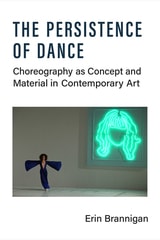
The Persistence of Dance
Choreography as Concept and Material in Contemporary ArtErin Brannigan
University of Michigan Press, 2023
The Persistence of Dance: Choreography as Concept and Material in Contemporary Art clarifies the continuities and differences between the second-wave dance avant-garde in the 1950s‒1970s and the third-wave starting in the 1990s. Through close readings of key artists such as Maria Hassabi, Sarah Michelson, Boris Charmatz, Meg Stuart, Philipp Gehmacher, Adam Linder, Agatha Gothe-Snape, Shelley Lasica and Latai Taumoepeau, The Persistence of Dance traces the relationship between the third-wave and gallery-based work. Looking at these artists highlights how the discussions and practices associated with “conceptual dance” resonate with the categories of conceptual and post-conceptual art as well as with the critical work on the function of visual art categories. Brannigan concludes that within the current post-disciplinary context, there is a persistence of dance and that a model of post-dance exists that encompasses dance as a contemporary art medium.
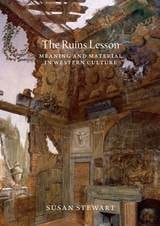
The Ruins Lesson
Meaning and Material in Western CultureSusan Stewart
University of Chicago Press, 2019
Stewart takes us on a sweeping journey through founding legends of broken covenants and original sin, the Christian appropriation of the classical past, and images of decay in early modern allegory. Stewart looks in depth at the works of Goethe, Piranesi, Blake, and Wordsworth, each of whom found in ruins a means of reinventing his art. Lively and engaging, The Ruins Lesson ultimately asks what can resist ruination—and finds in the self-transforming, ever-fleeting practices of language and thought a clue to what might truly endure.
Transforming Ethos
Place and the Material in Rhetoric and WritingRosanne Carlo
Utah State University Press, 2020
Through case studies of professional and student writings as well as narrative reflections Transforming Ethos imagines the ethos appeal as not only connected to style and voice but also a process of habituation, related to practices of everyday interaction in places and with things. Carlo addresses how ethos aids in creating identification, transcending divisions between the self and other. She shows that when writers tell their experiences, they create and reveal the ethos appeal, and this type of narrative/multimodal writing is central to scholarship in rhetoric and composition as well as the teaching of writing. In addition, Carlo considers how composition is becoming compromised by professionalization—particularly through the idea of “transfer”—which is overtaking the critical work of self-development with others that a writing classroom should encourage in college students.
Transforming Ethos cements ethos as an essential term for the modern practice and teaching of rhetoric and places it at the heart of writing studies. This book will be significant for students and scholars in rhetoric and composition, as well as those interested in higher education more broadly.