Results by title
161 books match the query 'Material culture' and 23 start with a
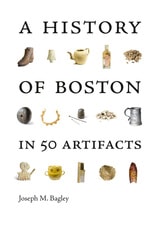
A History of Boston in 50 Artifacts
Joseph M. Bagley
University Press of New England, 2016
A History of Boston in 50 Artifacts
Joseph M. Bagley
Brandeis University Press, 2021
Joseph M. Bagley, the city archaeologist of Boston, uncovers a fascinating hodgepodge of history—from ancient fishing grounds to Jazz Age red-light districts—that will surprise and delight even longtime residents. Each artifact is shown in full color with a description of the item’s significance to its site location and Boston’s larger history. From cannonballs to drinking cups and from ancient spears to chinaware, A History of Boston in 50 Artifacts offers a unique and accessible introduction to Boston’s history and physical culture while revealing the ways objects can offer a tantalizing entrée into our past. Packed with vivid descriptions and art, this lively history of Boston will appeal to all manner of readers, locals, and visitors alike. This new edition showcases an important fact which has come to light since its first publication, that a chapter about a cat has now been shown to be a dog, thus demonstrating the perils of the archaeologist.
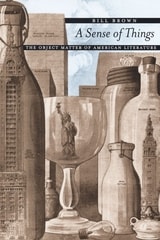
A Sense of Things
The Object Matter of American LiteratureBill Brown
University of Chicago Press, 2003
Brown's captivating new study explores the roots of modern America's fascination with things and the problem that objects posed for American literature at the turn of the century. This was an era when the invention, production, distribution, and consumption of things suddenly came to define a national culture. Brown shows how crucial novels of the time made things not a solution to problems, but problems in their own right. Writers such as Mark Twain, Frank Norris, Sarah Orne Jewett, and Henry James ask why and how we use objects to make meaning, to make or remake ourselves, to organize our anxieties and affections, to sublimate our fears, and to shape our wildest dreams. Offering a remarkably new way to think about materialism, A Sense of Things will be essential reading for anyone interested in American literature and culture.

Abolition’s Public Sphere
Robert Fanuzzi
University of Minnesota Press, 2003
An innovative analysis of the Enlightenment’s effects on the anti-slavery movement
Echoes of Thomas Paine and Enlightenment thought resonate throughout the abolitionist movement and in the efforts of its leaders to create an antislavery reading public. In Abolition’s Public Sphere Robert Fanuzzi critically examines the writings of William Lloyd Garrison, Frederick Douglass, Henry David Thoreau, and Sarah and Angelina Grimke, and their massive abolition publicity campaign—pamphlets, newspapers, petitions, and public gatherings—geared to an audience of white male citizens, free black noncitizens, women, and the enslaved. Including provocative readings of Thoreau’s Walden and of the symbolic space of Boston’s Faneuil Hall, Abolition’s Public Sphere demonstrates how abolitionist public discourse sought to reenact eighteenth-century scenarios of revolution and democracy in the antebellum era.
Fanuzzi illustrates how the dissemination of abolitionist tracts served to create an “imaginary public” that promoted and provoked the discussion of slavery. However, by embracing Enlightenment abstractions of liberty, reason, and progress, Fanuzzi argues, abolitionist strategy introduced aesthetic concerns that challenged political institutions of the public sphere and prevailing notions of citizenship. Insightful and thought-provoking, Abolition’s Public Sphere questions standard versions of abolitionist history and, in the process, our understanding of democracy itself.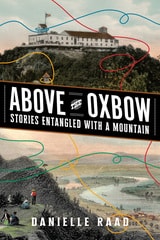
Above the Oxbow
Stories Entangled with a MountainDanielle R. Raad
West Virginia University Press, 2026
Above the Oxbow is a journey through the tangle of rich narratives surrounding Mount Holyoke, a locally cherished mountain in Western Massachusetts. It explores how visitors have forged connections with the mountain through various activities over the past two centuries. In an accessible blend of storytelling and scholarly analysis, Danielle Raad shows the significance of the landscape, historic sites, and material culture, revealing how cultural perspectives, community activism, collective memory, and personal experiences shape our understanding of a place. Situated at the intersection of public history and environmental history, this ethnography of place also discloses the curious stories of the Summit House, an erstwhile tramway, an airplane crash, and the local fight to conserve Mount Holyoke as a natural space and celebrates its myriad uses today.
Abundance
The Archaeology of PlenitudeMonica L. Smith
University Press of Colorado, 2020
Using case studies from around the globe—including Mesoamerica, North and South America, Africa, China, and the Greco-Roman world—and across multiple time periods, the authors in this volume make the case that abundance provides an essential explanatory perspective on ancient peoples’ choices and activities. Economists frequently focus on scarcity as a driving principle in the development of social and economic hierarchies, yet focusing on plenitude enables the understanding of a range of cohesive behaviors that were equally important for the development of social complexity.
Our earliest human ancestors were highly mobile hunter-gatherers who sought out places that provided ample food, water, and raw materials. Over time, humans accumulated and displayed an increasing quantity and variety of goods. In households, shrines, tombs, caches, and dumps, archaeologists have discovered large masses of materials that were deliberately gathered, curated, distributed, and discarded by ancient peoples. The volume’s authors draw upon new economic theories to consider the social, ideological, and political implications of human engagement with abundant quantities of resources and physical objects and consider how individual and household engagements with material culture were conditioned by the quest for abundance.
Abundance shows that the human propensity for mass consumption is not just the result of modern production capacities but fulfills a longstanding focus on plenitude as both the assurance of well-being and a buffer against uncertainty. This book will be of great interest to scholars and students in economics, anthropology, and cultural studies.
Contributors: Traci Ardren, Amy Bogaard, Elizabeth Klarich, Abigail Levine, Christopher R. Moore, Tito E. Naranjo, Stacey Pierson, James M. Potter, François G. Richard, Christopher W. Schmidt, Carol Schultze, Payson Sheets, Monica L. Smith, Katheryn C. Twiss, Mark D. Varien, Justin St. P. Walsh, María Nieves Zedeño
Accomplishing NAGPRA
Perspectives on the Intent, Impact, and Future of the Native American Graves Protection and Repatriation ActSangita Chari and Jaime M. N. Lavallee
Oregon State University Press, 2013
NAGPRA requires museums and federal agencies to return requested Native American cultural items to lineal descendants, culturally affiliated Indian tribes, and Native Hawai’ian organizations. Since the 1990 passage of the act, museums and federal agencies have made more than one million cultural items—and the remains of nearly forty thousand Native Americans—available for repatriation.
Drawing on case studies, personal reflections, historical documents, and statistics, the volume examines NAGPRA and its grassroots, practical application throughout the United States.? Accomplishing NAGPRA will appeal to professionals and academics with an interest in cultural resource management, Indian and human rights law, Indigenous studies, social justice movements, and public policy.
Aleutian Ethnography
Lucien Turner
University of Alaska Press, 2008
Alice Morse Earle and the Domestic History of Early America
Susan Reynolds Williams
University of Massachusetts Press, 2013
Author, collector, and historian Alice Morse Earle (1851–1911) was among the most important and prolific writers of her day. Between 1890 and 1904, she produced seventeen books as well as numerous articles, pamphlets, and speeches about the life, manners, customs, and material culture of colonial New England. Earle's work coincided with a surge of interest in early American history, genealogy, and antique collecting, and more than a century after the publication of her first book, her contributions still resonate with readers interested in the nation's colonial past.
An intensely private woman, Earle lived in Brooklyn, New York, with her husband and four children and conducted much of her research either by mail or at the newly established Long Island Historical Society. She began writing on the eve of her fortieth birthday, and the impressive body of scholarship she generated over the next fifteen years stimulated new interest in early American social customs, domestic routines, foodways, clothing, and childrearing patterns.
Written in a style calculated to appeal to a wide readership, Earle's richly illustrated books recorded the intimate details of what she described as colonial “home life.” These works reflected her belief that women had played a key historical role, helping to nurture communities by constructing households that both served and shaped their families. It was a vision that spoke eloquently to her contemporaries, who were busily creating exhibitions of early American life in museums, staging historical pageants and other forms of patriotic celebration, and furnishing their own domestic interiors.
Alutiit/Sugpiat
A Catalog of the Collections of the KunstkameraEdited by Yuri E. Berezkin
University of Alaska Press, 2012
This beautifully photographed book catalogs the collection of nearly five hundred Alutiiq cultural items held by the Peter the Great Museum of Anthropology and Ethnography, or the Kunstkamera, in St. Petersburg, Russia. Gathered between 1780 and 1867, many of the artifacts are composed of fur, feathers, gut, hair, and other delicate materials, which prevent their transport for display or study.
American Artifacts
Essays in Material CultureJules David Prown
Michigan State University Press, 2000
When defining culture, one must indeed take into account even the minutest of details. What of a lighter, for example, or a telephone? The essays in this new collection examine just that. The contributors pose not only a historical, pragmatic use for the items, but also delve into more imaginative aspects of what defines us as Americans. Both the lighter and the telephone are investigated, as well as how the lava lamp represents sixties counterculture and containment. The late nineteenth-century corset is discussed as an embodiment of womanhood, and an Amish quilt is used as an illustration of cultural continuity. These are just a few of the artifacts discussed. Scholars will be intrigued by the historical interpretations that contributors proposed concerning a teapot, card table, and locket; students will not only find merit in the expositions, but also by learning from the models how such interpretation can be carried out. This collection helps us understand that very thing that makes us who we are. Viewing these objects from both our past and our present, we can begin to define what it is to be American.
American Folklife
Edited by Don Yoder
University of Texas Press, 1976
Knowledge of folk custom and folk belief can help to explain ways of thought and behavior in modern America. American Folklife, a unique collection of essays dedicated to the presentation of American tradition, broadens our understanding of the regional differences and ethnic folkways that color American life.
Folklife research examines the entire context of everyday life in past and present. It includes every aspect of traditional life, from regional architecture through the full range of material culture into spiritual culture, folk religion, witchcraft, and other forms of folk belief. This collection is especially useful in its application to American society, where countless influences from European, American Indian, and African cultural backgrounds merge. American Folklife relates folklife research to history, anthropology, cultural geography, architectural history, ethnographic film, folk technology, folk belief, and ethnic tensions in American society. It documents the folk-cultural background that is the root of our society.
American Indians and the Market Economy, 1775-1850
Edited by Lance Greene and Mark R. Plane,with a foreword by Timothy K. Perttula
University of Alabama Press, 2011
The last quarter of the 18th century was a period of extensive political, economic, and social change in North America, as the continent-wide struggle between European superpowers waned. Native groups found themselves enmeshed in the market economy and new state forms of control, among other new threats to their cultural survival. Native populations throughout North America actively engaged the expanding marketplace in a variety of economic and social forms. These actions, often driven by and expressed through changes in material culture, were supported by a desire to maintain distinctive ethnic identities.
Illustrating the diversity of Native adaptations in an increasingly hostile and marginalized world, this volume is continental in scope—ranging from Connecticut to the Carolinas, and westward through Texas and Colorado. Calling on various theoretical perspectives, the authors provide nuanced perspectives on material culture use as a manipulation of the market economy. A thorough examination of artifacts used by Native Americans, whether of Euro-American or Native origin, this volume provides a clear view of the realities of the economic and social interactions between Native groups and the expanding Euro-American population and the engagement of these Native groups in determining their own fate.
American Relics and the Politics of Public Memory
Matthew Dennis
University of Massachusetts Press, 2023
The gold epaulettes that George Washington wore into battle. A Union soldier’s bloody shirt in the wake of the Civil War. A crushed wristwatch after the 9/11 attacks. The bullet-riddled door of the Pulse nightclub. Volatile and shape-shifting, relics have long played a role in memorializing the American past, acting as physical reminders of hard-won battles, mass tragedies, and political triumphs.
Surveying the expanse of U.S. history, American Relics and the Politics of Public Memory shows how these objects have articulated glory, courage, and national greatness as well as horror, defeat, and oppression. While relics mostly signified heroism in the nation’s early years, increasingly, they have acquired a new purpose—commemorating victimhood. The atrocious artifacts of lynching and the looted remains of Native American graves were later transformed into shameful things, exposing ongoing racial violence and advancing calls for equality and civil rights. Matthew Dennis pursues this history of fraught public objects and assesses the emergence of new venues of memorialization, such as virtual and digital spaces. Through it all, relics continue to fundamentally ground and shape U.S. public memory in its uncertain present and future.
An Older and More Beautiful Belgrade
A Visual Chronicle of the Milo.evic EraMileta Prodanovic
Central European University Press, 2023
This substantial essay depicts urban collapse in an exceptionally difficult period of the Serbian capital. The author has marshalled facts, reflections, photographs and other imagesto demonstrate the transformation of Belgrade during the Milošević years. With the theoretical grounding of cultural anthropology, history studies, culture of memory, history of art, and urbanism, Mileta Prodanović considers changes to the built environment and urban landscape in the city in the 1990s. He covers many visual aspects of life with great ingenuity: shopping centers, unregulated construction and “wild” modifications of buildings, new buildings (broadcasting studios, shops, homes) that do not fit the surroundings, bad taste in home furnishings (camp, kitsch), boondoggles such as the international art center, problematic historical markers like the obelisk of the eternal flame, billboards, store displays, electoral propaganda, graffiti, grave-markers and cemetery memorials, coins and paper money, calendars, beer labels, and even religious icons (and more). All this information is provided with some critique and much implied comparison to past standards.
Ancient Households on the North Coast of Peru
Ilana Johnson
University Press of Colorado, 2020
Many volumes on this region are limited to one time period or civilization, often the Moche. While Ancient Households on the North Coast of Peru does examine the Moche, it offers a wider thematic approach to a broader swath of prehistory. Chapters on various time periods use a comparable scale of analysis to examine long-term continuity and change and draw on a large corpus of prior research on states, rulership, and cosmology to offer new insight into the intersection of household, community, and state. Contributors address social reproduction, construction and reinforcement of gender identities and social hierarchy, household permanence and resilience, and expression of identity through cuisine.
This volume challenges common concepts of the “household” in archaeology by demonstrating the complexity and heterogeneity of household-level dynamics as they intersect with institutions at broader social scales and takes a comparative perspective on daily life within one region of the Andes. It will be of interest to both students and scholars of South American archaeology and household archaeology.
Contributors: Brian R. Billman, David Chicoine, Guy S. Duke, Hugo Ikehara, Giles Spence-Morrow, Jessica Ortiz, Edward Swenson, Kari A. Zobler
Ancient Nubian Art
A HistoryGates
J. Paul Getty Trust, The, 0
Lushly illustrated with stunning artifacts, this volume is the first comprehensive and accessible publication to explore the art, architecture, and material culture of ancient Nubia.
Kings and queens of Nubia reigned over one of the largest empires in the ancient world and had contacts extending north to Greece and Rome, south to sub-Saharan Africa, east to the Red Sea, and west across much of the Sahel. Even a quick look at Nubia’s artifacts reveals the incredible creativity of its artists, architects, craftspeople, and thinkers. Despite their significance, the achievements of ancient Nubia are little known to the public and are often viewed as a subculture, a derivative offshoot of Egypt, Nubia’s northern neighbor. Nothing could be further from the truth. During its over eight-thousand-year lifespan (beginning around 8000 BCE), Nubia indelibly shaped the art and architecture of the ancient world, an influence still felt today.
Ancient Nubian Art is the first comprehensive and accessible treatment of Nubian artistic culture and showcases its vast range—from ceramics, sculptures, and jewelry to tombs, temples, and palaces. Rita E. Freed, curator emerita at the Museum of Fine Arts, Boston, which has the largest collection of Nubian artifacts outside the Nile Valley, contextualizes the development of Nubian art against a vivid backdrop of kingship, power, worship, identity, gender, technology, and internationalism. Her text is accompanied by a foreword by Henry Louis Gates Jr. and sidebars by expert voices from the field.
André Leroi-Gourhan on Technology
A Selection of Writings from the 1930s to the 1960sAndré Leroi-Gourhan
Bard Graduate Center, 2023
André Leroi-Gourhan is undoubtedly one of the most acclaimed figures of twentieth-century anthropology and archaeology. In France, his intellectual importance rivals that of the Claude Lévi-Strauss, yet Leroi-Gourhan’s major contributions are almost entirely unknown in the Anglophone world. This collection seeks to change that. This selection highlights some of his chief influences, such as elaborating a theory of technology, which argues that material culture focuses on the object in use and how use is a dynamic feature that has specific consequences for human evolution and human society. With serious ramifications for our understanding of material culture, putting Leroi-Gourhan’s thinking about technology into English will have an immediate and transformative impact on material culture studies.
Archaeology and Apprenticeship
Body Knowledge, Identity, and Communities of PracticeEdited by Willeke Wendrich
University of Arizona Press, 2012
Apprenticeship is broadly defined as the transmission of culture through a formal or informal teacher–pupil relationship. This collection invites a wide discussion, citing case studies from all over the world and yet focuses the scholarship into a concise set of contributions. The chapters in this volume demonstrate how archaeology can benefit greatly from the understanding of the social dimensions of knowledge transfer. This book also examines apprenticeship in archaeology against a backdrop of sociological and cognitive psychology literature, to enrich the understanding of the relationship between material remains and enculturation.
Each of the authors in this collection looks specifically at how material remains can reveal several specific aspects of ancient cultures: What is the human potential for learning? How do people learn? Who is teaching? Why are they learning? What are the results of such learning? How do we recognize knowledge transfer in the archaeological record? These fundamental questions are featured in various forms in all chapters of the book. With case studies from the American Southwest, Alaska, Egypt, Ancient Greece, and Mesopotamia, this book will have broad appeal for scholars—particularly those concerned with cultural transmission and traditions of learning and education—all over the world.
Archaeology of the Lower Muskogee Creek Indians, 1715-1836
Howard Thomas Foster II
University of Alabama Press, 2006
The Muskogee Indians who lived along the lower Chattahoochee and Flint River watersheds had, and continue to have, a profound influence on the development of the southeastern United States, especially during the historic period (circa 1540–1836). Our knowledge of that culture is limited to what we can learn from their descendants and from archaeological and historical sources.
Combining historical documents and archaeological research on all known Lower Muskogee Creek sites, Thomas Foster has accurately pinpointed town locations discussed in the literature and reported in contemporary Creek oral histories. In so doing, this volume synthesizes the archaeological diversity and variation within the Lower Creek Indians between 1715 and 1836. The book is a study of archaeological methods because it analyzes the temporal and geographic variation within a single archaeological phase and the biases of that archaeological data. Foster’s research segregates the variation between Lower Creek Indian towns through a regional and direct historic approach. Consequently, he is able to discern the unique differences between individual Creek Indian towns.
Foster argues that the study of Creek Indian history should be at the level of towns instead of archaeological phases and that there is significant continuity between the culture of the Historic Period Indians and the Prehistoric and Protohistoric peoples.
Artifacts of Loss
Crafting Survival in Japanese American Concentration CampsDusselier, Jane E
Rutgers University Press, 2008
In Artifacts of Loss, Jane E. Dusselier looks at the lives of these internees through the lens of their art. These camp-made creations included flowers made with tissue paper and shells, wood carvings of pets left behind, furniture made from discarded apple crates, gardens grown next to their housingùanything to help alleviate the visual deprivation and isolation caused by their circumstances. Their crafts were also central in sustaining, re-forming, and inspiring new relationships. Creating, exhibiting, consuming, living with, and thinking about art became embedded in the everyday patterns of camp life and helped provide internees with sustenance for mental, emotional, and psychic survival.
Dusselier urges her readers to consider these often overlooked folk crafts as meaningful political statements which are significant as material forms of protest and as representations of loss. She concludes briefly with a discussion of other displaced people around the globe today and the ways in which personal and group identity is reflected in similar creative ways.
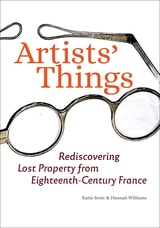
Artists' Things
Rediscovering Lost Property from Eighteenth-Century FranceKatie Scott
J. Paul Getty Trust, The, 2024
Artists are makers of things. Yet it is a measure of the disembodied manner in which we generally think about artists that we rarely consider the everyday items they own. This innovative book looks at objects that once belonged to artists, revealing not only the fabric of the eighteenth-century art world in France but also unfamiliar—and sometimes unexpected—insights into the individuals who populated it, including Jean-Antoine Watteau, François Boucher, Jean-Baptiste Greuze, and Elisabeth Vigée-LeBrun.
From the curious to the mundane, from the useful to the symbolic, these items have one thing in common: they have all been eclipsed from historical view. Some of the objects still exist, like Jean-Honoré Fragonard’s color box and Jacques-Louis David’s table. Others survive only in paintings, such as Jean-Siméon Chardin’s cistern in his Copper Drinking Fountain, or in documents, like François Lemoyne’s sword, the instrument of his suicide. Several were literally lost, including pastelist Jean-Baptiste Perronneau’s pencil case. In this fascinating book, the authors engage with fundamental historical debates about production, consumption, and sociability through the lens of material goods owned by artists.
The free online edition of this open-access publication is at www.getty.edu/publications/artists-things/ and includes zoomable illustrations. Free PDF and EPUB downloads of the book are also available.
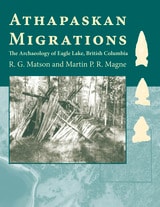
Athapaskan Migrations
The Archaeology of Eagle Lake, British ColumbiaR. G. Matson and Martin P. R. Magne
University of Arizona Press, 2007
In Athapaskan Migrations, authors R. G. Matson and Martin P. R. Magne use a variety of methods to identify and describe the arrival of the Athapaskan-speaking Chilcotin Indians in west central British Columbia. By contrasting two similar geographic areas—using the parallel direct historical approach—the authors define this aspect of Athapaskan culture. They present a sophisticated model of Northern Athapaskan migrations based on extensive archaeological, ethnographic, and dendrochronological research.
A synthesis of 25 years of work, Athapaskan Migrations includes detailed accounts of field research in which the authors emphasize ethnic group identification, settlement patterns, lithic analysis, dendrochronology, and radiocarbon dating. Their theoretical approach will provide a blueprint for others wishing to establish the ethnic identity of archaeological materials. Chapter topics include basic methodology and project history; settlement patterns and investigation of both the Plateau Pithouse and British Columbia Athapaskan Traditions; regional surveys and settlement patterns; excavated Plateau Pithouse Tradition and Athapaskan sites and their dating; ethnic identification of recovered material; the Chilcotin migration in the context of the greater Pacific Athapaskan, Navajo, and Apache migrations; and summaries and results of the excavations. The text is abundantly illustrated with more than 70 figures and includes access to convenient online appendixes. This substantial work will be of special importance to archaeologists, anthropologists, linguists, and scholars in Athapaskan studies and Canadian First Nation studies.