Results by title
7 books match the query 'Materialism in literature'
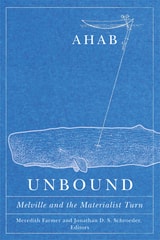
Ahab Unbound
Melville and the Materialist TurnMeredith Farmer
University of Minnesota Press, 2021
Why Captain Ahab is worthy of our fear—and our compassion
Herman Melville’s Captain Ahab is perennially seen as the paradigm of a controlling, tyrannical agent. Ahab Unbound leaves his position as a Cold War icon behind, recasting him as a contingent figure, transformed by his environment—by chemistry, electromagnetism, entomology, meteorology, diet, illness, pain, trauma, and neurons firing—in ways that unexpectedly force us to see him as worthy of our empathy and our compassion.
In sixteen essays by leading scholars, Ahab Unbound advances an urgent inquiry into Melville’s emergence as a center of gravity for materialist work, reframing his infamous whaling captain in terms of pressing conversations in animal studies, critical race and ethnic studies, disability studies, environmental humanities, medical humanities, political theory, and posthumanism. By taking Ahab as a focal point, we gather and give shape to the multitude of ways that materialism produces criticism in our current moment. Collectively, these readings challenge our thinking about the boundaries of both persons and nations, along with the racist and environmental violence caused by categories like the person and the human.
Ahab Unbound makes a compelling case for both the vitality of materialist inquiry and the continued resonance of Melville’s work.
Contributors: Branka Arsić, Columbia U; Christopher Castiglia, Pennsylvania State U; Colin Dayan, Vanderbilt U; Christian P. Haines, Pennsylvania State U; Bonnie Honig, Brown U; Jonathan Lamb, Vanderbilt U; Pilar Martínez Benedí, U of L’Aquila, Italy; Steve Mentz, St. John’s College; John Modern, Franklin and Marshall College; Mark D. Noble, Georgia State U; Samuel Otter, U of California, Berkeley; Donald E. Pease, Dartmouth College; Ralph James Savarese, Grinnell College; Russell Sbriglia, Seton Hall U; Michael D. Snediker, U of Houston; Matthew A. Taylor, U of North Carolina at Chapel Hill; Ivy Wilson, Northwestern U.
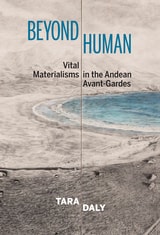
Beyond Human
Vital Materialisms in the Andean Avant-GardesDaly, Tara
Bucknell University Press, 2019
Published by Bucknell University Press. Distributed worldwide by Rutgers University Press.

Cervantes and the Material World
Carroll B. Johnson
University of Illinois Press, 2000
Cervantes and the Material World reveals a recurrent preoccupation with the clash of two different economic systems: a reenergized feudalism and an incipient capitalism. Overturning the common assumption that Don Quixote, Sancho Panza, and myriad other colorful characters carry out their adventures in a timeless social milieu, Johnson demonstrates how their perspectives and experiences are shaped by the events and crises of their immediate historical context.
Johnson examines how questions of the distribution of wealth, the ownership of the means of production, and membership in one or another economic order permeate Cervantes's fiction. Thoughtfully contextualizing key excerpts, he suggests how business activities, legal codes, and other materialist practices actively impinge on the lives of the characters, influencing and in some cases determining their motivations and their possibilities for action.
A major study that will change the face of Cervantes scholarship, Cervantes and the Material World is also an important resource for students of the Spanish Golden Age and Renaissance and baroque literature and culture.

Intangible Materialism
The Body, Scientific Knowledge, and the Power of LanguageRonald Schleifer
University of Minnesota Press, 2009
Taking as his point of departure Norbert Weiner’s statement that information is basic to understanding materialism in our era, Ronald Schleifer shows how discoveries of modern physics have altered conceptions of matter and energy and the ways in which both information theory and the study of literature can enrich these conceptions. Expanding the reductive notion of “the material” as simply matter and energy, he formulates a new, more inclusive idea of materialism.
Schleifer’s project attempts to bridge the divisions between the humanities and the sciences and to create a nonreductive materialism for the information age. He presents a materialistic account of human bodily experience by delving into language and literature that powerfully represents our faces, voices, hands, and pain. For example, he examines the material resources of poetic “literariness” as it is revealed in the condition of Tourette’s syndrome. Schleifer also investigates gestures of the hand in the formation of sociality, and he studies pain as both a physiological and phenomenological experience.
This ambitious work explores physiological analyses, evolutionary explanations, and semiotic descriptions of materialism to reveal how aspects of physical existence discover meaning in experience.
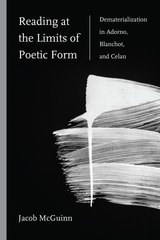
Reading at the Limits of Poetic Form
Dematerialization in Adorno, Blanchot, and CelanJacob McGuinn
Northwestern University Press, 2024
How does literary objecthood contend with the challenge of writing objects that emerge at an extreme limit of material presence? Jacob McGuinn delves into the ways literature writes this indeterminate presence in the context of pre- and post-’68 Paris, a vital moment in the history of criticism. The works of poet Paul Celan, philosopher Theodor Adorno, and writer Maurice Blanchot highlight how the complexities of reading such a dematerialized object are part of the indeterminacy of material itself. Indeterminate objects—glass, snow, walls, screens—are subjects Celan describes as existing in “meridian” space, while for Adorno and Blanchot, criticism not only responds to this indeterminacy but also takes it as its condition. Reading at the Limits of Poetic Form: Dematerialization in Adorno, Blanchot, and Celan shows how these readings simultaneously limit the object of criticism and outline alternative ways of thinking that lie between the models of critical formalism and historicism, ultimately revealing the possible materiality of literature in unrealized history, incomplete politics, and nondetermining thinking.
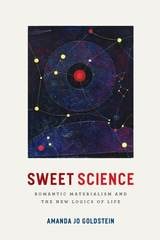
Sweet Science
Romantic Materialism and the New Logics of LifeAmanda Jo Goldstein
University of Chicago Press, 2017
Goldstein puts apparently literary projects, such as William Blake’s poetry of embryogenesis, Goethe’s journals On Morphology, and Percy Shelley’s “poetry of life,” back into conversation with the openly poetic life sciences of Erasmus Darwin, J. G. Herder, Jean-Baptiste Lamarck, and Étienne Geoffroy Saint-Hilaire. Such poetic sciences, Goldstein argues, share in reviving Lucretius’s De rerum natura to advance a view of biological life as neither self-organized nor autonomous, but rather dependent on the collaborative and symbolic processes that give it viable and recognizable form. They summon De rerum natura for a logic of life resistant to the vitalist stress on self-authorizing power and to make a monumental case for poetry’s role in the perception and communication of empirical realities. The first dedicated study of this mortal and materialist dimension of Romantic biopoetics, Sweet Science opens a through-line between Enlightenment materialisms of nature and Marx’s coming historical materialism.
The Environmental Unconscious
Ecological Poetics from Spenser to MiltonSteven Swarbrick
University of Minnesota Press, 2023
Bringing psychoanalysis to bear on the diagnosis of ecological crisis
Why has psychoanalysis long been kept at the margins of environmental criticism despite the many theories of eco-Marxism, queer ecology, and eco-deconstruction available today? What is unique, possibly even traumatic, about eco-psychoanalysis? The Environmental Unconscious addresses these questions as it provides an innovative and theoretical account of environmental loss focused on the counterintuitive forms of enjoyment that early modern poetry and psychoanalysis jointly theorize.
Steven Swarbrick urges literary critics and environmental scholars fluent in the new materialism to rethink notions of entanglement, animacy, and consciousness raising. He introduces concepts from psychoanalysis as keys to understanding the force of early modern ecopoetics. Through close readings of Edmund Spenser, Walter Ralegh, Andrew Marvell, and John Milton, he reveals a world of matter that is not merely hyperconnected, as in the new materialism, but porous and off-kilter. And yet the loss these poets reveal is central to the enjoyment their works offer—and that nature offers.
As insightful as it is engaging, The Environmental Unconscious offers a provocative challenge to ecocriticism that, under the current regime of fossil capitalism in which everything solid interconnects, a new theory of disconnection is desperately needed. Tracing the propulsive force of the environmental unconscious from the early modern period to Freudian and post-Freudian theories of desire, Swarbrick not only puts nature on the couch in this book but also renews the psychoanalytic toolkit in light of environmental collapse.