Results by title
21 books match the query 'Maternal health services'
A Good Position for Birth
Pregnancy, Risk, and Development in Southern BelizeAminata Maraesa
Vanderbilt University Press, 2018
Fear and shame are prominent affective tropes that Maraesa uses to understand women's attitudes toward reproduction that are at times contrary to development discourse but that make sense in the lived experiences of the women of southern Belize.
A Pleasing Birth
Midwives And Maternity CareRaymond De Vries
Temple University Press, 2005
Babylost
Racism, Survival, and the Quiet Politics of Infant Mortality, from A to ZMonica J. Casper
Rutgers University Press, 2021
Bishops and Bodies
Reproductive Care in American Catholic HospitalsLori Freedman
Rutgers University Press, 2023
One out of every six patients in the United States is treated in a Catholic hospital that follows the policies of the U.S. Conference of Catholic Bishops. These policies prohibit abortion, sterilization, contraception, some treatments for miscarriage and gender confirmation, and other reproductive care, undermining hard-won patients’ rights to bodily autonomy and informed decision-making. Drawing on rich interviews with patients and providers, this book reveals both how the bishops’ directives operate and how people inside Catholic hospitals navigate the resulting restrictions on medical practice. In doing so, Bishops and Bodies fleshes out a vivid picture of how The Church’s stance on sex, reproduction, and “life” itself manifests in institutions that affect us all.
Challenging Pregnancy
A Journey through the Politics and Science of Healthcare in AmericaGenevieve Grabman
University of Iowa Press, 2022
Ultimately, national anti-abortion politics—not medicine or her own choices—determined the outcome of Grabman’s pregnancy. At every juncture, anti-abortion politics limited the care available to her, the doctors and hospitals willing to treat her, the tools doctors could use, and the words her doctors could say. Although she asked for aggressive treatment to save at least one baby, hospital ethics boards blocked all able doctors from helping her.
Challenging Pregnancy is about Grabman’s harrowing pregnancy and the science and politics of maternal healthcare in the United States, where every person must self-advocate for the desired outcome of their own pregnancy.
Dying to Count
Post-Abortion Care and Global Reproductive Health Politics in SenegalSiri Suh
Rutgers University Press, 2021
Family Secrets
Risking Reproduction in Central MozambiqueRachel R. Chapman
Vanderbilt University Press, 2010
Pregnant herself during her research, Chapman interviewed 83 women during pregnancy and postpartum. She discovered that the social relations surrounding traditional Shona practices, Christian faith healing, and Western biomedical treatments are as important to women's choices as the efficacy of the therapies.
Formulas for Motherhood in a Chinese Hospital
Suzanne Gottschang
University of Michigan Press, 2018
Formulas for Motherhood follows a group of women over eighteen months as they visited a Beijing Baby- Friendly Hospital over the course of their pregnancies and throughout their postpartum recoveries. The book shows how the space of the hospital operates as a microcosm of the larger social, political, and economic forces that urban Chinese women navigate in the process of becoming a mother. Relations between biomedical practices, heightened expectations of femininity and sexuality demanded by a consumer culture, alongside international and national agendas to promote maternal and child health, reveal new agents of maternal governance emerging at the very moment China’s economy heats up. This ethnography provides insight into how women’s creative pragmatism in a rapidly changing society leads to their views and decisions about motherhood.
Health in Ruins
The Capitalist Destruction of Medical Care at a Colombian Maternity HospitalCésar Ernesto Abadía-Barrero
Duke University Press, 2022

La Partera
Story of a MidwifeFran Leeper Buss
University of Michigan Press, 2001
This is Jesusita's story, told in her own words. She describes her early training as a midwife, her forced departure from home due to two unmarried pregnancies, and her solitary struggle to support her children. La Partera tells how she gradually emerged as a leader in her community, painstakingly building by hand a small maternity center for her patients while gaining the respect of the Anglo medical community.
As Jesusita's story unfolds, so too does the story of the women of the region. Supplemental sections by the author illuminate Jesusita's culture and past, along with a historical account of the network of medical care provided by Hispanic and Anglo female healers. Illustrated with photographs of both people and places, La Partera reflects the culture of an era through the prism of Jesusita's hard and useful life.
Fran Leeper Buss lives and teaches in Tucson, Arizona.

La Partera
Story of a MidwifeFran Leeper Buss
University of Michigan Press, 1980
Managing Motherhood, Managing Risk
Fertility and Danger in West Central TanzaniaDenise Roth Allen
University of Michigan Press, 2004
In Managing Motherhood, Managing Risk, Denise Roth Allen persuasively argues that development interventions in the Third World often have unintended and unacknowledged consequences. Based on twenty-two months of fieldwork in the Shinyanga Region of west central Tanzania, this rich and engaging ethnography of women's fertility-related experiences highlights the processes by which a set of seemingly well-intentioned international maternal health policy recommendations go awry when implemented at the local level.
An exploration of how threats to maternal health have been defined and addressed at the global, national, and local levels, Managing Motherhood, Managing Risk presents two contrasting, and oftentimes competing, definitions of risk: those that form the basis of international recommendations and national maternal health policies and those that do not. The effect that these contrasting definitions of risk have on women's fertility-related experiences at the local level are explored throughout the book.
This study employs an innovative approach to the analysis of maternal health risk, one that situates rural Tanzanian women's fertility-related experiences within a broader historical and sociocultural context. Beginning with an examination of how maternal health risk was defined and addressed during the early years of British colonial rule in Tanganyika and moving to a discussion of an internationally conceived maternal health initiative that was launched on the world stage in the late 1980s, the author explores the similarities in the language used and solutions proposed by health development experts over time.
This set of "official" maternal health risks is then compared to an alternative set of risks that emerge when attention is focused on women's experiences of pregnancy and childbirth at the local level. Although some of these latter risks are often spoken about as deriving from spiritual or supernatural causes, the case studies presented throughout the second half of the book reveal that the concept of risk in the context of pregnancy and childbirth is much more complex, involving the interplay of spiritual, physical, and economic aspects of everyday life.
Medicalized Motherhood
Perspectives from the Lives of African-American and Jewish WomenJacquelyn S. Litt
Rutgers University Press, 1999
When Jacquelyn S. Litt interviewed African-American and Jewish women who raised their children in the 1930s and 1940s, she found that these women responded to experts' advice in ways uniquely shaped by their ethnicity, race, and class. For middle-class African-American and Jewish women, medicalization took place in ethnically/racially segregated networks and functioned as a collectively held strategy for social advance as much as a set of technical practices for raising healthy children. For poor, single African-American mothers, everyday networks offered limited access to medical institutions or mainstream norms. Medical discourse was largely controlled by white women and men, which left these women disempowered in medical institutions and marginal to dominant definitions of acceptable mothering.
Litt's book is enriched with many narratives from the mothers themselves. Both the women's voices and her acute sociological research bring to light how medicalized motherhood, while not the single cause of difference and inequality among the women, was a site where they were produced.
Midwifery and Childbirth in America
Judith Rooks
Temple University Press, 1999
The author vividly describes the history of struggle among health care providers over the meaning and handling of the birth process. The medical model and the midwifery model continue to collide today, the former focusing on pathology and monitoring the patient for it, the latter focusing on birth as a normal, healthy process.
The education and professional training of those who care for women during pregnancy, childbirth, and the important postpartum period reflects these divisions. Obstetrics, family physicians, midwives, nurses, and others play roles in providing the necessary care. In focusing on midwives, Rooks deals fairly and sensitively between certified nurse-midwives and direct-entry midwives, most of whom lack formal educational preparation in midwifery.
This book describes clearly and with documented scientific evidence the specific benefits of the midwifery approach to the care of pregnant women and their families. In clear language accessible to the lay reader, Rooks summarizes the research on the unintended effects of obstetrical interventions, such as episiotomies, epidurals, C-sections, and continuous electronic fetal heart monitoring, and the effectiveness and important benefits of an approach that focuses on the positive potential of childbearing, as contrasted with a narrow focus of potential for pathology. While she acknowledges the importance of access to medical care, extensive research shows the advantages of the midwifery approach. Much that passes for "routine" obstetric care in the United States has been found to be unnecessary, ineffective, or even harmful when applied to women with normal pregnancies.
The arguments over the control of childbirth are set in the context of recent changes in health care, including the current transition to managed care; the impact of the women's movement and movements for natural childbirth, home birth, and breastfeeding; and women's fear of and concern about the pain associated with labor. Rooks also explains the influence of the reports and recommendations of prestigious scientific and health-policy commissions and of federal initiatives and programs on the care provided to pregnant women in this country. She contrasts U.S. practices with those of comparable industrialized countries like the European states, Canada, Australia, New Zealand, and Japan.
Midwives and Mothers
The Medicalization of Childbirth on a Guatemalan PlantationBy Sheila Cosminsky
University of Texas Press, 2016
The World Health Organization is currently promoting a policy of replacing traditional or lay midwives in countries around the world. As part of an effort to record the knowledge of local midwives before it is lost, Midwives and Mothers explores birth, illness, death, and survival on a Guatemalan sugar and coffee plantation, or finca, through the lives of two local midwives, Doña Maria and her daughter Doña Siriaca, and the women they have served over a forty-year period.
By comparing the practices and beliefs of the mother and daughter, Sheila Cosminsky shows the dynamics of the medicalization process and the contestation between the midwives and biomedical personnel, as the latter try to impose their system as the authoritative one. She discusses how the midwives syncretize, integrate, or reject elements from Mayan, Spanish, and biomedical systems. The midwives’ story becomes a lens for understanding the impact of medicalization on people’s lives and the ways in which women’s bodies have become contested terrain between traditional and contemporary medical practices. Cosminsky also makes recommendations for how ethno-obstetric and biomedical systems may be accommodated, articulated, or integrated. Finally, she places the changes in the birthing system in the larger context of changes in the plantation system, including the elimination of coffee growing, which has made women, traditionally the primary harvesters of coffee beans, more economically dependent on men.
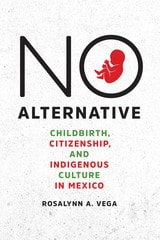
No Alternative
Childbirth, Citizenship, and Indigenous Culture in MexicoBy Rosalynn A. Vega
University of Texas Press, 2018
Recent anthropological scholarship on “new midwifery” centers on how professional midwives in various countries are helping women reconnect with “nature,” teaching them to trust in their bodies, respecting women’s “choices,” and fighting for women’s right to birth as naturally as possible. In No Alternative, Rosalynn A. Vega uses ethnographic accounts of natural birth practices in Mexico to complicate these narratives about new midwifery and illuminate larger questions of female empowerment, citizenship, and the commodification of indigenous culture, by showing how alternative birth actually reinscribes traditional racial and gender hierarchies.
Vega contrasts the vastly different birthing experiences of upper-class and indigenous Mexican women. Upper-class women often travel to birthing centers to be delivered by professional midwives whose methods are adopted from and represented as indigenous culture, while indigenous women from those same cultures are often forced by lack of resources to use government hospitals regardless of their preferred birthing method. Vega demonstrates that women’s empowerment, having a “choice,” is a privilege of those capable of paying for private medical services—albeit a dubious privilege, as it puts the burden of correctly producing future members of society on women’s shoulders. Vega’s research thus also reveals the limits of citizenship in a neoliberal world, as indigeneity becomes an object of consumption within a transnational racialized economy.
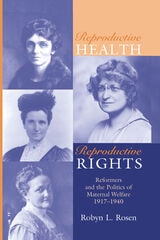
REPRODUCTIVE HEALTH, REPRODUCTIVE RIGHTS
REFORMERS & THE POLITICS OF MATERNAL WELFARE, 1917–1940Robyn L. Rosen
The Ohio State University Press, 2003
In the early twentieth century, shifting attitudes and new public health standards brought an unprecedented interest in and effort to regulate issues affecting reproduction and maternity. Maternal and infant health, nutrition, and medical care came under scrutiny, as did the issue of birth control. While the prior gained public support, the latter remained controversial. Though some reformers saw birth control as an important part of maternal welfare, others sought to separate it from more popular reforms. The careers of the four prominent but usually neglected reformers (Elizabeth Lowell Putnam, Ethel Sturges Dummer, Mary Ware Dennett, and Blanche Ames) examined in this book embody the struggle to define and resolve these tensions.
The study of these reformers offers a new perspective on more recognized leaders in the arena of reproductive health and rights, especially the U.S. Children's Bureau and Margaret Sanger. Putnam's elitism contextualizes the class politics of the Bureau, underscoring its sensitivity to the vulnerable and its innovative approach to public health. Dummer reminds us of roads not taken by policy makers in the Bureau, accentuating the differences between a child-centered and a woman-centered agenda. Dennett highlights the obstacles to women reformers in the formal political sphere, while Ames's penchant toward maternalism and compromise also led to difficulties. Together, they illustrate the complexities of formulating an effective approach to securing reproductive rights and health.
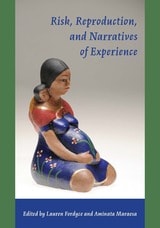
Risk, Reproduction, and Narratives of Experience
Lauren Fordyce
Vanderbilt University Press, 2012
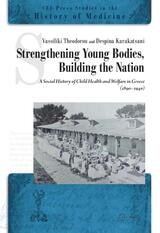
Strengthening Young Bodies, Building the Nation
A Social History of the Child Health and Welfare in Greece (1890–1940)Vassiliki Theodorou
Central European University Press, 2019

The Medical Delivery Business
Health Reform, Childbirth, and the Economic OrderPerkins, Barbara Bridgman
Rutgers University Press, 2004
Americans at the end of the twentieth century worried that managed care had fundamentally transformed the character of medicine. In The Medical Delivery Business, Barbara Bridgman Perkins uses examples drawn from maternal and infant care to argue that the business approach in medicine is not a new development. Health care reformers throughout the century looked to industrial, corporate, and commercial enterprises as models for the institutions, specialties, and technological strategies that defined modern medicine.
In the case of perinatal care, the business model emphasized specialized over primary care, encouraged the use of surgical and technological procedures, and unnecessarily turned childbirth into an intensive care situation. Active management techniques, for example, encouraged obstetricians to accelerate labor with oxytocin to augment their productivity. Despite the achievements of the childbirth and women’s health movement in the 1970s, aggressive medical intervention has remained the birth experience for millions of American women (and their babies) every year.
The Medical Delivery Business challenges the conventional view that a dose of the market is good for medicine. While Perkins is sympathetic to the goals of progressive and feminist reformers, she questions whether their strategies will succeed in making medicine more equitable and effective. She argues that the medical care system itself needs to be fundamentally "re-formed," and the reforms must be based on democracy, caring, and social justice as well as economics.
The Politics of Potential
Global Health and Gendered Futures in South AfricaMichelle Pentecost
Rutgers University Press, 2024