Results by title
74 books match the query 'Mathematical models' and 15 start with a
A General Equilibrium Model for Tax Policy Evaluation
Charles L. Ballard, Don Fullerton, John B. Shoven, and John Whalley
University of Chicago Press, 1985
This book reports the authors' research on one of the most sophisticated general equilibrium models designed for tax policy analysis. Significantly disaggregated and incorporating the complete array of federal, state, and local taxes, the model represents the U.S. economy and tax system in a large computer package. The authors consider modifications of the tax system, including those being raised in current policy debates, such as consumption-based taxes and integration of the corporate and personal income tax systems. A counterfactual economy associated with each of these alternatives is generated, and the possible outcomes are compared.
A New Architecture for the U.S. National Accounts
Edited by Dale W. Jorgenson, J. Steven Landefeld, and William D. Nordhaus
University of Chicago Press, 2006
Since the United States economy accounts for almost thirty percent of the world economy, it is not surprising that accounting for this huge and diverse set of economic activities requires a decentralized statistical system. This volume outlines the major assignments among institutions that include the Bureau of Economic Analysis, the Bureau of Labor Statistics, the Department of Labor, the Census Bureau, and the Governors of the Federal Reserve System.
An important part of the motivation for the new architecture is to integrate the different components and make them consistent. This volume is the first step toward achieving that goal.

AC-DC Power System Analysis
Jos Arrillaga
The Institution of Engineering and Technology, 1998
Advanced Electromagnetic Analysis of Passive and Active Planar Structures
Tullio Rozzi
The Institution of Engineering and Technology, 1999
Algorithms of Education
How Datafication and Artificial Intelligence Shape PolicyKalervo N. Gulson
University of Minnesota Press, 2022
A critique of what lies behind the use of data in contemporary education policy
While the science fiction tales of artificial intelligence eclipsing humanity are still very much fantasies, in Algorithms of Education the authors tell real stories of how algorithms and machines are transforming education governance, providing a fascinating discussion and critique of data and its role in education policy.
Algorithms of Education explores how, for policy makers, today’s ever-growing amount of data creates the illusion of greater control over the educational futures of students and the work of school leaders and teachers. In fact, the increased datafication of education, the authors argue, offers less and less control, as algorithms and artificial intelligence further abstract the educational experience and distance policy makers from teaching and learning. Focusing on the changing conditions for education policy and governance, Algorithms of Education proposes that schools and governments are increasingly turning to “synthetic governance”—a governance where what is human and machine becomes less clear—as a strategy for optimizing education.
Exploring case studies of data infrastructures, facial recognition, and the growing use of data science in education, Algorithms of Education draws on a wide variety of fields—from critical theory and media studies to science and technology studies and education policy studies—mapping the political and methodological directions for engaging with datafication and artificial intelligence in education governance. According to the authors, we must go beyond the debates that separate humans and machines in order to develop new strategies for, and a new politics of, education.
Altering Party Systems
Strategic Behavior and the Emergence of New Political Parties in Western DemocraciesSimon Hug
University of Michigan Press, 2001
Analysis of Metallic Antennas and Scatterers
B.D. Popović
The Institution of Engineering and Technology, 1994

Analyzing Animal Societies
Quantitative Methods for Vertebrate Social AnalysisHal Whitehead
University of Chicago Press, 2008
Analyzing AnimalSocieties presents a conceptual framework for analyzing social behavior and demonstrates how to put this framework into practice by collecting suitable data on the interactions and associations of individuals so that relationships can be described, and, from these, models can be derived. In addition to presenting the tools, Hal Whitehead illustrates their applicability using a wide range of real data on a variety of animal species—from bats and chimps to dolphins and birds. The techniques that Whitehead describes will be profitably adopted by scientists working with primates, cetaceans, birds, and ungulates, but the tools can be used to study societies of invertebrates, amphibians, and even humans. Analyzing AnimalSocieties will become a standard reference for those studying vertebrate social behavior and will give to these studies the kind of quality standard already in use in other areas of the life sciences.

Applied General Equilibrium and Economic Development
Present Achievements and Future TrendsJean Mercenier and T. N. Srinivasan, Editors
University of Michigan Press, 1994
Approximate Boundary Conditions in Electromagnetics
T.B.A. Senior
The Institution of Engineering and Technology, 1995

Archaeology, History, and Predictive Modeling
Research at Fort Polk, 1972-2002David G. Anderson and Steven D. Smith
University of Alabama Press, 2003
Fort Polk Military Reservation encompasses approximately 139,000 acres in western Louisiana 40 miles southwest of Alexandria. As a result of federal mandates for cultural resource investigation, more archaeological work has been undertaken there, beginning in the 1970s, than has occurred at any other comparably sized area in Louisiana or at most other localities in the southeastern United States. The extensive program of survey, excavation, testing, and large-scale data and artifact recovery, as well as historic and archival research, has yielded a massive amount of information. While superbly curated by the U.S. Army, the material has been difficult to examine and comprehend in its totality.
With this volume, Anderson and Smith collate and synthesize all the information into a comprehensive whole. Included are previous investigations, an overview of local environmental conditions, base military history and architecture, and the prehistoric and historic cultural sequence. An analysis of location, environmental, and assemblage data employing a sample of more than 2,800 sites and isolated finds was used to develop a predictive model that identifies areas where significant cultural resources are likely to occur. Developed in 1995, this model has already proven to be highly accurate and easy to use.
Archaeology, History, and Predictive Modeling will allow scholars to more easily examine the record of human activity over the past 13,000 or more years in this part of western Louisiana and adjacent portions of east Texas. It will be useful to southeastern archaeologists and anthropologists, both professional and amateur.
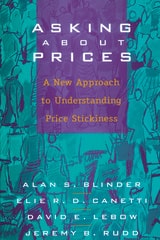
Asking About Prices
A New Approach to Understanding Price StickinessAlan Blinder
Russell Sage Foundation, 1998
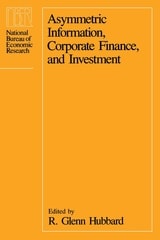
Asymmetric Information, Corporate Finance, and Investment
Edited by R. Glenn Hubbard
University of Chicago Press, 1990
In this volume, specialists from traditionally separate areas in economics and finance investigate issues at the conjunction of their fields. They argue that financial decisions of the firm can affect real economic activity—and this is true for enough firms and consumers to have significant aggregate economic effects. They demonstrate that important differences—asymmetries—in access to information between "borrowers" and "lenders" ("insiders" and "outsiders") in financial transactions affect investment decisions of firms and the organization of financial markets. The original research emphasizes the role of information problems in explaining empirically important links between internal finance and investment, as well as their role in accounting for observed variations in mechanisms for corporate control.

Asymptotic and Hybrid Methods in Electromagnetics
F. Molinet
The Institution of Engineering and Technology, 2005
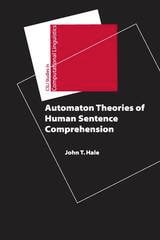
Automaton Theories of Human Sentence Comprehension
John T. Hale
CSLI, 2014