Results by title
5 books match the query 'Mavor, Carol'
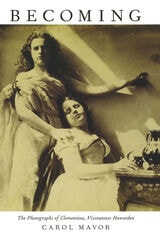
Becoming
The Photographs of Clementina, Viscountess HawardenCarol Mavor
Duke University Press, 1999
With drama, wit, and verve, Lady Hawarden’s girls, becoming women, entwine each other, their mirrored reflections and select feminine objects (an Indian traveling cabinet, a Gothic-style desk, a shell-covered box) as homoerotic partners. The resulting mise-en-scène is secretive, private, delicious, and arguably queer—a girltopia ripe with maternality and adolescent flirtation, as touching as it is erotic. Luxuriating in the photographs’ interpretive possibilities, Mavor makes illuminating connections between Hawarden and other artists and writers, including Vermeer, Christina Rossetti, George Eliot, Lewis Carroll, and twentieth-century photographers Sally Mann and Francesca Woodman. Weaving psychoanalytic theory and other photographic analyses into her work, Mavor contemplates the experience of the photograph and considers the relationship of Hawarden’s works to the concept of the female fetish, to voyeurism, mirrors and lenses, and twins and doubling. Under the spell of Roland Barthes, Mavor’s voice unveils the peculiarities of the erotic in Lady Hawarden’s images through a writerly approach that remembers and rewrites adolescence as sustained desire.
In turn autobiographical, theoretical, historical, and analytical, Mavor’s study caresses these mysteriously ripped and scissored images into fables of sapphic love and the real magic of photography.
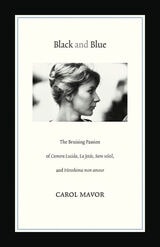
Black and Blue
The Bruising Passion of Camera Lucida, La Jete, Sans soleil, and Hiroshima mon amourCarol Mavor
Duke University Press, 2012
Personal recollections punctuate Mavor's dazzling interpretations of these and many other works of art and criticism. Childhood memories become Proust's "small-scale contrivances," tiny sensations that open onto panoramas. Mavor's mother lost her memory to Alzheimer's, and Black and Blue is framed by the author's memories of her mother and effort to understand what it means to not be recognized by one to whom you were once so known.

Forevering
Carol Mavor
Duke University Press, 2027
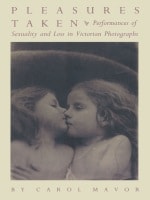
Pleasures Taken
Performances of Sexuality and Loss in Victorian PhotographsCarol Mavor
Duke University Press, 1995
Mavor’s original approach to these photographs emphatically sees sexuality where it has been previously rendered invisible. She insists that the sexuality of the girls in Carroll’s pictures is not only present, but deserves recognition, respect, and scrutiny. Similarly, she sees in Cameron’s photographs of sensual Madonnas surprising visions of motherhood that outstrip both Victorian and contemporary understandings of the maternal as untouchable and inviolate, without sexuality. Finally she shows how Hannah Cullwick, posing in various masquerades for her secret paramour, emerges as a subject with desires rather than simply a victim of her upper-class partner. Even when confronting the darker areas of these photographs, Mavor perseveres in her insistence on the pleasures taken—by the viewer, the photographer, and often by the model herself—in the act of imagining these sexualities. Inspired by Roland Barthes, and drawing on other theorists such as Julia Kristeva and Luce Irigaray, Mavor creates a text that is at once interdisciplinary, personal, and profoundly pleasurable.
Reading Boyishly
Roland Barthes, J. M. Barrie, Jacques Henri Lartigue, Marcel Proust, and D. W. WinnicottCarol Mavor
Duke University Press, 2007
To “read boyishly” is to covet the mother’s body as a home both lost and never lost, to desire her as only a son can, as only a body that longs for, but will never become Mother, can. Nostalgia (from the Greek nostos = return to native land, and algos = suffering or grief) is at the heart of the labor of boyish reading, which suffers in its love affair with the mother. The writers and the photographer that Mavor lovingly considers are boyish readers par excellence: Barrie, creator of Peter Pan, the boy who refused to grow up; Barthes, the “professor of desire” who lived with or near his mother until her death; Proust, the modernist master of nostalgia; Winnicott, therapist to “good enough” mothers; and Lartigue, the child photographer whose images invoke ghostlike memories of a past that is at once comforting and painful.
Drawing attention to the interplay between writing and vision, Reading Boyishly is stuffed full with more than 200 images. At once delicate and powerful, the book is a meditation on the threads that unite mothers and sons and on the writers and artists who create from those threads art that captures an irretrievable past.