Results by title
7 books match the query 'May, Todd'
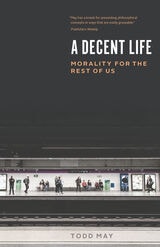
A Decent Life
Morality for the Rest of UsTodd May
University of Chicago Press, 2019
In a world full of suffering and deprivation, it’s easy to despair—and it’s also easy to judge ourselves for not doing more. Even if we gave away everything we own and devoted ourselves to good works, it wouldn’t solve all the world’s problems. It would make them better, though. So is that what we have to do? Is anything less a moral failure? Can we lead a fundamentally decent life without taking such drastic steps?
Todd May has answers. He’s not the sort of philosopher who tells us we have to be model citizens who display perfect ethics in every decision we make. He’s realistic: he understands that living up to ideals is a constant struggle. In A Decent Life, May leads readers through the traditional philosophical bases of a number of arguments about what ethics asks of us, then he develops a more reasonable and achievable way of thinking about them, one that shows us how we can use philosophical insights to participate in the complicated world around us. He explores how we should approach the many relationships in our lives—with friends, family, animals, people in need—through the use of a more forgiving, if no less fundamentally serious, moral compass. With humor, insight, and a lively and accessible style, May opens a discussion about how we can, realistically, lead the good life that we aspire to.
A philosophy of goodness that leaves it all but unattainable is ultimately self-defeating. Instead, Todd May stands at the forefront of a new wave of philosophy that sensibly reframes our morals and redefines what it means to live a decent life.
A Fragile Life
Accepting Our VulnerabilityTodd May
University of Chicago Press, 2017
It is perhaps our noblest cause, and certainly one of our oldest: to end suffering. Think of the Buddha, Chuang Tzu, or Marcus Aurelius: stoically composed figures impervious to the torments of the wider world, living their lives in complete serenity—and teaching us how to do the same. After all, isn’t a life free from suffering the ideal? Isn’t it what so many of us seek? Absolutely not, argues Todd May in this provocative but compassionate book. In a moving examination of life and the trials that beset it, he shows that our fragility, our ability to suffer, is actually one of the most important aspects of our humanity.
May starts with a simple but hard truth: suffering is inevitable. At the most basic level, we suffer physically—a sprained ankle or a bad back. But we also suffer insults and indifference. We suffer from overburdened schedules and unforeseen circumstances, from moral dilemmas and emotional heartaches. Even just thinking about our own mortality—the fact that we only live one life—can lead us to tremendous suffering. No wonder philosophies such as Buddhism, Taosim, Stoicism, and even Epicureanism—all of which counsel us to rise above these plights—have had appeal over the centuries. May highlights the tremendous value of these philosophies and the ways they can guide us toward better lives, but he also exposes a major drawback to their tenets: such invulnerability is too emotionally disengaged from the world, leading us to place too great a distance between ourselves and our experience. Rather than seeking absolute immunity, he argues most of us just want to hurt less and learn how to embrace and accept what suffering we do endure in a meaningful way.
A Fragile Life
Accepting Our VulnerabilityTodd May
University of Chicago Press, 2017
This is an auto-narrated audiobook edition of this book.
May starts with a simple but hard truth: suffering is inevitable. At the most basic level, we suffer physically—a sprained ankle or a bad back. But we also suffer insults and indifference. We suffer from overburdened schedules and unforeseen circumstances, from moral dilemmas and emotional heartaches. Even just thinking about our own mortality—the fact that we only live one life—can lead us to tremendous suffering. No wonder philosophies such as Buddhism, Taosim, Stoicism, and even Epicureanism—all of which counsel us to rise above these plights—have had appeal over the centuries. May highlights the tremendous value of these philosophies and the ways they can guide us toward better lives, but he also exposes a major drawback to their tenets: such invulnerability is too emotionally disengaged from the world, leading us to place too great a distance between ourselves and our experience. Rather than seeking absolute immunity, he argues most of us just want to hurt less and learn how to embrace and accept what suffering we do endure in a meaningful way.
Offering a guide on how to positively engage suffering, May ultimately lays out a new way of thinking about how we exist in the world, one that reassures us that our suffering, rather than a failure of physical or psychological resilience, is a powerful and essential part of life itself.
A Significant Life
Human Meaning in a Silent UniverseTodd May
University of Chicago Press, 2015
What makes for a good life, or a beautiful one, or, perhaps most important, a meaningful one? Throughout history most of us have looked to our faith, our relationships, or our deeds for the answer. But in A Significant Life, philosopher Todd May offers an exhilarating new way of thinking about these questions, one deeply attuned to life as it actually is: a work in progress, a journey—and often a narrative. Offering moving accounts of his own life and memories alongside rich engagements with philosophers from Aristotle to Heidegger, he shows us where to find the significance of our lives: in the way we live them.
May starts by looking at the fundamental fact that life unfolds over time, and as it does so, it begins to develop certain qualities, certain themes. Our lives can be marked by intensity, curiosity, perseverance, or many other qualities that become guiding narrative values. These values lend meanings to our lives that are distinct from—but also interact with—the universal values we are taught to cultivate, such as goodness or happiness. Offering a fascinating examination of a broad range of figures—from music icon Jimi Hendrix to civil rights leader Fannie Lou Hamer, from cyclist Lance Armstrong to The Portrait of a Lady’s Ralph Touchett to Claus von Stauffenberg, a German officer who tried to assassinate Hitler—May shows that narrative values offer a rich variety of criteria by which to assess a life, specific to each of us and yet widely available. They offer us a way of reading ourselves, who we are, and who we might like to be.
Clearly and eloquently written, A Significant Life is a recognition and a comfort, a celebration of the deeply human narrative impulse by which we make—even if we don’t realize it—meaning for ourselves. It offers a refreshing way to think of an age-old question, of quite simply, what makes a life worth living.
A Significant Life
Human Meaning in a Silent UniverseTodd May
University of Chicago Press, 2015
This is an auto-narrated audiobook edition of this book.
What makes for a good life, or a beautiful one, or, perhaps most important, a meaningful one? Throughout history most of us have looked to our faith, our relationships, or our deeds for the answer. But in A Significant Life, philosopher Todd May offers an exhilarating new way of thinking about these questions, one deeply attuned to life as it actually is: a work in progress, a journey—and often a narrative. Offering moving accounts of his own life and memories alongside rich engagements with philosophers from Aristotle to Heidegger, he shows us where to find the significance of our lives: in the way we live them.
May starts by looking at the fundamental fact that life unfolds over time, and as it does so, it begins to develop certain qualities, certain themes. Our lives can be marked by intensity, curiosity, perseverance, or many other qualities that become guiding narrative values. These values lend meanings to our lives that are distinct from—but also interact with—the universal values we are taught to cultivate, such as goodness or happiness. Offering a fascinating examination of a broad range of figures—from music icon Jimi Hendrix to civil rights leader Fannie Lou Hamer, from cyclist Lance Armstrong to The Portrait of a Lady’s Ralph Touchett to Claus von Stauffenberg, a German officer who tried to assassinate Hitler—May shows that narrative values offer a rich variety of criteria by which to assess a life, specific to each of us and yet widely available. They offer us a way of reading ourselves, who we are, and who we might like to be.
Clearly and eloquently written, A Significant Life is a recognition and a comfort, a celebration of the deeply human narrative impulse by which we make—even if we don’t realize it—meaning for ourselves. It offers a refreshing way to think of an age-old question, of quite simply, what makes a life worth living.

Emerging Trends in Continental Philosophy
Edited by Todd May
University of Chicago Press, 2010
From Kant to Kierkegaard, from Hegel to Heidegger, continental philosophers have indelibly shaped the trajectory of Western thought since the eighteenth century. Although much has been written about these monumental thinkers, students and scholars lack a definitive guide to the entire scope of the continental tradition. The most comprehensive reference work to date, this eight-volume History of Continental Philosophy will both encapsulate the subject and reorient our understanding of it. Beginning with an overview of Kant’s philosophy and its initial reception, the History traces the evolution of continental philosophy through major figures as well as movements such as existentialism, phenomenology, hermeneutics, and poststructuralism. The final volume outlines the current state of the field, bringing the work of both historical and modern thinkers to bear on such contemporary topics as feminism, globalization, and the environment. Throughout, the volumes examine important philosophical figures and developments in their historical, political, and cultural contexts.
The first reference of its kind, A History of Continental Philosophy has been written and edited by internationally recognized experts with a commitment to explaining complex thinkers, texts, and movements in rigorous yet jargon-free essays suitable for both undergraduates and seasoned specialists. These volumes also elucidate ongoing debates about the nature of continental and analytic philosophy, surveying the distinctive, sometimes overlapping characteristics and approaches of each tradition. Featuring helpful overviews of major topics and plotting road maps to their underlying contexts, A History of Continental Philosophy is destined to be the resource of first and last resort for students and scholars alike.

Operation Defensive Shield
Witnesses to Israeli War CrimesEdited by Muna Hamzeh and Todd June
Pluto Press, 2003
On March 29, 2002 the Israeli army launched Operation Defensive Shield, the largest military offensive against Palestinian civilians since the 1948 Arab-Israeli War. During the operation, the military used the most advanced weaponry at its disposal: Merkava tanks, Apache attack helicopters and F-15 fighter jets. When the operation ended on April 21, Israel had destroyed the Palestinian economic and social infrastructure, leveled large swathes of residential area, killed 220 people, injured hundreds more and arrested thousands.
This book documents these events through a collection of electronic witness narratives written by Palestinians who were under attack and by Israeli and international peace activists who witnessed the results of these attacks. Deeply moving and courageous, these narratives offer a uniquely powerful and intimate account of the daily reality for Palestinians who endured Ariel Sharon's military strategy, and the death and destruction that strategy has caused throughout the Occupied Territories.
Most important, the witnesses' voices bring to life the aggressive nature of this strategy -- they belie the noble motives ascribed to Sharon and those in his government and military who designed and carried it out. The editors argue that Operation Defensive Shield is a prelude to Israel's ethnic cleansing of the Palestinians. They provide historical context, a chronology, and an analysis of the conflict that situates the horror of these days in their proper perspective.
Operation Defensive Shield: Witnesses to Israeli War Crimes is an essential record for those who want to understand what happened in the West Bank in the spring of 2002, and what it portends for the future of the region.