Results by title
3 books match the query 'Maya arts'
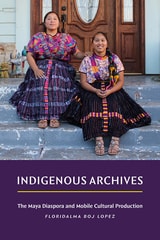
Indigenous Archives
The Maya Diaspora and Mobile Cultural ProductionFloridalma Boj Lopez
Duke University Press, 2026
Indigenous Archives analyzes the modes through which young Guatemalan Mayas in Los Angeles and Guatemala make sense of and respond to transnational structures of settler colonialism. Drawing on in-depth analysis of cultural production and interviews with Guatemalan Maya youth and young adults, Floridalma Boj Lopez examines how Mayas in diaspora craft and circulate narratives about their experiences across borders. Citing a more active practice of “archives in formation,” Boj Lopez depicts Indigenous archives as a cross-generational, collective conversation rooted in memory, survival, and cultural expression where Indigenous cultural practices and artifacts move, adapt, and assert their presence in the contemporary. Indigenous Archives invites readers to consider Indigeneity as a process, lived experience, and historical perspective, rather than as a static identity, and shows how extending analysis across borders is critical to understanding Latinidad and Indigeneity.
[more]
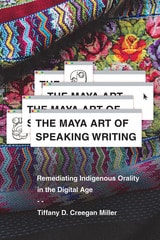
The Maya Art of Speaking Writing
Remediating Indigenous Orality in the Digital AgeTiffany D. Creegan Miller
University of Arizona Press, 2022
Challenging the distinctions between “old” and “new” media and narratives about the deprecation of orality in favor of inscribed forms, The Maya Art of Speaking Writing draws from Maya concepts of tz’ib’ (recorded knowledge) and tzij, choloj, and ch’owen (orality) to look at expressive work across media and languages.
Based on nearly a decade of fieldwork in the Guatemalan highlands, Tiffany D. Creegan Miller discusses images that are sonic, pictorial, gestural, and alphabetic. She reveals various forms of creativity and agency that are woven through a rich media landscape in Indigenous Guatemala, as well as Maya diasporas in Mexico and the United States. Miller discusses how technologies of inscription and their mediations are shaped by human editors, translators, communities, and audiences, as well as by voices from the natural world.
These texts push back not just on linear and compartmentalized Western notions of media but also on the idea of the singular author, creator, scholar, or artist removed from their environment. The persistence of orality and the interweaving of media forms combine to offer a challenge to audiences to participate in decolonial actions through language preservation.
The Maya Art of Speaking Writing calls for centering Indigenous epistemologies by doing research in and through Indigenous languages as we engage in debates surrounding Indigenous literatures, anthropology, decoloniality, media studies, orality, and the digital humanities.
[more]
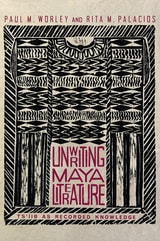
Unwriting Maya Literature
Ts'íib as Recorded KnowledgePaul M. Worley and Rita M. Palacios
University of Arizona Press, 2019
Unwriting Maya Literature provides an important decolonial framework for reading Maya texts that builds on the work of Maya authors and intellectuals such as Q’anjob’al Gaspar Pedro González and Kaqchikel Irma Otzoy. Paul M. Worley and Rita M. Palacios privilege the Maya category ts’íib over constructions of the literary in order to reveal how Maya peoples themselves conceive of artistic creation. This offers a decolonial departure from theoretical approaches that remain situated within alphabetic Maya linguistic and literary creation.
As ts’íib refers to a broad range of artistic production from painted codices and textiles to works composed in Latin script, as well as plastic arts, the authors argue that texts by contemporary Maya writers must be read as dialoguing with a multimodal Indigenous understanding of text. In other words, ts’íib is an alternative to understanding “writing” that does not stand in opposition to but rather fully encompasses alphabetic writing, placing it alongside and in dialogue with a number of other forms of recorded knowledge. This shift in focus allows for a critical reexamination of the role that weaving and bodily performance play in these literatures, as well as for a nuanced understanding of how Maya writers articulate decolonial Maya aesthetics in their works.
Unwriting Maya Literature places contemporary Maya literatures within a context that is situated in Indigenous ways of knowing and being. Through ts’íib, the authors propose an alternative to traditional analysis of Maya cultural production that allows critics, students, and admirers to respectfully interact with the texts and their authors. Unwriting Maya Literature offers critical praxis for understanding Mesoamerican works that encompass non-Western ways of reading and creating texts.
[more]