Results by title
4 books match the query 'McCann, James C.'
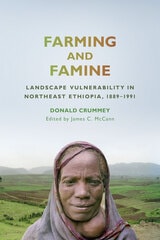
Farming and Famine
Landscape Vulnerability in Northeast Ethiopia, 1889–1991Donald E. Crummey; Edited by James C. McCann
University of Wisconsin Press, 2018
Crummey draws on photographs comparing identical landscapes in 1937 and 1997 as well as interviews with local farmers, among other sources. He reveals that forestation actually increased due to farmers' tree-planting initiatives. More broadly, he shows that, in the face of growing environmental stress, Ethiopian farmers have innovated and adapted. Yet the threat of famine remains because of constricted access to resources and erratic rainfall. To avoid future famines, Crummey suggests, Ethiopia's farmers must transform agricultural productivity, but they cannot achieve that on their own.
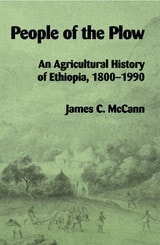
People of the Plow
An Agricultural History of Ethiopia, 1800–1990James C. McCann
University of Wisconsin Press, 1995
For more than two thousand years, Ethiopia’s ox-plow agricultural system was the most efficient and innovative in Africa, but has been afflicted in the recent past by a series of crises: famine, declining productivity, and losses in biodiversity. James C. McCann analyzes the last two hundred years of agricultural history in Ethiopia to determine whether the ox-plow agricultural system has adapted to population growth, new crops, and the challenges of a modern political economy based in urban centers.
This agricultural history is set in the context of the larger environmental and landscape history of Ethiopia, showing how farmers have integrated crops, tools, and labor with natural cycles of rainfall and soil fertility, as well as with the social vagaries of changing political systems. McCann traces characteristic features of Ethiopian farming, such as the single-tine scratch plow, which has retained a remarkably consistent design over two millennia, and a crop repertoire that is among the most genetically diverse in the world.
People of the Plow provides detailed documentation of Ethiopian agricultural practices since the early nineteenth century by examining travel narratives, early agricultural surveys, photographs and engravings, modern farming systems research, and the testimony of farmers themselves, collected during McCann’s five years of fieldwork. He then traces the ways those practices have evolved in the twentieth century in response to population growth, urban markets, and the presence of new technologies.
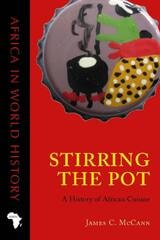
Stirring the Pot
A History of African CuisineJames C. McCann
Ohio University Press, 2009
Africa’s art of cooking is a key part of its history. All too often Africa is associated with famine, but in Stirring the Pot, James C. McCann describes how the ingredients, the practices, and the varied tastes of African cuisine comprise a body of historically gendered knowledge practiced and perfected in households across diverse human and ecological landscape. McCann reveals how tastes and culinary practices are integral to the understanding of history and more generally to the new literature on food as social history.
Stirring the Pot offers a chronology of African cuisine beginning in the sixteenth century and continuing from Africa’s original edible endowments to its globalization. McCann traces cooks’ use of new crops, spices, and tastes, including New World imports like maize, hot peppers, cassava, potatoes, tomatoes, and peanuts, as well as plantain, sugarcane, spices, Asian rice, and other ingredients from the Indian Ocean world. He analyzes recipes, not as fixed ahistorical documents,but as lively and living records of historical change in women’s knowledge and farmers’ experiments. A final chapter describes in sensuous detail the direct connections of African cooking to New Orleans jambalaya, Cuban rice and beans, and the cooking of African Americans’ “soul food.”
Stirring the Pot breaks new ground and makes clear the relationship between food and the culture, history, and national identity of Africans.
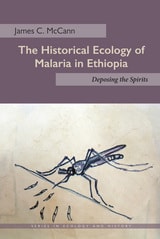
The Historical Ecology of Malaria in Ethiopia
Deposing the SpiritsJames C. McCann
Ohio University Press, 2015
Malaria is an infectious disease like no other: it is a dynamic force of nature and Africa’s most deadly and debilitating malady. James C. McCann tells the story of malaria in human, narrative terms and explains the history and ecology of the disease through the science of landscape change. All malaria is local. Instead of examining the disease at global or continental scale, McCann investigates malaria’s adaptation and persistence in a single region, Ethiopia, over time and at several contrasting sites.
Malaria has evolved along with humankind and has adapted to even modern-day technological efforts to eradicate it or to control its movement. Insecticides, such as DDT, drug prophylaxis, development of experimental vaccines, and even molecular-level genetic manipulation have proven to be only temporary fixes. The failure of each stand-alone solution suggests the necessity of a comprehensive ecological understanding of malaria, its transmission, and its persistence, one that accepts its complexity and its local dynamism as fundamental features.
The story of this disease in Ethiopia includes heroes, heroines, witches, spirits—and a very clever insect—as well as the efforts of scientists in entomology, agroecology, parasitology, and epidemiology. Ethiopia is an ideal case for studying the historical human culture of illness, the dynamism of nature’s disease ecology, and its complexity within malaria.