Results by title
2 books match the query 'McCook, Stuart'
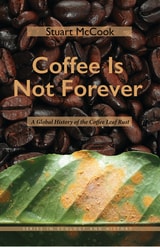
Coffee Is Not Forever
A Global History of the Coffee Leaf RustStuart McCook
Ohio University Press, 2019
The global coffee industry, which fuels the livelihoods of farmers, entrepreneurs, and consumers around the world, rests on fragile ecological foundations. In Coffee Is Not Forever, Stuart McCook explores the transnational story of this essential crop through a history of one of its most devastating diseases, the coffee leaf rust. He deftly synthesizes agricultural, social, and economic histories with plant genetics and plant pathology to investigate the increasing interdependence of the world’s coffee-producing zones. In the process, he illuminates the progress and prognosis of the challenges—especially climate change—that pose an existential threat to a crop that global consumers often take for granted. And finally, in putting a tropical plant disease at the forefront, he has crafted the first truly global environmental history of coffee, pushing its study and the discipline in bold new directions.
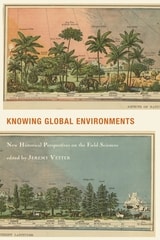
Knowing Global Environments
New Historical Perspectives on the Field SciencesVetter, Jeremy
Rutgers University Press, 2011
Collectively their essays explore the history of the field sciences, through the lens of place, practice, and the production of scientific knowledge, with a wide-ranging perspective extending outwards from the local to regional, national, imperial, and global scales. The book also shows what the history of the field sciences can contribute to environmental history-especially how knowledge in the field sciences has intersected with changing environments-and addresses key present-day problems related to sustainability, such as global climate, biodiversity, oceans, and more.
Contributors to Knowing Global Environments reveal how the field sciences have interacted with practical economic activities, such as forestry, agriculture, and tourism, as well as how the public has been involved in the field sciences, as field assistants, students, and local collaborators.