Results by title

3 books match the query 'McCool, Daniel C.'
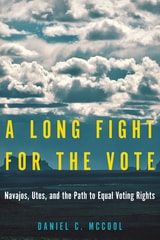
cover of A Long Fight for the Vote: Navajos, Utes, and the Path to Equal Voting Rights

A Long Fight for the Vote

Navajos, Utes, and the Path to Equal Voting Rights

Daniel C. McCool

University of Arizona Press, 2027

In A Long Fight for the Vote, Daniel C. McCool offers a deeply researched and compelling account of the fight for equal voting rights in San Juan County, Utah—homeland to the Navajo and Ute peoples and a flashpoint of persistent Anglo–Native conflict. 

Centering on landmark voting rights cases that culminated in the historic election of two Navajo county commissioners, McCool situates these legal battles within a broader history of discrimination, shifting federal Indian policy, and the gradual political empowerment of Native communities across the American West. Through meticulous analysis, the book reveals how local elections became a crucible for national debates over citizenship, sovereignty, and democracy.

Drawing on court records, expert testimony, and decades of engagement with voting rights litigation, McCool demonstrates that Native peoples have never been passive victims of disenfranchisement but active protagonists in a sustained struggle for political equality. Richly contextualized and powerfully argued, A Long Fight for the Vote speaks to scholars and students of law, politics, and Western history, as well as legal professionals and engaged readers seeking to understand how race, power, and the ballot box intersect in Indian Country—and why these struggles continue to shape American democracy today.
[more]
cover of Command of the Waters: Iron Triangles, Federal Water Development, and Indian Water

Command of the Waters

Iron Triangles, Federal Water Development, and Indian Water

Daniel C. McCool

University of Arizona Press, 1994
Much has been written about legal questions surrounding Indian water rights; this book now places them in the political framework that also includes water development. McCool analyzes the two conflicting doctrines relating to water use—one based on federal case law governing the rights of Indians on reservations, the other sanctioned by legislation and applied to non-Indians—based on the "iron triangles" of bureaucrats, legislators, and interest groups that dominate policy issues. He examines the way federal and BIA water development programs have reacted to conflict, competition, and opportunity from the turn of the century to the 1980s and updates the situation in an introduction written for this edition.
[more]
cover of Native Waters: Contemporary Indian Water Settlements and the Second Treaty Era

Native Waters

Contemporary Indian Water Settlements and the Second Treaty Era

Daniel McCool

University of Arizona Press, 2002

Since the beginning of the reservation era, the bitter conflict between Indians and non-Indians over water rights was largely confined to the courtroom. But in the 1980s the federal government began to emphasize negotiated settlements over lawsuits, and the settlements are changing water rights in fundamental ways—not only for tribes but also for non-Indian communities that share scarce water resources with Indians.In Native Waters, Daniel McCool describes the dramatic impact these settlements are having both on Indian country and on the American West as a whole. Viewing the settlements as a second treaty era, he considers whether they will guarantee the water future of reservations—or, like treaties of old, will require tribes to surrender vast resources in order to retain a small part of their traditional homelands. As one tribal official observed, "It's like your neighbors have been stealing your horses for many years, and now we have to sit down and decide how many of those horses they get to keep."Unlike technical studies of water policy, McCool's book is a readable account that shows us real people attempting to end real disputes that have been going on for decades. He discusses specific water settlements using a combination of approaches—from personal testimony to traditional social science methodology—to capture the richness, complexity, and human texture of the water rights conflict. By explaining the processes and outcomes in plain language and grounding his presentation in relevant explanations of Indian culture, he conveys the complexity of the settlements for readers from a wide range of disciplines.Native Waters illustrates how America is coming to grips with an issue that has long been characterized by injustice and conflict, seeking to enhance our understanding of the settlements in the hope that this understanding will lead to better settlements for all parties. As one of the first assessments of a policy that will have a pervasive impact for centuries to come, it shows that how we resolve Indian water claims tells us a great deal about who we are as a nation and how we confront difficult issues involving race, culture, and the environment.
[more]