Results by title

5 books match the query 'McDougall, Jo'
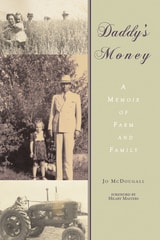
cover of Daddy’s Money: A Memoir of Farm and Family

Daddy’s Money

A Memoir of Farm and Family

Jo McDougall

University of Arkansas Press, 2011
Jo McDougall brings a poet's sensibility to memoir. Recounting five generations of Delta rice farmers, through family archives and oral histories, she traces how the clan made their way into the fabric of America, beginning with her Belgian-immigrant grandfather, a pioneer rice farmer on the Arkansas Delta at the turn of the twentieth century. As John Grisham has for a 1950s Arkansas cotton farm, McDougall illuminates an Arkansas rice farm in the 1930s and 1940s. The Garot family's acreage near DeWitt and the town itself provide the stage for McDougall's wry, compelling, and layered account of the day-to-day of rice growing on the farm that her father inherited. In that setting she discovers a rich "universe of words" in the Great Depression, comes of age during World War II, and finds her way alongside "that whole quirky, compelling cast of characters" that comprised her kin. In this conflicted, ironic, southern-but-universal account of betrayal, heartbreak, loss, and joy, "the vagaries and the grace" of the land join forces with the power of money as family bonds are both forged and dissolved. Deeply felt, unsentimental, and often humorous,Daddy's Money presents McDougall's life and the lives of her relatives in the way that all our lives are eventually framed-as stories. "When all else is lost," the author maintains, "the stories remain."
[more]
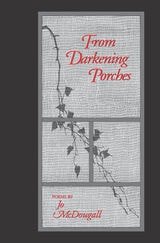
cover of From Darkening Porches: Poems

From Darkening Porches

Poems

Jo McDougall

University of Arkansas Press, 1996
In just five lines, Jo McDougall can make you shudder. Her poems are often as stark and open as their settings—the Kansas plains and Southern bottomlands. But in these wide fields and hot kitchens, on these front porches where ordinary people tell their stories, the everyday becomes fabled, truth becomes hallowed. To C. D. Wright, McDougall writes “a lean, stoic line; each poem makes its mark, like spit.” In those lines, McDougall brings to life farmers, dressmakers, widows, and waitresses with such precise clarity that we take part in the strange delights, the struggles, the tangled mysteries of their faltering lives.
[more]
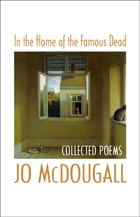
cover of In the Home of the Famous Dead: Collected Poems

In the Home of the Famous Dead

Collected Poems

Jo McDougall

University of Arkansas Press, 2015

In the Home of the Famous Dead will appeal to newcomers as well as to avid followers of Jo McDougall’s long career and complex work, providing valuable insights to the development of a poet’s signature, inimitable style. This collection presents work known for its sparse, compact language; surprising metaphor; humor; irony; idiomatic speech; and a stoic, sadly earned wisdom concerning death and loss. In McDougall’s world, folks making do with what they have take the stage to speak of, in the words of one critic, “the tangled mysteries of their faltering lives.” Her work has been described as having “excruciating honesty” (Gerald Stern), giving voice to the “ineffable emotions of plain people” (Judith Kitchen). Miller Williams notes that the work has “cleanness and clarity . . . in all the funk and smell of humanity.” This is the poetry of midwestern plains and southern botttomlands, of waitresses and professors, farmers and bankers, the disadvantaged and privileged alike. Often beginning in the personal and expanding to the universal, this poet takes note of the phenomenological world with a mixture of joy, despair, and awe, providing a haunting look at the cosmic irony of our existence. McDougall’s style is indescribable, yet wholly accessible. As Kelly Cherry notes, “Call it magic, call it art; either way [Jo McDougall’s work] is something like a miracle.”
[more]
cover of Lewis Nordan: Humor, Heartbreak, and Hope

Lewis Nordan

Humor, Heartbreak, and Hope

Edited by Barbara A. Baker

University of Alabama Press, 2012

A vibrant tribute to Lewis Nordan’s unforgettable blend of Southern surrealism, dark humor, and deep humanity.

Lewis Nordan: Humor, Heartbreak, and Hope is a rich collection of essays that examines the life and work of one of the South’s most distinctive literary voices. Edited by Barbara A. Baker, this volume brings together scholars and writers who explore Nordan’s use of magical realism, dark humor, and emotional vulnerability to portray the complexities of life in the Mississippi Delta. Through themes of race, poverty, family, and resilience, the contributors illuminate how Nordan’s fiction captures both the pain and beauty of the Southern experience. This book is essential reading for fans of Southern literature, cultural studies, and American fiction.

Written by scholars and fiction writers who represent a fascinating range of experience—from a Shakespearean scholar to English professors to a former student of Nordan’s—this is a rich array of essays, poems, and visual arts in tribute to this increasingly important writer. The collection deepens the base of scholarship on Nordan, and contextualizes his work in relation to other important southern writers such as William Faulkner and Eudora Welty.

Nordan was born and raised in Mississippi before moving to Alabama to pursue his Ph.D. at Auburn University. He taught for several years at the University of Arkansas in Fayetteville and retired from the University of Pittsburgh, where he was a professor of English. Nordan has written four novels, three collections of short stories, and a memoir entitled Boy with Loaded Gun. His second novel, Wolf Whistle, won the Southern Book Award, and his subsequent novel, The Sharpshooter Blues, won the Notable Book Award from the American Library Association and the Fiction Award from the Mississippi Institute of Arts and Letters. Nordan is renowned for his distinctive comic writing style, even while addressing more serious personal and cultural issues such as heartbreak, loss, violence, and racism. He transforms tragic characters and events into moments of artistic transcendence, illuminating what he calls the “history of all human beings.”
[more]
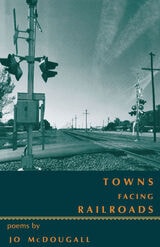
cover of Towns Facing Railroads: Poems

Towns Facing Railroads

Poems

Jo McDougall

University of Arkansas Press, 1991

In her second book of poetry, Jo McDougall takes her readers to the dusty prairie towns of the central states, places where the flat terrain belies a complex human landscape. In short, dceptively simple lines, McDougall can so keenly trace the lineaments of place and era that her subject stands before us, its essence displayed and made timeless.

Quietly, with an almost aphoristic bit, McDougall writes about ordinary lives and small towns in a way that her readers may never forget.

[more]