Results by title
5 books match the query 'McGann, Jerome'
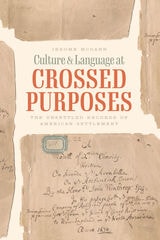
Culture and Language at Crossed Purposes
The Unsettled Records of American SettlementJerome McGann
University of Chicago Press, 2022
Classic American literature, Jerome McGann argues, is haunted by the betrayal of seventeenth- and eighteenth-century Indian treaties—“a stunned memory preserved in the negative spaces of the treaty records.” A noted scholar of the “textual conditions” of literature, McGann investigates canonical works from the colonial period, including the Arbella sermon and key writings of William Bradford, John Winthrop, Anne Bradstreet, Cotton Mather’s Magnalia, Benjamin Franklin’s celebrated treaty folios and Autobiography, and Thomas Jefferson’s Notes on the State of Virginia. These are highly practical, purpose-driven works—the record of Enlightenment dreams put to the severe test of dangerous conditions. McGann suggests that the treaty-makers never doubted the unsettled character of what they were prosecuting, and a similar conflicted ethos pervades these works. Like the treaty records, they deliberately test themselves against stringent measures of truth and accomplishment and show a distinctive consciousness of their limits and failures. McGann’s book is ultimately a reminder of the public importance of truth and memory—the vocational commitments of humanist scholars and educators.
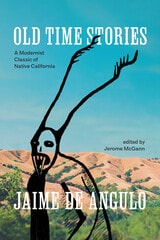
Old Time Stories
A Modernist Classic of Native CaliforniaJaime de Angulo
University of Chicago Press, 2026
Dismantled and scattered just before his death, Jaime de Angulo’s poetic masterpiece Old Time Stories is now reconstituted for the first time in this edition.
Jaime de Angulo’s Old Time Stories, a visual prose-poem drawing on his anthropological research among Indigenous communities in California, is a forgotten modernist treasure. Completed shortly before de Angulo’s death, the work has survived only in fragments, divided between an abridged 1953 publication and a limited edition from the 1970s. This new reconstituted edition gives contemporary readers—whether interested in experimental literature, linguistics, cultural anthropology, or Native American history—their first chance to engage with the complete work.
Structured around children’s stories inspired by the Indigenous tales and legends de Angulo encountered directly during his studies, Old Time Stories uses illustrations, different typefaces, and other experimental formatting techniques to translate rich oral and pictographic traditions into the condensed form of print. Beyond its significance as an innovative work of American literary modernism, it interrogates the colonialist foundations of Western modernity through this very reworking of Western literary conventions.
The Point Is To Change It
Poetry and Criticism in the Continuing PresentJerome McGann
University of Alabama Press, 2007
A preeminent critic maps the frontier of contemporary poetry.
In this book, Jerome McGann argues that contemporary language-oriented writing implies a marked change in the way we think about our poetic tradition on one hand and in the future of criticism on the other. He focuses on Walter Benjamin and Gertrude Stein as important intellectual resources because both see the history of poetry as a crisis of the present rather than as a legacy of the past. The crisis appears as a poetic deficit in contemporary culture, where values of politics and morality are judged prima facie more important than aesthetic values. McGann argues for the fundamental relevance of the aesthetic dimension and the contemporary relevance of cultural works of the past.
McGann moves through several broad categories in his examination of contemporary poetry, including the ways in which poetry must be abstract, change, and give pleasure. The author draws on sources ranging from the poetry of Bruce Andrews and Robert Duncan to Looney Tunes cartoons. The experimental move in contemporary poetry, McGann contends, is an emergency signal for readers and critics as much as it is for writers and poets, a signal that calls us to rethink the aesthetics of criticism. The interpretation of literary works has been dominated by enlightenment models—the expository essay and monograph—for almost two hundred years. With the emergence of new media, especially digital culture, the limitations of those models have grown increasingly apparent.
The Point Is To Change It explores alternative critical methods and provides a powerful call to reinvent our modes of investigation in order to escape the limitations of our inherited academic models. The goal of this process is to widen existing cracks or create new ones because, as McGann points out via the lyrics of Leonard Cohen, "That's how the light gets in."
The Romantic Ideology
A Critical InvestigationJerome McGann
University of Chicago Press, 1983
In the course of his study, McGann analyzes both the predominant theories of Romanticism (those deriving from Coleridge, Hegel, and Heine) and the products of its major English practitioners. Words worth, Coleridge, Shelley, and Byron are considered in greatest depth, but the entire movement is subjected to a searching critique. Arguing that poetry is produced and reproduced within concrete historical contexts and that criticism must take these contexts into account, McGann shows how the ideologies embodied in Romantic poetry and theory have shaped and distorted contemporary critical activities.
The Scholar's Art
Literary Studies in a Managed WorldJerome McGann
University of Chicago Press, 2006
Of particular interest to McGann is the demise of public discourse about poetry. That poetry has become recondite is, to his mind, at once a problem for how scholars do their work and a general cultural emergency. The Scholar’s Art asks what could be gained by reimagining the way scholars have codified the literary and cultural history of the past two hundred years and goes on to provide a series of case studies that illustrate how scholarly method can help bring about such reimaginings. McGann closes with a discussion of technology’s ability to harness the reimagination of cultural memory and concludes with exemplary acts of critical reflection.
Astute observation from one of America’s most bracing and original commentators on the place of literature in twenty-first century culture, The Scholar’s Art proposes new ways—cultural, philological, and technological—to reimagine our literary past and future.