Results by title
3 books match the query 'McGinnies, William G.'
Arid Lands in Perspective
Edited by William G. McGinnies and Bram J. Goldman
University of Arizona Press, 1969
These articles represent the combined efforts of many people with varied orientations to summarize aspects of current research and knowledge relevant for the multitudes attempting to inhabit Earth’s warm arid areas, known for their imbalance of natural resources.
Contributors:
Michel Batisse
William A. Dick-Peddie
Carl N. Hodges
Richard F. Logan
Roy E. Cameron
Clifford S. Christian
Klaus W. Flach
Ronald L. Heathcote
Douglas H. K. Lee
Lawrence K. Lustig
William G. McGinnies
Peveril Meigs
James T. Neal
Daniel A. Okun
Harland I. Padfield
Patricia Paylore
Rayden A. Perry
Roald A. Peterson
Robert L. Raikes
Courtland L. Smith
Guy D. Smith
Andrew Warren
John C. York
[more]
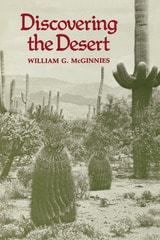
Discovering the Desert
The Legacy of the Carnegie Desert Botanical LaboratoryWilliam G. McGinnies
University of Arizona Press, 1981
Now you can share the experiences of the first U.S. scientists who set about discovering the nature of North American deserts. "This is a fascinating account of how these pioneer ecologists laid the foundations for our modern knowledge of plant adaptation to desert environments. . . . It is well done." (American Scientist)
[more]
Food, Fiber, and the Arid Lands
Edited by William G. McGinnies, Bram J. Goldman, and Patricia G. Paylore
University of Arizona Press, 1971
From the Foreword:
The world’s dramatic awakening to the impact of ecology on the quality of human life, and a new awareness of the potential for exploitation of the desert environment—in which our particular interest lies—give rise to more thoughtful, even sober, attention to the problems faced by those aspiring only to bigger yields from crops and more protein from animals. To these very basic needs of food and fiber, we are, therefore, addressing ourselves further to a consideration of housing, educational programs, and nonagrarian resource evolution, to the end that the planners and the decision makers may have the benefit of the most intelligent and contemporary understanding possible of the cultural and social aspects of arid lands as well as the latest technological advances on a wide-ranging spectrum of scientific developments.
The world’s dramatic awakening to the impact of ecology on the quality of human life, and a new awareness of the potential for exploitation of the desert environment—in which our particular interest lies—give rise to more thoughtful, even sober, attention to the problems faced by those aspiring only to bigger yields from crops and more protein from animals. To these very basic needs of food and fiber, we are, therefore, addressing ourselves further to a consideration of housing, educational programs, and nonagrarian resource evolution, to the end that the planners and the decision makers may have the benefit of the most intelligent and contemporary understanding possible of the cultural and social aspects of arid lands as well as the latest technological advances on a wide-ranging spectrum of scientific developments.
[more]