Results by title
2 books match the query 'McLaughlin, Greg'
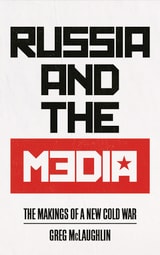
Russia and the Media
The Makings of a New Cold WarGreg McLaughlin
Pluto Press, 2020
President Vladimir Putin is a figure of both fear and fascination in the Western imagination. In the minds of media pundits and commentators, he personifies Russia itself - a country riven with contradictions, enthralling and yet always a threat to world peace.
But recent propaganda images that define public debate around growing tensions with Russia are not new or arbitrary. Russia and the Media asks, what is the role of Western journalism in constructing a new kind of Cold War with Russia? Focusing on British and US media coverage of moments of crisis and of co-operation between the West and Russia, McLaughlin exposes how such a Cold War framework shapes public perceptions of a major, hostile power reasserting itself on the world stage.
Scrutinizing events such as the Ukraine/Crimea crisis, the Skripal Poisoning and Russia's military intervention in Syria - as well as analyzing media coverage of the 2018 Russian presidential election and build up to the 2018 World Cup - Russia and the Media makes a landmark intervention at the intersection of media studies and international relations.
[more]

The British Media and Bloody Sunday
Greg McLaughlin and Stephen Baker
Intellect Books, 2015
On Bloody Sunday, January 30, 1972, British paratroopers killed thirteen innocent men in Derry. It was one of the most controversial events in the history of the Northern Ireland conflict and also one of the most mediated. The horror was recorded in newspapers and photographs, on TV news and current affairs, and in film and TV drama. In a cross media analysis that spans a period of almost forty years up to the publication of the Saville Report in 2010, The British Media and Bloody Sunday identifies two countervailing impulses in media coverage of Bloody Sunday and its legacy: an urge in the press to rescue the image and reputation of the British Army versus a troubled conscience in TV current affairs and drama about what was done in Britain’s name. In so doing, it suggests a much more complex set of representations than a straightforward propaganda analysis might allow for, one that says less about the conflict in Ireland than it does about Britain, with its loss of empire and its crisis of national identity.
[more]