Results by title

3 books match the query 'McLeod, Kembrew'
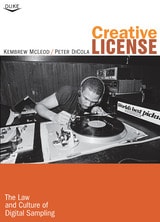
cover of Creative License: The Law and Culture of Digital Sampling

Creative License

The Law and Culture of Digital Sampling

Kembrew McLeod and Peter DiCola

Duke University Press, 2011

How did the Depression-era folk-song collector Alan Lomax end up with a songwriting credit on Jay-Z’s song “Takeover”? Why doesn’t Clyde Stubblefield, the primary drummer on James Brown recordings from the late 1960s such as “Funky Drummer” and “Cold Sweat,” get paid for other musicians’ frequent use of the beats he performed on those songs? The music industry’s approach to digital sampling—the act of incorporating snippets of existing recordings into new ones—holds the answers. Exploring the complexities and contradictions in how samples are licensed, Kembrew McLeod and Peter DiCola interviewed more than 100 musicians, managers, lawyers, industry professionals, journalists, and scholars. Based on those interviews, Creative License puts digital sampling into historical, cultural, and legal context. It describes hip-hop during its sample-heavy golden age in the 1980s and early 1990s, the lawsuits that shaped U.S. copyright law on sampling, and the labyrinthine licensing process that musicians must now navigate. The authors argue that the current system for licensing samples is inefficient and limits creativity. For instance, by estimating the present-day licensing fees for the Beastie Boys’ Paul’s Boutique (1989) and Public Enemy’s Fear of a Black Planet (1990), two albums from hip-hop’s golden age, the authors show that neither album could be released commercially today. Observing that the same dynamics that create problems for remixers now reverberate throughout all culture industries, the authors conclude by examining ideas for reform.

Interviewees include David Byrne, Cee Lo Green, George Clinton, De La Soul, DJ Premier, DJ Qbert, Eclectic Method, El-P, Girl Talk, Matmos, Mix Master Mike, Negativland, Public Enemy, RZA, Clyde Stubblefield, T.S. Monk.
[more]
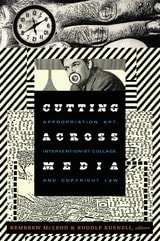
cover of Cutting Across Media: Appropriation Art, Interventionist Collage, and Copyright Law

Cutting Across Media

Appropriation Art, Interventionist Collage, and Copyright Law

Kembrew McLeod and Rudolf Kuenzli, eds.

Duke University Press, 2011

In this collection of essays, leading academics, critics, and artists historicize collage and appropriation tactics that cut across diverse media and genres. They take up issues of appropriation in the popular and the avant-garde, in altered billboards and the work of the renowned painter Chris Ofili, in hip-hop and the compositions of Béla Bartók and Zoltán Kodály, and in audio mash-ups, remixed news broadcasts, pranks, culture jamming, and numerous other cultural forms. The borrowing practices that they consider often run afoul of intellectual property regimes, and many of the contributors address the effects of copyright and trademark law on creativity. Among the contributors are the novelist and essayist Jonathan Lethem, the poet and cultural critic Joshua Clover, the filmmaker Craig Baldwin, the hip-hop historian Jeff Chang, the ’zine-maker and sound collage artist Lloyd Dunn, and Negativland, the infamous collective that was sued in 1991 for sampling U2 in a satirical sound collage. Cutting Across Media is both a serious examination of collage and appropriation practices and a celebration of their transformative political and cultural possibilities.

Contributors. Craig Baldwin, David Banash, Marcus Boon, Jeff Chang, Joshua Clover, Lorraine Morales Cox, Lloyd Dunn, Philo T. Farnsworth, Pierre Joris, Douglas Kahn, Rudolf Kuenzli, Rob Latham, Jonathan Lethem, Carrie McLaren, Kembrew McLeod, Negativland, Davis Schneiderman, David Tetzlaff, Gábor Vályi, Warner Special Products, Eva Hemmungs Wirtén
[more]
cover of Freedom of Expression: Resistance and Repression in the Age of Intellectual Property

Freedom of Expression

Resistance and Repression in the Age of Intellectual Property

Kembrew McLeod

University of Minnesota Press, 2007

Freedom of Expression® covers the ways in which intellectual property laws have been used to privatize all forms of expression—from guitar riffs and Donald Trump’s “you’re fired” gesture to human genes and public space—and in the process stifle creative expression. Kembrew McLeod challenges the blind embrace of privatization as it clashes against our right to free speech and shared resources.

Kembrew McLeod is professor of communication studies at the University of Iowa, author of Owning Culture: Authorship, Ownership, and Intellectual Property Law, and coproducer of the documentary Copyright Criminals: This Is a Sampling Sport.

Lawrence Lessig is professor of law at Stanford Law School.

This book’s documentary companion will be available through Media Education Foundation.

[more]