Results by title
4 books match the query 'McLuhan, Marshall'
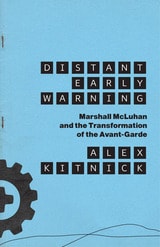
Distant Early Warning
Marshall McLuhan and the Transformation of the Avant-GardeAlex Kitnick
University of Chicago Press, 2021
Marshall McLuhan (1911–1980) is best known as a media theorist—many consider him the founder of media studies—but he was also an important theorist of art. Though a near-household name for decades due to magazine interviews and TV specials, McLuhan remains an underappreciated yet fascinating figure in art history. His connections with the art of his own time were largely unexplored, until now. In Distant Early Warning, art historian Alex Kitnick delves into these rich connections and argues both that McLuhan was influenced by art and artists and, more surprisingly, that McLuhan’s work directly influenced the art and artists of his time.
Kitnick builds the story of McLuhan’s entanglement with artists by carefully drawing out the connections among McLuhan, his theories, and the artists themselves. The story is packed with big names: Marcel Duchamp, Niki de Saint Phalle, Jasper Johns, Andy Warhol, Nam June Paik, and others. Kitnick masterfully weaves this history with McLuhan’s own words and his provocative ideas about what art is and what artists should do, revealing McLuhan’s influence on the avant-garde through the confluence of art and theory. The illuminating result sheds light on new aspects of McLuhan, showing him not just as a theorist, or an influencer, but as a richly multifaceted figure who, among his many other accolades, affected multiple generations of artists and their works. The book finishes with Kitnick overlaying McLuhan’s ethos onto the state of contemporary and post-internet art. This final channeling of McLuhan is a swift and beautiful analysis, with a personal touch, of art’s recent transgressions and what its future may hold.
Kitnick builds the story of McLuhan’s entanglement with artists by carefully drawing out the connections among McLuhan, his theories, and the artists themselves. The story is packed with big names: Marcel Duchamp, Niki de Saint Phalle, Jasper Johns, Andy Warhol, Nam June Paik, and others. Kitnick masterfully weaves this history with McLuhan’s own words and his provocative ideas about what art is and what artists should do, revealing McLuhan’s influence on the avant-garde through the confluence of art and theory. The illuminating result sheds light on new aspects of McLuhan, showing him not just as a theorist, or an influencer, but as a richly multifaceted figure who, among his many other accolades, affected multiple generations of artists and their works. The book finishes with Kitnick overlaying McLuhan’s ethos onto the state of contemporary and post-internet art. This final channeling of McLuhan is a swift and beautiful analysis, with a personal touch, of art’s recent transgressions and what its future may hold.
[more]

Global Village
Dead Or Alive?Edited by Ray B. Browne and Marshall W. Fishwick
University of Wisconsin Press, 1999
In a world that is witnessing the explosive forces of individualism, tribalism, cultism, religion, nationalism, and regionalism, can the “global village” concept as envisioned by Marshall McLuhan have any meaning or hope for fruition? Do the media merely electronically override the stronger forces of basic human expression without in any way changing them?
The Global Village offers fifteen essays by leading scholars and thinkers who weigh the pros and cons and come up with individual conclusions as well as a consensus. Included are “Turning McLuhan on His Head” by James E. Grunig, “The Vanishing Global Village” by Ray B. Browne, and “Global Village—Writ Small” by Marshall Fishwick. This book speaks to concerns in journalism, media, popular culture, and communications.
The Global Village offers fifteen essays by leading scholars and thinkers who weigh the pros and cons and come up with individual conclusions as well as a consensus. Included are “Turning McLuhan on His Head” by James E. Grunig, “The Vanishing Global Village” by Ray B. Browne, and “Global Village—Writ Small” by Marshall Fishwick. This book speaks to concerns in journalism, media, popular culture, and communications.
[more]
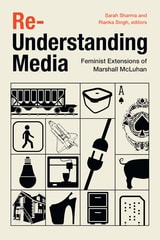
Re-Understanding Media
Feminist Extensions of Marshall McLuhanSarah Sharma and Rianka Singha, editors
Duke University Press, 2022
The contributors to Re-Understanding Media advance a feminist version of Marshall McLuhan’s key text, Understanding Media: The Extensions of Man, repurposing his insight that “the medium is the message” for feminist ends. They argue that while McLuhan’s theory provides a falsely universalizing conception of the technological as a structuring form of power, feminist critics can take it up to show how technologies alter and determine the social experiences of race, gender, class, and sexuality. This volume showcases essays, experimental writings, and interviews from media studies scholars, artists, activists, and those who work with and create technology. Among other topics, the contributors extend McLuhan’s discussion of transportation technology to the attics and cargo boxes that moved Black women through the Underground Railroad, apply McLuhan’s concept of media as extensions of humans to analyze Tupperware as media of containment, and take up 3D printing as a feminist and decolonial practice. The volume demonstrates how power dynamics are built into technological media and how media can be harnessed for radical purposes.
Contributors. Nasma Ahmed, Morehshin Allahyari, Sarah Banet-Weiser, Wendy Hui Kyong Chun, Brooke Erin Duffy, Ganaele Langlois, Sara Martel, Shannon Mattern, Cait McKinney, Jeremy Packer, Craig Robertson, Sarah Sharma, Ladan Siad, Rianka Singh, Nicholas Taylor, Armond R. Towns, and Jennifer Wemigwans
Contributors. Nasma Ahmed, Morehshin Allahyari, Sarah Banet-Weiser, Wendy Hui Kyong Chun, Brooke Erin Duffy, Ganaele Langlois, Sara Martel, Shannon Mattern, Cait McKinney, Jeremy Packer, Craig Robertson, Sarah Sharma, Ladan Siad, Rianka Singh, Nicholas Taylor, Armond R. Towns, and Jennifer Wemigwans
[more]

Taking Up McLuhan's Cause
Perspectives on Media and Formal CausalityEdited by Corey Anton, Robert K. Logan, and Lance Strate
Intellect Books, 2017
This book brings together a number of prominent scholars to explore a relatively under-studied area of Marshall McLuhan’s thought: his idea of formal cause and the role that formal cause plays in the emergence of new technologies and in structuring societal relations. Aiming to open a new way of understanding McLuhan’s thought in this area, and to provide methodological grounding for future media ecology research, the book runs the gamut, from contributions that directly support McLuhan’s arguments to those that see in them the germs of future developments in emergent dynamics and complexity theory.
[more]