Results by title
3 books match the query 'McNamara, Robert'
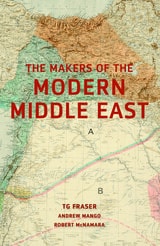
Making the Modern Middle East
Second EditionT.G. Fraser, Andrew Mango, and Robert McNamara
Gingko, 2015
A century ago, as World War I got underway, the Middle East was dominated, as it had been for centuries, by the Ottoman Empire. But by 1923, its political shape had changed beyond recognition, as the collapse of the Ottoman Empire and the insistent claims of Arab and Turkish nationalism and Zionism led to a redrawing of borders and shuffling of alliances—a transformation whose consequences are still felt today.
This fully revised and updated second edition of The Makers of the Modern Middle East traces those changes and the ensuing history of the region through the rest of the twentieth century and on to the present. Focusing in particular on three leaders—Emir Feisal, Mustafa Kemal, and Chaim Weizmann—the book offers a clear, authoritative account of the region seen from a transnational perspective, one that enables readers to understand its complex history and the way it affects present-day events.
This fully revised and updated second edition of The Makers of the Modern Middle East traces those changes and the ensuing history of the region through the rest of the twentieth century and on to the present. Focusing in particular on three leaders—Emir Feisal, Mustafa Kemal, and Chaim Weizmann—the book offers a clear, authoritative account of the region seen from a transnational perspective, one that enables readers to understand its complex history and the way it affects present-day events.
[more]
The Hashemites
The Dream of ArabiaRobert McNamara
Haus Publishing, 2010
The story of the Arab Revolt and the Hashemite princes who led it during the First World War is inextricably linked in modern eyes to the legend of Lawrence of Arabia as portrayed in David Lean's 1962 film. But behind this romantic image lies a harsher reality of wartime expediency, double-dealing and dynastic ambition, which shaped the modern Middle East and laid the foundations of many of the conflicts that rack the region to this day. Arab nationalists claim that British instigation for the Arab Revolt against the Ottoman Empire was a commitment to independence for the Arab people, but in this book Robert McNamara shows how the British cultivated the Hashemite Sherifs of Mecca more as an alternative focus during the First World War for Muslim loyalty from the Ottoman Sultan, who as Caliph had declared a jihad against the Allies when the Turks joined the Central Powers, than a leader of an independent and united Arabia. At the same time, the Sykes-Picot Agreement divided up the Middle East between British and French spheres of influence. The sense of betrayal that this caused has coloured Arab nationalists' views of the West ever since. The main countries of the Middle East —Jordan, Syria and Iraq—are all the creations of the post-First World War settlement worked out at the Paris Peace Conference. The story of the Hashemite dynasty at the Paris Peace Conference is the story of the birth of the modern history of a region that is now more than ever at the centre of world affairs.
[more]
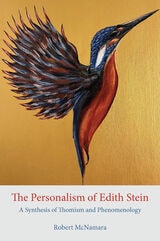
The Personalism of Edith Stein
A Synthesis of Thomism and PhenomenologyRobert McNamara
Catholic University of America Press, 2023
Edith Stein’s life and thought intersect with many important movements of life and thought in the twentieth century. Through her life and eventual martyrdom, she gave witness to the primacy of truth and faith in the face of political totalitarianism, and in her philosophical works, she contributed to a synthesis of phenomenological thought with the thought of Aquinas, while also progressively advancing a compelling form of philosophical personalism. As a result, Stein represents one of the most important Catholic thinkers of the twentieth century and is a figure of growing fascination and devotion among believers and nonbelievers alike.
The Personalism of Edith Stein is an investigation of Stein’s mature philosophical anthropology, exploring her engagement with the thought of Aquinas and Thomism while maintaining the phenomenological mode of investigation. Through a careful examination of Stein’s later works under the themes of human nature, the human individual, and the human being’s relation to God, McNamara shows that Stein’s mature personalism is considerably expanded and substantiated by her assimilation of key anthropological and metaphysical teachings of Aquinas and Thomism, and, conversely, that Stein significantly develops and deepens these same teachings through a phenomenological reconsideration of each from a personalist perspective.
As a whole, the study reveals the profound accord between Stein’s mature thought and the received teachings of Aquinas, while yet carefully attending to the remaining differences between them. Ultimately, the author proposes that Stein imbues the teachings of Aquinas with a fundamental personalization such that her mature anthropology can be understood as a Thomistically informed personalism that represents a significant, original contribution to the anthropological dimension of the philosophia perennis.
[more]