Results by title
5 books match the query 'McPherson, James M.'
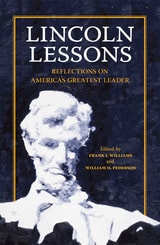
Lincoln Lessons
Reflections on America's Greatest LeaderEdited by Frank J. Williams and William D. Pederson
Southern Illinois University Press, 2009
In Lincoln Lessons, seventeen of today’s most respected academics, historians, lawyers, and politicians provide candid reflections on the importance of Abraham Lincoln in their intellectual lives. Their essays, gathered by editors Frank J. Williams and William D. Pederson, shed new light on this political icon’s remarkable ability to lead and inspire two hundred years after his birth.
Collected here are glimpses into Lincoln’s unique ability to transform enemies into steadfast allies, his deeply ingrained sense of morality and intuitive understanding of humanity, his civil deification as the first assassinated American president, and his controversial suspension of habeas corpus during the Civil War. The contributors also discuss Lincoln’s influence on today’s emerging democracies, his lasting impact on African American history, and his often-overlooked international legend—his power to instigate change beyond the boundaries of his native nation. While some contributors provide a scholarly look at Lincoln and some take a more personal approach, all explore his formative influence in their lives. What emerges is the true history of his legacy in the form of first-person testaments from those whom he has touched deeply.
Lincoln Lessons brings together some of the best voices of our time in a unique combination of memoir and history. This singular volume of original essays is a tribute to the enduring inspirational powers of an extraordinary man whose courage and leadership continue to change lives today.
Contributors
Jean H. Baker
Mario M. Cuomo
Joan L. Flinspach
Sara Vaughn Gabbard
Doris Kearns Goodwin
Harold Holzer
Harry V. Jaffa
John F. Marszalek
James M. McPherson
Edna Greene Medford
Sandra Day O’Connor
Mackubin Thomas Owens
William D. Pederson
Edward Steers Jr.
Craig L. Symonds
Thomas Reed Turner
Frank J. Williams
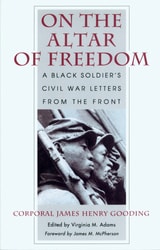
On the Altar of Freedom
A Black Soldier’s Civil War Letters from the FrontJames Henry Gooding
University of Massachusetts Press, 1991
From basic training at Camp Meigs in Readville, Massachusetts, through campaigns in Georgia, South Carolina, and Florida, Gooding faithfully records the activities of the 54th, including the legendary storming of Fort Wagner. He also voices the injustice felt by soldiers of his regiment over the issue of unequal pay, the refusal to promote deserving black enlistees to officer rank, and the deeply ingrained racism of whites in both the North and South.
Wounded and captured during the battle of Olustee, Florida, in February 1864, Gooding died later that year in Andersonville Prison.
In her introduction, Virginia M. Adams provides biographical details on Gooding's life and examines the antebellum history of New Bedford's large and articulate community of free blacks.
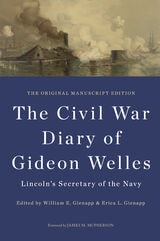
The Civil War Diary of Gideon Welles, Lincoln's Secretary of the Navy
The Original Manuscript EditionGideon Welles, Edited by William E. Gienapp and Erica L. Gienapp; Foreword by James M. McPherson
University of Illinois Press, 2014
Perhaps the hardest-working member of the cabinet, Welles still found time to keep a detailed diary that has become one of the key documents for understanding the inner workings of the Lincoln administration. In this new edition, William E. and Erica L. Gienapp have restored Welles’s original observations, gleaned from the manuscript diaries at the Library of Congress and freed from his many later revisions, so that the reader can experience what he wrote in the moment. With his vitriolic pen, Welles captures the bitter disputes over strategy and war aims, lacerates colleagues from Secretary of State William H. Seward to General-in-Chief Henry Halleck, and condemns the actions of the self-serving southern elite he sees as responsible for the war. He just as easily waxes eloquent about the Navy's wartime achievements, extols the virtues of Lincoln, and drops in a tidbit of Washington gossip.
Carefully edited and extensively annotated, this edition contains a wealth of supplementary material. The appendixes include short biographies of the members of Lincoln’s cabinet, the retrospective Welles wrote after leaving office covering the period missing from the diary proper, and important letters regarding naval matters and international law.
The Historian behind the History
Conversations with Southern HistoriansMegan L. Bever
University of Alabama Press, 2014
The historians and their main topics include:
Richard J. M. Blackett on antebellum and African American history
Dan T. Carter on Reconstruction, Civil Rights, and George Wallace
Pete Daniel on the New Deal and the Cold War South
Laura F. Edwards on the Early Republic, the Civil War, Reconstruction, and women’s history
William W. Freehling on the antebellum South
Gary W. Gallagher on the Civil War
Glenda Elizabeth Gilmore on Jim Crow
James M. McPherson on the Civil War
Theodore Rosengarten on the Depression
J. Mills Thornton III on the antebellum South
In his introduction, award-winning author and historian George C. Rable draws together the multifaceted themes of these interviews, offering a compelling overview of the nature of the field. Edited by Megan L. Bever and Scott A. Suarez, The Historian behind the History offers critical insights about the craft and professional life of the historian.

We Cannot Escape History
Lincoln and the Last Best Hope of EarthEdited by James M. McPherson
University of Illinois Press, 1995
A who's who of Lincoln scholars explores why Lincoln considered the Union the "last best hope of earth" and how his words and deeds have continued to shape the nation through modern times. Focusing on Lincoln's view of American history and his legacy for the United States and the world, this volume demonstrates the complexity of the problems Lincoln faced and the genius of his leadership in preserving the nation while purging it of slavery.