Results by title
6 books match the query 'McWilliams, Tennant'
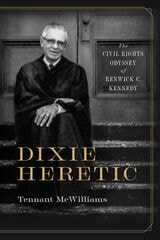
Dixie Heretic
The Civil Rights Odyssey of Renwick C. KennedyTennant McWilliams
University of Alabama Press, 2023
A life-and-times biography of the minister and social reformer Renwick C. Kennedy
Drawn from some 5,000 letters, six decades of daily-diary writings, and extensive interviews, Dixie Heretic: The Civil Rights Odyssey of Renwick C. Kennedy offers a life-and-times biography of the Alabama Black Belt minister, Renwick C. Kennedy (1900–1985). Here, Tennant McWilliams gives an unvarnished account of Kennedy’s tortuous efforts to make his congregants and other southern whites “better Christians.”
Kennedy came from “upcountry” South Carolina, a place rife with Scotch-Irish Associate Reformed Presbyterians—people of biblical infallibility and individual piety and salvation. In 1927, after a life-changing theology education at Princeton, he moved to Camden, Alabama, county seat of Wilcox County. There, he came to believe that God had a mandate for him: to change the “Half Christian” conservative, and the often violent, racial behaviors around him. As a neo-orthodox Protestant, Kennedy never rejected literal approaches to the Bible. Still, out of the “Full Christian” Social Gospel, he urged changed racial behavior. Ultimately this led him to publish confrontational short stories and essays in Christian Century and New Republic—most set in fictitious “Yaupon County.”
In World War II, Kennedy served as a chaplain with the famed 102nd Evacuation Hospital. He came home hoping the Allied victory would spur Americans to fight racial segregation just as they had fought racial fascism in Europe. The 1948 Dixiecrat movement dashed these hopes, turning much of his neo-orthodox optimism to cynicism. His hope found fleeting resurgence in the civil rights movement, and saw Kennedy quietly leading desegregation of Troy University, where he was an administrator. But the era’s assassinations, combined with George Wallace and the rise of southern white Republicans, regularly returned him to the frustrated hopes of 1948 and fostered a pessimism about truly changed hearts that he took to his grave in 1985.
Fairhope, 1894–1954
The Story of a Single Tax ColonyPaul E. Alyea and Blanche R. Alyea, With a New Introduction by Tennant McWilliams
University of Alabama Press, 2022
The remarkable and improbable story of the utopian single-tax social experiment that gave rise to one of the most unique and colorful communities along the Gulf Coast
Paul E. and Blanche R. Alyea’s Fairhope, 1894–1954, first published in 1954, is the history of this unique and improbable community and the single-tax social experiment that gave rise to it. This new edition offers an introduction by historian and Fairhope resident Tennant McWilliams, giving invaluable context and entertaining anecdotes not just regarding Fairhope’s founding but about the Alyeas themselves—all to the abiding value of their story for today’s residents and visitors.
On November 15, 1894, a small group of men and women met on a remote stretch of Mobile Bay’s eastern shore to establish a colony. It was a decidedly utopian undertaking in a period characterized by many similar social experiments and ideal communities, most of them failures. This group, which gathered at “Stapleton’s pasture” to found Fairhope, hoped to demonstrate the benefits of the single tax as a means of curing social and economic evils, making a practical test of the doctrines of economist Henry George.
Today, the wealth of parks, public and private schools, art galleries, and restaurants, combined with quaint shops and residential areas and a vibrant nautical life, all attest to Fairhope’s unique position among many older communities in the same region. Its residents represent a diverse array of interests and talents, and with a strong civic regard for individualism and creativity, Fairhope is also a haven for painters, potters, writers, and musicians.
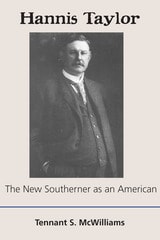
Hannis Taylor
The New Southerner as an AmericanTennant McWilliams
University of Alabama Press, 1978
During the late nineteenth and early twentieth centuries, American life took on contradictions that were later to surface with considerable poignancy. While many publicists and politicians foresaw an America of harmony and great opportunity, they also clung tenaciously to such doctrines as Anglo-Saxon racial superiority and the righteousness of liberal capitalism-notions that worked to defeat the progress they espoused. Here is a study of one of those persons, Hannis Taylor.
For a number of reasons Taylor’s life is uniquely useful for the historian interested in the paradoxes of American life at the turn of the century. Unlike many others of the era who have been examined through biography, Taylor pursued the multifaceted career of practicing attorney, constitutional historian, journalist, diplomat, and ever-aspiring politician. Hence he had occasion to write and speak on almost every intellectual and popular issue of the period. His record serves as a microcosm of many of the contradictions spanning American thought during that time. Further, Taylor was a Southerner. Before moving to Washington, D.C. in 1902, Taylor had grown up in a North Carolina torn by the Civil War and had taken an active role in Alabama affairs during the three decades following Reconstruction. His life shows how a proponent of the New South creed could move easily to advocate the nationalistic foreign and domestic policies often associated with Theodore Roosevelt. Finally, from a humanistic standpoint Taylor's life permits a study in human strivings for achievement. American historiography gravitates to the successful; here is an account of a more common stereotype, the man who worked relentlessly at becoming a noted American by supporting popular causes and who failed tragically.
Iberville's Gulf Journals
Pierre Le Moyne d'Iberville, translated by Richebourg Gaillard McWilliams
University of Alabama Press, 1991
Europe's expansion into the New World during the 16th, 17th, and 18th centuries was a story of power alignment and cultural transmission as well as dramatic individual effort. Spain had her conquistadores, France her coureurs de bois, and England her sea dogs. Isolated from the authority of home governments, tempted by the abundance of gold, fur, and fish in the New World, these adventurers so vital to national policies of expansion developed their own personal creeds of conquest and colonization. Their individual exploits not only represent a humanistic theme essential in Europe's movement westward but heighten the analyses of cultural institutions of the era. It is within such a multidisciplinary light that one can experience the Gulf Coast adventures of Pierre LeMoyne d'Iberville.
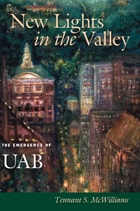
New Lights in the Valley
The Emergence of UABTennant S. McWilliams
University of Alabama Press, 2007
A scholarly narrative of UAB from its nascent beginnings through the mid 1990s.
While the economy and culture of the post—World War II South changed from an era of material capital (e.g., cotton and iron ore) to a period of social capital (intellectual development and networked approaches to social change), one of the most important components of urban life, the university, emerged as both a creator and a reflector of such modernization.
This is the case with Birmingham and its youthful institution of higher learning, the University of Alabama at Birmingham. From its early days as a struggling offshoot of the capstone campus in Tuscaloosa, UAB’s journey to its current status as a major university has been a bumpy but interesting one. Tennant McWilliams, a longtime UAB history professor, explores the whole range of historical considerations, including UAB’s similarities and connections to trans-Atlantic civic universities; the irony of the shift from Big Steel to Big Medicine in Birmingham; the visionary administrations of Joseph F. Volker and others; and the evolving decision to make non-medical life at UAB less of a commuter experience and more of a traditional campus experience.
McWilliams does not palliate the missteps and disputes that have, from time to time, impeded the institution’s progress. But he explains why, despite various hurdles and distractions, UAB has risen to be Alabama’s largest employer and can rightly boast that its complex of health care services, especially organ transplantation and neuroscience, as well as such fields as philosophy and psychology, are among the best in the nation.
The New South Faces the World
Foreign Affairs and the Southern Sense of Self,1877-1950Tennant S. McWilliams
University of Alabama Press, 2007