Results by title
5 books match the query 'MeToo movement'
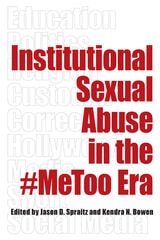
Institutional Sexual Abuse in the #MeToo Era
Edited by Jason D. Spraitz and Kendra N. Bowen
Southern Illinois University Press, 2021
Examining the evolving reach of the #MeToo Movement
In this timely and important collection, editors Jason D. Spraitz and Kendra N. Bowen bring together the work of contributors in the fields of criminal justice and criminology, sociology, journalism, and communications. These chapters show #MeToo is not only a support network of victims’ voices and testimonies but also a revolutionary interrogation of policies, power imbalances, and ethical failures that resulted in decades-long cover-ups and institutions structured to ensure continued abuse. This book reveals #MeToo as so much more than a hashtag.
Contributors discuss how #MeToo has altered the landscape of higher education; detail a political history of sexual abuse in the United States and the UK; discuss a recent grand jury report about religious institutions; and address the foster care and correctional systems. Hollywood instances are noted for their fear of retaliation among victims and continued accolades for alleged abusers. In sports, contributors examine the Jerry Sandusky scandal and the abuse by Larry Nassar. Advertising and journalism are scrutinized for covering the #MeToo disclosures while dealing with their own scandals. Finally, social media platforms are investigated for harassment and threats of violent victimization.
Drawing on the general framework of the #MeToo Movement, contributors look at complex and very different institutions—athletics, academia, religion, politics, justice, childcare, social media, and entertainment. Contributors include revelatory case studies to ensure we hear the victims’ voices; bring to light the complicity and negligence of social institutions; and advocate for systemic solutions to institutional sexual abuse, violence, and harassment.
The Deconstruction of Sex
Jean-Luc Nancy and Irving Goh
Duke University Press, 2021
Unsafe Words
Queering Consent in the #MeToo EraShantel Gabrieal Buggs
Rutgers University Press, 2023
Telling a queerer side of the #MeToo story, Unsafe Words dares to challenge dogmatic assumptions about sex and consent while developing tools and language to promote more ethical and more pleasurable sex for everyone.

Why We Lost the Sex Wars
Sexual Freedom in the #MeToo EraLorna N. Bracewell
University of Minnesota Press, 2021
Reexamining feminist sexual politics since the 1970s—the rivalries and the remarkable alliances
Since the historic #MeToo movement materialized in 2017, innumerable survivors of sexual assault and misconduct have broken their silence and called out their abusers publicly—from well-known celebrities to politicians and high-profile business leaders. Not surprisingly, conservatives quickly opposed this new movement, but the fact that “sex positive” progressives joined in the opposition was unexpected and seldom discussed. Why We Lost the Sex Wars explores how a narrow set of political prospects for resisting the use of sex as a tool of domination came to be embraced across this broad swath of the political spectrum in the contemporary United States.
To better understand today’s multilayered sexual politics, Lorna N. Bracewell offers a revisionist history of the “sex wars” of the 1970s, ’80s, and ’90s. Rather than focusing on what divided antipornography and sex-radical feminists, Bracewell highlights significant points of contact and overlap between these rivals, particularly the trenchant challenges they offered to the narrow and ambivalent sexual politics of postwar liberalism. Bracewell leverages this recovered history to illuminate in fresh and provocative ways a range of current phenomena, including recent controversies over trigger warnings, the unimaginative politics of “sex-positive” feminism, and the rise of carceral feminism. By foregrounding the role played by liberal concepts such as expressive freedom and the public/private divide as well as the long-neglected contributions of Black and “Third World” feminists, Bracewell upends much of what we think we know about the sex wars and makes a strong case for the continued relevance of these debates today.
Why We Lost the Sex Wars provides a history of feminist thinking on topics such as pornography, commercial sex work, LGBTQ+ identities, and BDSM, as well as discussions of such notable figures as Patrick Califia, Alan Dershowitz, Andrea Dworkin, Elena Kagan, Audre Lorde, Catharine MacKinnon, Cherríe Moraga, Robin Morgan, Gayle Rubin, Nadine Strossen, Cass Sunstein, and Alice Walker.
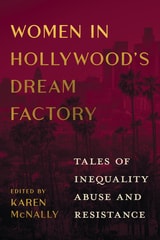
Women in Hollywood's Dream Factory
Tales of Inequality, Abuse, and ResistanceEdited by Karen McNally
University of Illinois Press, 2026
The #MeToo revelations put a twenty-first-century stamp on the age-old story of women’s mistreatment in Hollywood. Karen McNally edits a collection focused on examining and revising film history in the aftermath of the women’s stories, past and present, that have come to light.
The collection begins with essays on the interplay between reality and imagination in narratives and representations of women’s experiences of unequal treatment. In Part 2, contributors discuss how the gendered attitudes of the media’s stories enable inequality in Hollywood and look at the forces that arise whenever women resist these media assaults. The next section addresses the structures that built the inequalities and mistreatment while Part 4 revisits established narratives to challenge, renew, and expand upon our understanding of film history through women’s stories. Essays in the final section address the combination of inequality and resistance that defines women’s experiences in Hollywood.
Piercing and astute, Women in Hollywood’s Dream Factory confronts our perception of Hollywood as a mythological land of dreams.
Contributors: Alicia Byrnes, Anna M. Dempsey, Harriet Fletcher, Amanda Konkle, Tamar Jeffers McDonald, Kerry McElroy, Adrienne L. McLean, Karen McNally, Donna Peberdy, Melanie Piper, Victoria K. Pistivsek, Sarah Polley, Ina C. Seethaler, Gabrielle Stecher, and Jennifer Voss