Results by title
3 books match the query 'Meaning (Philosophy) in literature'
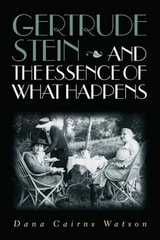
Gertrude Stein and the Essence of What Happens
Dana Cairns Watson
Vanderbilt University Press, 2005
Seeking to sustain Stein's lively, pleasant, populist spirit, Watson shows how the writer's playful entanglement of sight and sound--of silent reading and social speaking--reveals the crucial ambiguity by which reading and conversation build communities of meaning, and thus form not only personal relationships but also our very selves and the larger political structures we inhabit. Stein reminds us that the residual properties of words and the implications behind the give-and-take of ordinary conversation offer alternatives to linear structures of social order, alternatives especially precious in times of political oppression. For example, her novels Mrs. Reynolds and Brewsie and Willie, both written in embattled Vichy France, contemplate the speech patterns of totalitarian leaders and the ways in which everyday discourse might capitulate to--or resist--such verbal tyranny.
Like recent theorists, Stein recognized the repressiveness of conventional order--carried in language and thus in thought and social organization--but as Watson persuasively shows, she also insisted that the free will of individuals can persist in language and enable change. In the play of literary aesthetics, Stein saw a liberating force.
Interruptions
The Fragmentary Aesthetic in Modern LiteratureGerald L. Bruns
University of Alabama Press, 2018
A history of fragmentary—or interrupted—writing in avant-garde poetry and prose by a renowned literary critic.
In Interruptions: The Fragmentary Aesthetic in Modern Literature, Gerald L. Bruns explores the effects of parataxis, or fragmentary writing as a device in modern literature. Bruns focuses on texts that refuse to follow the traditional logic of sequential narrative. He explores numerous examples of self-interrupting composition, starting with Friedrich Schlegel's inaugural theory and practice of the fragment as an assertion of the autonomy of words, and their freedom from rule-governed hierarchies.
Bruns opens the book with a short history of the fragment as a distinctive feature of literary modernism in works from Gertrude Stein to Paul Celan to present-day authors. The study progresses to the later work of Maurice Blanchot and Samuel Beckett, and argues, controversially, that Blanchot's writings on the fragment during the 1950s and early 1960s helped to inspire Beckett’s turn toward paratactic prose.
The study also extends to works of poetry, examining the radically paratactic arrangements of two contemporary British poets, J. H. Prynne and John Wilkinson, focusing chiefly on their most recent, and arguably most abstruse, works. Bruns also offers a close study of the poetry and poetics of Charles Bernstein.
Interruptions concludes with two chapters about James Joyce. First, Bruns tackles the language of Finnegans Wake, namely the break-up of words themselves, its reassembly into puns, neologisms, nonsense, and even random strings of letters. Second, Bruns highlights the experience of mirrors in Joyce’s fiction, particularly in Dubliners, Portrait of the Artist as a Young Man, and Ulysses, where mirrored reflections invariably serve as interruptions, discontinuities, or metaphorical displacements and proliferations of self-identity.
The Obligation Toward the Difficult Whole
Postmodernist Long PoemsBrian McHale
University of Alabama Press, 2003
Addressing subjects as wide-ranging as angelology, the court masque, pop art, caricature, the cult of the ruin, hip-hop, Spense’'s Irish policy, and the aesthetics of silence, Brian McHale pulls varied threads together to identify a repertoire of postmodernist elements characteristic of the long poems he examines.
As critic Jed Rasula explains, “McHale is wonderfully resourceful in changing the subject from chapter to chapter to fit the poems discussed, and while his approach adheres to the conventions of textual exegesis, the chapters really shine as orchestrations of issues. For instance, James Merrill’s The Changing Light at Sandover works unexpectedly well in raising the subject of found poetry and procedural composition; Melvin Tolso’'s Harlem Gallery and Edward Dorn's Gunslinger are effectively paired to demonstrate the period flavor of pastiche; Geoffrey Hill’s Mercian Hymns and Armand Schwerner’s The Tablets explode the modernist fixation with depth; John Ashbery’s work is given a nuanced reading as proto-theory; Letter to an Imaginary Friend by Thomas McGrath provides a lucid backdrop to raise the question of political efficacy in approaching language poet Bruce Andrews; and Susan Howe's The Europe of Trusts is explored for its intertextual tapestry.”
McHale shows how elements from these long poems overlap, interfere, pull in different directions, jar against, and even contradict each other; and he demonstrates how they also echo, amplify, and reinforce each other. They do not slot smoothly together like pieces in a jigsaw puzzle, but they do form (what else?) a difficult whole.