Results by title
7 books match the query 'Meat'
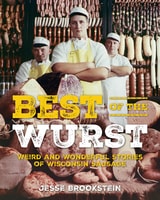
Best of the Wurst
Weird and Wonderful Stories of Wisconsin SausageJesse Brookstein
Wisconsin Historical Society Press, 2026
Sink your teeth into a big, bold, and unabashed celebration of a quintessential Wisconsin food.
Wisconsin is famous for its world-class cheeses and its “beer state” moniker. But every Wisconsinite knows that no tailgate party or backyard barbecue is complete without a grill full of sizzling hot brats. Or Polish sausages. Or good ol’ Oscar Mayer wieners. From charcuterie boards to chorizo, sausage is an essential ingredient in the state’s cultural identity. In this lively, comprehensive ode to the link, writer and storyteller Jesse Brookstein embarks on a quest to show why Wisconsin is the sausage maker to the world.
Best of the Wurst traces the long arc of sausage making in the state, starting with First Nations communities who used pemmican as a staple food source. It features subsequent immigrant groups—German, Polish, Italian, Thai, Mexican, and more—who brought their own sausage recipes and traditions, and lands squarely on today’s bustling sausage scene. A final chapter, “The Future of Sausage,” explores emerging trends, tastes, and technologies—offering a peek at what’s next for Wisconsin’s revered food.
Brookstein travels the state to meet the people behind the links and captures the culture, craft, and quirks that make Wisconsin sausages unlike those found anywhere else. Profiles of standout producers are threaded throughout, from household names like Usinger’s and Johnsonville to family-run shops that have fed communities for generations. Brookstein also highlights the professionals shaping the field today, including graduates of UW–Madison’s Master Meat Crafter Program and chefs who feature local sausage in their menus with pride.
Readers will get insights from master butchers, small-town sausage savants, big-name producers, and superfans reflecting on hotly debated topics like seasonings, casings, and the eternal question: “Should you parboil?” And memorable traditions—such as Sheboygan’s double brat on a hard roll, the ceremonial slicing of La Crosse’s Golden Brat, Madison’s world’s largest Brat Fest, and the show-stealing Milwaukee Brewers’ Famous Racing Sausages—showcase the sausage’s indelible mark on the state.
Featuring 150 color photos and packed with humor and an insider’s appreciation for the art of stuffing a perfect link, Best of the Wurst encases these stories, people, and places in a perfect blend of history and heart. Wisconsinites love eating sausages—and now you can enjoy reading about them too.
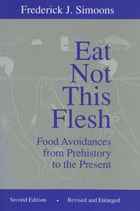
Eat Not This Flesh, 2nd Edition
Food Avoidances from Prehistory to the PresentFrederick J. Simoons
University of Wisconsin Press, 1994
Hailed as a classic when initially published in 1961, Eat Not This Flesh was the first book that explored, from a historical and cultural perspective, taboos against eating certain kinds of flesh. Frederick J. Simoons's research remains original and invaluable, the only attempt of its kind to reconstruct the origin and spread of food avoidances while challenging current Western explanations. In this expanded and updated edition, Simoons integrates new research as he examines the use and avoidance of flesh foods—including beef, pork, chicken, and eggs, camel, dog, horse, and fish—from antiquity to the present day.
Simoons suggests that Westerners are too ready, even in the absence of supporting evidence, to cite contemporary thinking about disease and environmental factors to explain why certain cultures avoid particular kinds of meat. He demonstrates how historical and archaeological evidence fails to support such explanations. He examines the origin of pork rejection in the Near East, explores the concept of the sacred cow in India and the ensuing ban on beef, and reveals how some African women abstain from chicken and eggs, fearing infertility.
While no single explanation exists for food taboos, Simoons finds that the powerful, recurrent theme of maintaining ritual purity, good health, and well-being underlies diet habits. He emphasizes that only a full range of factors can explain eating patterns, and he stresses the interplay of religious, moral, hygienic, ecological, and economic factors in the context of human culture. Maps, drawings, and photos highlighting food avoidance patterns in Africa, Asia, Europe, and the Pacific provide additional information throughout the book.
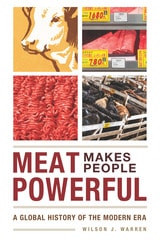
Meat Makes People Powerful
A Global History of the Modern EraWilson J. Warren
University of Iowa Press, 2018
From large-scale cattle farming to water pollution, meat— more than any other food—has had an enormous impact on our environment. Historically, Americans have been among the most avid meat-eaters in the world, but long before that meat was not even considered a key ingredient in most civilizations’ diets. Labor historian Wilson Warren, who has studied the meat industry for more than a decade, provides this global history of meat to help us understand how it entered the daily diet, and at what costs and benefits to society.
Spanning from the nineteenth century to current and future trends, Warren walks us through the economic theory of food, the discovery of protein, the Japanese eugenics debate around meat, and the environmental impact of livestock, among other topics. Through his comprehensive, multifaceted research, he provides readers with the political, economic, social, and cultural factors behind meat consumption over the last two centuries. With a special focus on East Asia, Meat Makes People Powerful reveals how national governments regulated and oversaw meat production, helping transform virtually vegetarian cultures into major meat consumers at record speed.
As more and more Americans pay attention to the sources of the meat they consume, Warren’s compelling study will help them not only better understand the industry, but also make more informed personal choices. Providing an international perspective that will appeal to scholars and nutritionists alike, this timely examination will forever change the way you see the food on your plate.

Meat and the Birth of Rome
Zooarchaeology, Foodways, and Religious RitualsVictoria C. Moses
University of Alabama Press, 2026
Meat and the Birth of Rome explores faunal remains from archaeological sites dating to the early Iron Age through early Republican period in Rome and its environs and challenges a prevailing view of Rome’s exceptionalism. Victoria C. Moses tempers the myth by illuminating the roles of meat production, distribution, and consumption and ritual sacrifice in the social hierarchy, economy, and religious practices as Rome grew. During the transformative period around the eighth century BCE, Romans conserved older foodways and their diverse ritual practices. These findings within the broader zooarchaeological data from peninsular Italy show that, despite Rome’s later success, it shared many early characteristics with its neighbors.
This compelling narrative adds to the current archaeological conversations and research on the history of the eternal city.
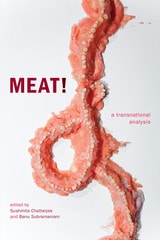
Meat!
A Transnational AnalysisSushmita Chatterjee and Banu Subramaniam, editors
Duke University Press, 2021
Contributors. Neel Ahuja, Irina Aristarkhova, Sushmita Chatterjee, Mel Y. Chen, Kim Q. Hall, Jennifer A. Hamilton, Anita Mannur, Elspeth Probyn, Parama Roy, Banu Subramaniam, Angela Willey, Psyche Williams-Forson
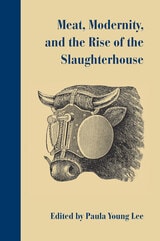
Meat, Modernity, and the Rise of the Slaughterhouse
Paula Young Lee
University of New Hampshire Press, 2008
Contributors include: Dorothee Brantz, Kyri Claflin, Jared Day, Roger Horowitz, Lindgren Johnson, Ian MacLachlan, Christopher Otter, Dominic Pacyga, Richard Perren, Jeffrey Pilcher, and Sydney Watts.
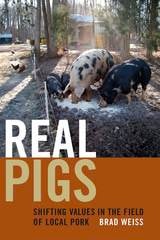
Real Pigs
Shifting Values in the Field of Local PorkBrad Weiss
Duke University Press, 2016