Results by title
5 books match the query 'Mediating'

Abjection Incorporated
Mediating the Politics of Pleasure and ViolenceMargaret Hennefeld and Nicholas Sammond, editors
Duke University Press, 2019
Contributors. Meredith Bak, Eugenie Brinkema, James Leo Cahill, Michelle Cho, Maggie Hennefeld, Rob King, Thomas Lamarre, Sylvère Lotringer, Rijuta Mehta, Mark Mulroney, Nicholas Sammond, Yiman Wang, Rebecca Wanzo
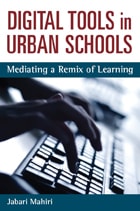
Digital Tools in Urban Schools
Mediating a Remix of LearningJabari Mahiri
University of Michigan Press, 2011
"Today there is massive interest in how digital tools and popular culture are transforming learning out of school and lots of dismay at how digitally lost our schools are. Jabari Mahiri works his usual magic and here shows us how to cross this divide in a solidly grounded and beautifully written book."
---James Paul Gee, Fulton Presidential Professor of Literacy Studies, Arizona State University
"Digital Tools in Urban Schools is a profoundly sobering yet inspiring depiction of the potential for committed educators to change the lives of urban youth, with the assistance of a new set of technical capabilities."
---Mimi Ito, Professor in Residence and MacArthur Foundation Chair in Digital Media and Learning, Departments of Informatics and Anthropology, University of California, Irvine
"An uplifting book that addresses a critical gap in existing literature by providing rich and important insights into ways teachers, administrators, and members of the wider community can work together with students previously alienated---even excluded---from formal education to enhance classroom learning with appropriate digital tools and achieve inspiring results under challenging circumstances."
---Colin Lankshear, James Cook University, and Michele Knobel, Montclair State University
Digital Tools in Urban Schools demonstrates significant ways in which high school teachers in the complex educational setting of an urban public high school in northern California extended their own professional learning to revitalize learning in their classrooms. Through a novel research collaboration between a university and this public school, these teachers were supported and guided in developing the skills necessary to take greater advantage of new media and new information sources to increase student learning while making connections to their relevant experiences and interests. Jabari Mahiri draws on extensive qualitative data---including blogs, podcasts, and other digital media---to document, describe, and analyze how the learning of both students and teachers was dramatically transformed as they utilized digital media in their classrooms. Digital Tools in Urban Schools will interest instructional leaders and participants in teacher preparation and professional development programs, education and social science researchers and scholars, graduate and undergraduate programs and classes emphasizing literacy and learning, and those focused on urban education issues and conditions.

Interpreting and Experiencing Disney
Mediating the MouseEdited by Priscilla Hobbs
Intellect Books, 2022
It would be difficult to go through life without ever encountering a Disney product. Since the first Mickey Mouse cartoon premiered in 1928, Disney has played a central role in shaping American popular culture, and it has expanded to the global market. The company positioned itself as a titan of family entertainment, and many of its offerings, from films to consumable products, have become embedded in the minds of children and adults, woven into many of our life experiences. Fans of Disney build connections with their favorite characters and franchises, fueled by Disney’s marketing practices. Others have developed a near-cult-like relationship with the brand, equating its products with religious icons and theme park visits with pilgrimages.
This edited volume looks beyond the movies and merchandise to peer into the very heart of the Disney phenomenon: how the fan response drives the corporation’s massive marketing machine and how the corporate response, in turn, shapes the fan experience.
Mediating the South Korean Other
Representations and Discourses of Difference in the Post/Neocolonial Nation-StateDavid C. Oh, Editor
University of Michigan Press, 2022
This collection brings together leading and emerging scholars of multiculturalism in Korean media culture to examine mediated constructions of the “other,” taking into account the nation’s postcolonial and neocolonial relationships and its mediated construction of self. “Anthrocategorism ,” a more nuanced translation of injongchabyeol, is proffered as a new framework for understanding difference in ways that are locally meaningful in a society and media system in which racial or even ethnic differences are not the most salient. The collection points to the construction of racial others that elevates, tolerates, and incorporates difference; the construction of valued and devalued ethnic others, and the ambivalent construction of co-ethnic others as sympathetic victims or marginalized threats.
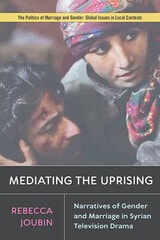
Mediating the Uprising
Narratives of Gender and Marriage in Syrian Television DramaRebecca Joubin
Rutgers University Press, 2020
While for some screenwriters a return to pre-2011 life would be welcome after so much bloodshed, others advocated profound cultural and social transformation, instead. They employed marriage and gender metaphors in the stories they wrote to engage in political critique, even at the risk of creating marketing difficulties for the shows or they created escapist stories such as transnational adaptations and Old Damascus tales. Serving as heritage preservation, Mediating the Uprising underscores that television drama creators in Syria have many ways of engaging in protest, with gender and marriage at the heart of the polemic.