Results by title
5 books match the query 'Medicaid & Medicare'

Medicare Reform
Issues and AnswersEdited by Andrew J. Rettenmaier and Thomas R. Saving
University of Chicago Press, 1999
Medicare Reform—the first volume in a new series sponsored by the George Bush School of Government and Public Policy at Texas A&M University—tackles the current Medicare predicament head-on, delving into the fundamental issues surrounding the reorganization of the system: whether to allocate Medicare's growing financial load to current workers in the form of higher taxes, shift the onus to future generations, or shortchange both the expectations and care of present recipients by substantially cutting benefits. This volume assembles a group of the most highly respected analysts of health issues to consider the economic forces impacting the surging health care market.
Written for the general reader and offering innovative ideas for policy revision along with critical new data on health care economics, this comprehensive volume provides a timely and thoughtful deliberation on the precarious future of Medicare.
"Because, as Richard Weaver once said, 'ideas have consequences,' this book is important. It will not end the debate on Medicare, but it will begin it."—Phil Gramm, from the foreword
Medicare
Intentions, Effects, and Politics, Volume 26Mark A. Peterson, ed.
Duke University Press, 0
A complete understanding of the particular and peculiar structure of Medicare can be gained only by considering the ideas, politics, and institutions of the 1960s that shaped it. With this historical perspective, the articles in this collection can move beyond partisan arguments and politically motivated reform proposals. Instead, they outline educated guidelines for improving Medicare and debunk commonly held but false assumptions about the program. In "How Not to Think about Medicare" the field’s most noted scholar, Theodore Marmor, exposes four such misconceptions, including the program’s seeming inability to control costs and ward off what some call a fiscal tsunami—the aging of the baby boomers. Other contributions address frequently overlooked functions of Medicare. While the program is known for its universal health coverage for the elderly and the disabled, for instance, Medicare also serves a crucial role in overseeing hospital performance and furthering health education. This special issue concludes with a discussion of Marmor’s recently revised classic book, The Politics of Medicare, by five leading specialists who interpret the present Medicare program in light of its original construct and current political influences.
Contributors. Michael Gusmano, Jacob Hacker, Nancy M. Kane, Stephen A. Magnus, Theodore Marmor, Jonathan Oberlander, Eric M. Patashnik, Mark A. Peterson, Mark J. Schlesinger, Carolyn Tuohy, Bruce Vladeck, Julian Zelizer
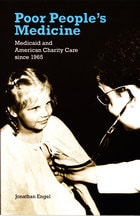
Poor People's Medicine
Medicaid and American Charity Care since 1965Jonathan Engel
Duke University Press, 2006
Starting with a brief overview of the history of charity medical care, Jonathan Engel presents the debates surrounding Medicaid’s creation and the compromises struck to allow federal funding of the nascent programs. He traces the development of Medicaid through the decades, as various states attempted to both enlarge the programs and more finely tailor them to their intended targets. At the same time, he describes how these new programs affected existing institutions and initiatives such as public hospitals, community clinics, and private pro bono clinical efforts. Along the way, Engel recounts the many political battles waged over Medicaid, particularly in relation to larger discussions about comprehensive health care and social welfare reform. Poor People’s Medicine is an invaluable resource for understanding the evolution and present state of programs to deliver health care to America’s poor.
Redesigning the Medicare Contract
Politics, Markets, and AgencyEdward F. Lawlor
University of Chicago Press, 2003
Challenging conventional ideas, Lawlor suggests that we look at Medicare as a contract between the federal government, the program's beneficiaries, and health care providers. Medicare reform, then, would involve rewriting this contract so that it more successfully serves the interests of both beneficiaries and taxpayers. To do this, Lawlor argues that we must improve the agency of the program—the informational, organizational, and incentive elements that assure Medicare program carries out beneficiary and taxpayer interests in providing the most appropriate, high-quality care possible. The book includes a chapter devoted solely to concepts and applications that give definition to this brand of agency theory. Lawlor's innovative agency approach is matched with lucid explanation of the more comprehensive groundwork in the history and politics of the Medicare program.
Lawlor's important and timely book reframes the Medicare debate in a productive manner and effectively analyzes alternatives for reform. Lawlor argues that effective policy design for Medicare requires greater appreciation of the vulnerability of beneficiaries, the complexity of the program itself, its wide geographical variations in services and financing, and the realistic possibilities for government and private sector roles. Tackling difficult problems like end-of-life and high-tech care—and offering sensible solutions—Redesigning the Medicare Contract will interest political scientists, economists, policy analysts, and health care professionals alike.
The Political Life of Medicare
Jonathan Oberlander
University of Chicago Press, 2003