Results by title
4 books match the query 'Medical Malpractice'

Dealing with Medical Malpractice
British and Swedish ExperienceMarilynn M. Rosenthal
Duke University Press, 1988
Medical Malpractice
Duncan Yaggy and Patricia Hodgson, editors
Duke University Press, 1987
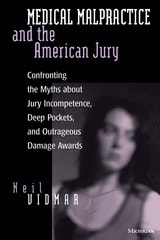
Medical Malpractice and the American Jury
Confronting the Myths about Jury Incompetence, Deep Pockets, and Outrageous Damage AwardsNeil Vidmar
University of Michigan Press, 1997
Written in a thoroughly inviting, jargon-free style, Medical Malpractice and the American Jury places those cases that go to trial in the broader context of litigation, noting that only about ten percent of malpractice cases ever result in trials. Of those that do go to trial, the author notes, more than two out of three cases are decided in the doctor's favor--repudiating the view that jurors are inherently biased against doctors and are motivated more by sympathy for the plaintiff than by the facts of the case.
Neil Vidmar comprehensively addresses all the claims that have been leveled against the performance of malpractice juries. For example, he compares actual jury decisions on negligence with neutral physicians' ratings of whether negligence occurred in the medical treatment and finds a remarkable consistency--repudiating the view that jurors are unable to understand experts or uncritically defer to their opinion.
"Medical Malpractice and the American Jury is quite simply the most compelling, comprehensive examination of the American jury system yet written. It brings reason and fact to the debate in a way that puts the lie to the many myths surrounding medical negligence cases. For anyone genuinely interested in just solutions, this book should be required reading. To act in ignorance of its findings invites disaster." --Trial
"For anyone really interested in the evidence about the daily grind of the courthouse mill, Neil Vidmar's Medical Malpractice and the American Jury is a good place to start." --Washington Post Book World
Neil Vidmar is Professor of Social Science and Law, Duke Law School, and Professor of Psychology, Duke University.
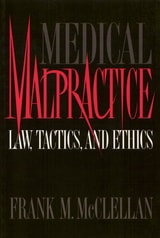
Medical Malpractice
Law, Tactics, and EthicsFrank M. McClellan
Temple University Press, 1993
From practical to philosophical considerations, this succinct, clear presentation of medical malpractice issues is a valuable resource for the classroom and the reference shelf. Frank M. McClellan illustrates the multitude of considerations that impact the merit of each case, never losing sight of the importance of preserving human dignity in malpractice lawsuits.
Early chapters urge the evaluation of legal, medical, and ethical standards, especially the Standard of Care. Part II focuses on assessing and proving compensatory and punitive damages, Part III sets out guidelines for intelligence gathering, medical research, choosing expert witnesses, and preparing for trial.
Students of law, medicine, and public health, as well as lawyers and health care professionals, will find in Medical Malpractice a valuable text or reference book. "Problems" in twelve of the thirteen chapters illustrate the range of issues that can arise in malpractice suits. An appendix lists leading cases that have shaped medical malpractice law.