Results by title
2 books match the query 'Medical examinations'
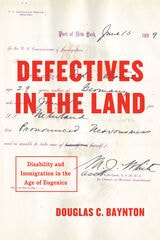
Defectives in the Land
Disability and Immigration in the Age of EugenicsDouglas C. Baynton
University of Chicago Press, 2016
Immigration history has largely focused on the restriction of immigrants by race and ethnicity, overlooking disability as a crucial factor in the crafting of the image of the “undesirable immigrant.” Defectives in the Land, Douglas C. Baynton’s groundbreaking new look at immigration and disability, aims to change this.
In the late nineteenth and early twentieth centuries, Baynton explains, immigration restriction in the United States was primarily intended to keep people with disabilities—known as “defectives”—out of the country. The list of those included is long: the deaf, blind, epileptic, and mobility impaired; people with curved spines, hernias, flat or club feet, missing limbs, and short limbs; those unusually short or tall; people with intellectual or psychiatric disabilities; intersexuals; men of “poor physique” and men diagnosed with “feminism.” Not only were disabled individuals excluded, but particular races and nationalities were also identified as undesirable based on their supposed susceptibility to mental, moral, and physical defects.
In this transformative book, Baynton argues that early immigration laws were a cohesive whole—a decades-long effort to find an effective method of excluding people considered to be defective. This effort was one aspect of a national culture that was increasingly fixated on competition and efficiency, anxious about physical appearance and difference, and haunted by a fear of hereditary defect and the degeneration of the American race.
[more]
Saving Babies?
The Consequences of Newborn Genetic ScreeningStefan Timmermans and Mara Buchbinder
University of Chicago Press, 2012
It has been close to six decades since Watson and Crick discovered the structure of DNA and more than ten years since the human genome was decoded. Today, through the collection and analysis of a small blood sample, every baby born in the United States is screened for more than fifty genetic disorders. Though the early detection of these abnormalities can potentially save lives, the test also has a high percentage of false positives—inaccurate results that can take a brutal emotional toll on parents before they are corrected. Now some doctors are questioning whether the benefits of these screenings outweigh the stress and pain they sometimes produce. In Saving Babies?, Stefan Timmermans and Mara Buchbinder evaluate the consequences and benefits of state-mandated newborn screening—and the larger policy questions they raise about the inherent inequalities in American medical care that limit the effectiveness of this potentially lifesaving technology.
Drawing on observations and interviews with families, doctors, and policy actors, Timmermans and Buchbinder have given us the first ethnographic study of how parents and geneticists resolve the many uncertainties in screening newborns. Ideal for scholars of medicine, public health, and public policy, this book is destined to become a classic in its field.
[more]