Results by title
3 books match the query 'Medical literature'
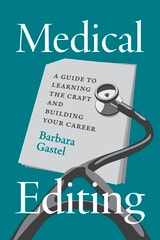
Medical Editing
A Guide to Learning the Craft and Building Your CareerBarbara Gastel
University of Chicago Press, 2025
Medical editing is a thriving and wide-ranging specialty within the editorial profession. Its practitioners occupy a unique ecosystem that involves its own style manuals and the ability to work with highly technical medical terminology and issues, and its work helps ensure that health practitioners, researchers, and the public receive sound, understandable medical information. Today, opportunities abound for medical editors—who come from many backgrounds and work in many settings, such as medical journals, medical institutions, and the freelance realm.
Written by an experienced and award-winning editor, Medical Editing: A Guide to Learning the Craft and Building Your Career provides a thorough introduction to the profession. At levels ranging from the punctuation mark to the publication, Barbara Gastel provides accessible and concrete instruction in editing medical writing. Distinctively, the book also explores ethical issues encountered in medical editing and other topics such as working effectively with medical authors, editing medical writing by and for nonnative users of English, and editing medical conference presentations.
For those considering entering medical editing or transitioning from other employment, the book also provides helpful career guidance. Readers will learn about the range of medical editing positions, receive advice on taking medical editing tests for employment, learn about certificates and certifications in the field, and more.
Enhanced by examples, exercises, and humor, Medical Editing will benefit both prospective and beginning medical editors while serving as a useful resource for experienced editors, teachers of courses in related fields, and supervisors mentoring interns or new hires.
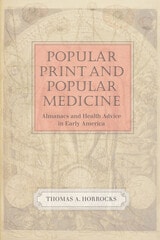
Popular Print and Popular Medicine
Almanacs and Health Advice in Early AmericaThomas A. Horrocks
University of Massachusetts Press, 2008
In this innovative study of the relationship between popular print and popular attitudes toward the body, health, and disease in antebellum America, Thomas A. Horrocks focuses our attention on a publication long neglected by scholars—the almanac.
Approaching his subject as both a historian of the book and a historian of medicine, Horrocks contends that the almanac, the most popular secular publication in America from the late eighteenth century to the first quarter of the nineteenth, both shaped and was shaped by early Americans' beliefs and practices pertaining to health and medicine. Analyzing the astrological, therapeutic, and regimen advice offered in American almanacs over two centuries, and comparing it with similar advice offered in other genres of popular print of the period, Horrocks effectively demonstrates that the almanac was a leading source of health information in America prior to the Civil War. He contends that the almanac was an integral component of a complicated, fragmented, semi-vernacular health literature of the period, and that the genre played a leading role in disseminating astrological health advice as well as shaping contemporary and future perceptions of astrology.
In terms of therapeutic and regimen advice, Horrocks asserts that the almanac performed a complementary role, confirming and reinforcing traditional beliefs and practices. By analyzing the almanac as a cultural artifact that represents a time, a place, and a certain set of assumptions and beliefs, he demonstrates that the genre can provide a lens through which scholars may examine early American attitudes and practices concerning their health in particular and American popular culture in general.

The Context of Self
A Phenomenological Inquiry Using Medicine as a ClueRichard M. Zaner
Ohio University Press, 1981
This study takes up the challenge presented to philosophy in a dramatic and urgent way by contemporary medicine: the phenomenon of human life. Initiated by a critical appreciation of the work of Hans Jonas, who poses that issue as well, the inquiry is brought to focus on the phenomenon of embodiment, using relevant medical writing to help elicit its concrete dimensions.
The explication of embodiment, aided by critical studies and inquiries into medical phenomena (autism, brain injury, terminal illness) make possible the development of the author’s original phenomenological theory of self, and its concrete relationships with the other self. This study attempts not only to show connections among the works of a number of thinkers in terms of central problems, but to demonstrate the mutual relevance of medicine and philosophy through concrete illustrations and analysis.