Results by title
4 books match the query 'Medical screening'
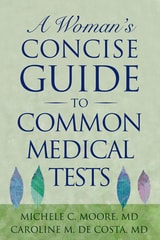
A Woman's Concise Guide to Common Medical Tests
Moore, M.D., Michele C
Rutgers University Press, 2005
Every year, millions of healthy women undergo a variety of screening tests without understanding why or the meaning of the outcome. If you are among those women, overwhelmed by information and baffled by results, this is the book you've been waiting for. In straightforward, personable prose, A Woman's Concise Guide to Common Medical Tests surveys a wide variety of standard tests commonly suggested by doctors.
Using the recommendations of the U.S. Preventative Health Services Task Force as a starting point, physicians Michele C. Moore and Caroline M. de Costa describe and explain screening tests for STDs and other communicable diseases, diabetes, thyroid disease, bone loss, various genetic tests, pregnancy, and cancer (including breast, colon, and skin). A section on common blood tests demystifies the numerical results that can be virtually impossible to interpret for women outside the medical profession. The authors detail what is considered "normal" as well as what's not-to help women make sense of their results.
As practicing physicians, both authors have fielded patients' questions about standard screening tests and understand what women should know but often feel afraid to ask about. For each test, there is an explanation of why it may be ordered, how it is done, what sort of preparation may be involved, and what risks may be incurred.
As the health-care industry continues to evolve, the amount of medical information available to women about their health can be overwhelming and confusing. Without being encyclopedic or intimidating, A Woman's Concise Guide to Common Medical Tests offers all the facts you need about screening tests, all in one place.
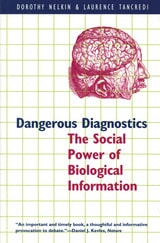
Dangerous Diagnostics
The Social Power of Biological InformationDorothy Nelkin and Laurence Tancredi
University of Chicago Press, 1994
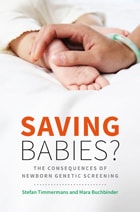
Saving Babies?
The Consequences of Newborn Genetic ScreeningStefan Timmermans and Mara Buchbinder
University of Chicago Press, 2012
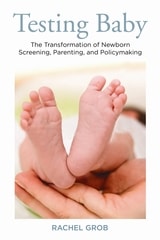
Testing Baby
The Transformation of Newborn Screening, Parenting, and PolicymakingGrob, Rachel
Rutgers University Press, 2011
Within forty-eight hours after birth, the heel of every baby in the United States has been pricked and the blood sent for compulsory screening to detect or rule out a large number of disorders. Newborn screening is expanding rapidly, fueled by the prospect of saving lives. Yet many lives are also changed by it in ways not yet recognized.
Testing Baby is the first book to draw on parents’ experiences with newborn screening in order to examine its far-reaching sociological consequences. Rachel Grob’s cautionary tale also explores the powerful ways that parents’ narratives have shaped this emotionally charged policy arena. Newborn screening occurs almost always without parents’ consent and often without their knowledge or understanding, yet it has the power to alter such things as family dynamics at the household level, the context of parenting, the way we manage disease identity, and how parents’ interests are understood and solicited in policy debates.