Results by title
7 books match the query 'Medicine, Magic, mystic, and spagiric'
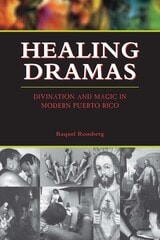
Healing Dramas
Divination and Magic in Modern Puerto RicoBy Raquel Romberg
University of Texas Press, 2009
In this intimate ethnography, Raquel Romberg seeks to illuminate the performative significance of healing rituals and magic works, their embodied nature, and their effectiveness in transforming the states of participants by focusing on the visible, albeit mostly obscure, ways in which healing and magic rituals proceed. The questions posed by Romberg emerge directly from the particular pragmatics of Puerto Rican brujería (witch-healing), shaped by the eclecticism of its rituals, the heterogeneous character of its participants, and the heterodoxy of its moral economy.
What, if any, is the role of belief in magic and healing rituals? How do past discourses on possession enter into the performative experience of ritual in the here and now? Where does belief stop, and where do memories of the flesh begin? While these are questions that philosophers and anthropologists of religion ponder, they acquire a different meaning when asked from an ethnographic perspective.
Written in an evocative, empathetic style, with theoretical ruminations about performance, the senses, and imagination woven into stories that highlight the drama and humanity of consultations, this book is an important contribution to the cross-cultural understanding of our capacity to experience the transcendental in corporeal ways.

Mojo Workin'
The Old African American Hoodoo SystemKatrina Hazzard-Donald
University of Illinois Press, 2013
A bold reconsideration of Hoodoo belief and practice
Katrina Hazzard-Donald explores African Americans' experience and practice of the herbal, healing folk belief tradition known as Hoodoo. She examines Hoodoo culture and history by tracing its emergence from African traditions to religious practices in the Americas. Working against conventional scholarship, Hazzard-Donald argues that Hoodoo emerged first in three distinct regions she calls "regional Hoodoo clusters" and that after the turn of the nineteenth century, Hoodoo took on a national rather than regional profile. The spread came about through the mechanism of the "African Religion Complex," eight distinct cultural characteristics familiar to all the African ethnic groups in the United States.
The first interdisciplinary examination to incorporate a full glossary of Hoodoo culture, Mojo Workin': The Old African American Hoodoo System lays out the movement of Hoodoo against a series of watershed changes in the American cultural landscape. Hazzard-Donald examines Hoodoo material culture, particularly the "High John the Conquer" root, which practitioners employ for a variety of spiritual uses. She also examines other facets of Hoodoo, including rituals of divination such as the "walking boy" and the "Ring Shout," a sacred dance of Hoodoo tradition that bears its corollaries today in the American Baptist churches. Throughout, Hazzard-Donald distinguishes between "Old tradition Black Belt Hoodoo" and commercially marketed forms that have been controlled, modified, and often fabricated by outsiders; this study focuses on the hidden system operating almost exclusively among African Americans in the Black spiritual underground.
Ritual Healing in Surburban America
McGuire, Meredith
Rutgers University Press, 1988
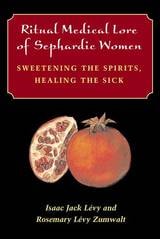
Ritual Medical Lore of Sephardic Women
Sweetening the Spirits, Healing the SickIsaac Jack Lévy and Rosemary Lévy Zumwalt
University of Illinois Press, 2002
Winner of the Ellii Kongas-Maranda Prize from the Women's Section of the American Folklore Society, 2003.
Ritual Medical Lore of Sephardic Women preserves the precious remnants of a rich culture on the verge of extinction while affirming women's pivotal role in the health of their communities. Centered around extensive interviews with elders of the Sephardic communities of the former Ottoman Empire, this volume illuminates a fascinating complex of preventive and curative rituals conducted by women at home--rituals that ensured the physical and spiritual well-being of the community and functioned as a vital counterpart to the public rites conducted by men in the synagogues.
Isaac Jack Lévy and Rosemary Lévy Zumwalt take us into the homes and families of Sephardim in Turkey, Israel, Greece, the former Yugoslavia, and the United States to unravel the ancient practices of domestic healing: the network of blessings and curses tailored to every occasion of daily life; the beliefs and customs surrounding mal ojo (evil eye), espanto (fright), and echizo (witchcraft); and cures involving everything from herbs, oil, and sugar to the powerful mumia (mummy) made from dried bones of corpses.
For the Sephardim, curing an illness required discovering its spiritual cause, which might be unintentional thought or speech, accident, or magical incantation. The healing rituals of domesticated medicine provided a way of making sense of illness and a way of shaping behavior to fit the narrow constraints of a tightly structured community. Tapping a rich and irreplaceable vein of oral testimony, Ritual Medical Lore of Sephardic Women offers fascinating insight into a culture where profound spirituality permeated every aspect of daily life.
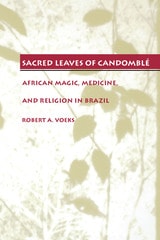
Sacred Leaves of Candomblé
African Magic, Medicine, and Religion in BrazilBy Robert A. Voeks
University of Texas Press, 1997
Winner, Hubert Herring Book Award, Pacific Coast Council on Latin American Studies
Candomblé, an African religious and healing tradition that spread to Brazil during the slave trade, relies heavily on the use of plants in its spiritual and medicinal practices. When its African adherents were forcibly transplanted to the New World, they faced the challenge not only of maintaining their culture and beliefs in the face of European domination but also of finding plants with similar properties to the ones they had used in Africa.
This book traces the origin, diffusion, medicinal use, and meaning of Candomblé's healing pharmacopoeia—the sacred leaves. Robert Voeks examines such topics as the biogeography of Africa and Brazil, the transference—and transformation—of Candomblé as its adherents encountered both native South American belief systems and European Christianity, and the African system of medicinal plant classification that allowed Candomblé to survive and even thrive in the New World. This research casts new light on topics ranging from the creation of African American cultures to tropical rain forest healing floras.
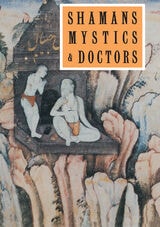
Shamans, Mystics and Doctors
A Psychological Inquiry into India and its Healing TraditionsSudhir Kakar
University of Chicago Press, 1990
"With extraordinary sympathy, open-mindedness, and insight Sudhir Kakar has drawn from both his Eastern and Western backgrounds to show how the gulf that divides native healer from Western psychiatrist can be spanned."—Rosemary Dinnage, New York Review of Books
"Each chapter describes the geographical and cultural context within which the healers work, their unique approach to healing mental illness, and . . . the philosophical and religious underpinnings of their theories compared with psychoanalytical theory."—Choice
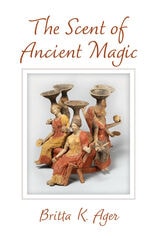
The Scent of Ancient Magic
Britta K. Ager
University of Michigan Press, 2022
The Scent of Ancient Magic explores the complex interconnection of scent and magic in the Greco-Roman world between 800 BCE and CE 600, drawing on ancient literature and the modern study of the senses to examine the sensory depth and richness of ancient magic. Author Britta K. Ager looks at how ancient magicians used scents as part of their spells, to put themselves in the right mindset for an encounter with a god or to attack their enemies through scent. Ager also examines the magicians who appear in ancient fiction, like Medea and Circe, and the more metaphorical ways in which their spells are confused with perfumes and herbs. This book brings together recent scholarship on ancient magic from classical studies and on scent from the interdisciplinary field of sensory studies in order to examine how practicing ancient magicians used scents for ritual purposes, how scent and magic were conceptually related in ancient literature and culture, and how the assumption that strong scents convey powerful effects of various sorts was also found in related areas like ancient medical practices and normative religious ritual.