Results by title
7 books match the query 'Medicine, Military'
Bullets and Bacilli
The Spanish-American War and Military MedicineCirillo, Vincent J.
Rutgers University Press, 2003
Civil War Pharmacy
A HistoryMichael A. Flannery, with a foreword by Margaret Humphreys
Southern Illinois University Press, 2017
Winner (first edition), Archivists and Librarians in the History of the Health Sciences, Best Book Award
Contested Medicine
Cancer Research and the MilitaryGerald Kutcher
University of Chicago Press, 2009
In the 1960s University of Cincinnati radiologist Eugene Saenger infamously conducted human experiments on patients with advanced cancer to examine how total body radiation could treat the disease. But, under contract with the Department of Defense, Saenger also used those same patients as proxies for soldiers to answer questions about combat effectiveness on a nuclear battlefield.
Using the Saenger case as a means to reconsider cold war medical trials, Contested Medicine examines the inherent tensions at the heart of clinical studies of the time. Emphasizing the deeply intertwined and mutually supportive relationship between cancer therapy with radiation and military medicine, Gerald Kutcher explores post–World War II cancer trials, the efforts of the government to manage clinical ethics, and the important role of military investigations in the development of an effective treatment for childhood leukemia. Whereas most histories of human experimentation judge research such as Saenger’s against idealized practices, Contested Medicine eschews such an approach and considers why Saenger’s peers and later critics had so much difficulty reaching an unambiguous ethical assessment. Kutcher’s engaging investigation offers an approach to clinical ethics and research imperatives that lays bare many of the conflicts and tensions of the postwar period.
Disabled Empire
The Colonial Body in First World War BritainHilary R. Buxton
University of Chicago Press, 2026
Disabled Empire examines how imperial precedents and racial ideologies shaped the medical treatments that the British state offered to several million Black and brown servicemen during World War I. In recovering the voices and experiences of these soldiers, Hilary R. Buxton illustrates how they navigated the institutional culture of the imperial military and how they helped to shape health and welfare systems well beyond the interwar period.
The Great War was the first time that troops and volunteers from nearly all reaches of the Empire participated in the war effort side-by-side. Despite official attempts at segregation, colonial troops met in trenches, mobile camps, casualty clearing stations, hospital ships, and convalescent homes. Just as importantly, those organizing treatment encountered men of different ethnicities, religions, and cultures from across and beyond the British Empire. For British officials, this moment offered an opportunity to remake colonial efficiency and medical knowledge. Yet, as Buxton shows, colonial servicemen were not passive subjects in a wartime laboratory: they were vocal participants who demanded a say in the therapies prescribed to them, the rations they required, the psychiatric care they received, and the prosthetics with which they were fitted. Together, these encounters profoundly remade colonial relations, reshaping imperial science, administration, and colonial understandings of subjecthood.
Disabled Empire pushes literature on the war and medicine outside its national, Eurocentric focus to confront the colonial logic of global health inequity.
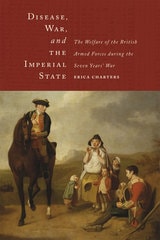
Disease, War, and the Imperial State
The Welfare of the British Armed Forces during the Seven Years' WarErica Charters
University of Chicago Press, 2014
In Disease, War, and the Imperial State, Erica Charters demonstrates how disease played a vital role in shaping strategy and campaigning, British state policy, and imperial relations during the Seven Years’ War. Military medicine was a crucial component of the British war effort; it was central to both eighteenth-century scientific innovation and the moral authority of the British state. Looking beyond the traditional focus of the British state as a fiscal war-making machine, Charters uncovers an imperial state conspicuously attending to the welfare of its armed forces, investing in medical research, and responding to local public opinion. Charters shows military medicine to be a credible scientific endeavor that was similarly responsive to local conditions and demands.
Disease, War, and the Imperial State is an engaging study of early modern warfare and statecraft, one focused on the endless and laborious task of managing manpower in the face of virulent disease in the field, political opposition at home, and the clamor of public opinion in both Britain and its colonies.
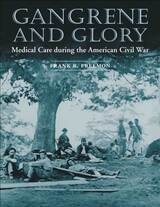
Gangrene and Glory
Medical Care during the American Civil WarFrank R. Freemon
University of Illinois Press, 1998
A medical doctor and a credentialed historian, Frank R. Freemon combines poignant, sometimes horrifying anecdotes of amputation, infection, and death with a clearheaded discussion of the state of medical knowledge, the effect of the military bureaucracy on medical supplies, and the members of the medical community who risked their lives, their health, and even their careers to provide appropriate care to the wounded. Freemon examines the impact on major campaigns--Manassas, Gettysburg, Vicksburg, Shiloh, Atlanta--of ignorance, understaffing, inexperience, overcrowded hospitals, insufficient access to ambulances, and inadequate supplies of essentials such as quinine.
Presenting the medical side of the war from a variety of perspectives--the Union, the Confederacy, doctors, nurses, soldiers, and their families--Gangrene and Glory achieves a peculiar immediacy by restricting its scope to the knowledge and perceptions available to its nineteenth-century subjects. Now available for the first time in paperback, this important volume takes a hard, close look at a neglected and crucial aspect of this bloody conflict.
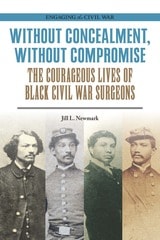
Without Concealment, Without Compromise
The Courageous Lives of Black Civil War SurgeonsJill L. Newmark
Southern Illinois University Press, 2023
Of some twelve thousand Union Civil War surgeons, only fourteen were Black men. This book is the first-ever comprehensive exploration of their lives and service. Jill L. Newmark’s outstanding research uncovers stories hidden for more than 150 years, illuminating the unique experiences of proud, patriotic men who fought racism and discrimination to attend medical school and serve with the U.S. military. Their efforts and actions influenced societal change and forged new pathways for African Americans.
Individual biographies bring to light Alexander T. Augusta, who challenged discriminatory laws; William P. Powell Jr., who pursued a military pension for twenty-five years; Anderson R. Abbott, a friend of Elizabeth Keckley’s; John van Surly DeGrasse, the only Black surgeon to serve on the battlefield; John H. Rapier Jr., an international traveler; Richard H. Greene, the only Black surgeon known to have served in the Navy; Willis R. Revels, a preacher; Benjamin A. Boseman, a politician and postmaster; and Charles B. Purvis, who taught at Howard University. Information was limited for five other men, all of whom broke educational barriers by attending medical schools in the United States: Cortlandt Van Rensselaer Creed, William B. Ellis, Alpheus W. Tucker, Joseph Dennis Harris, and Charles H. Taylor.
Newmark presents all available information about the surgeons’ early lives, influences, education, Civil War service, and post-war experiences. Many of the stories overlap, as did the lives of the men. Each man, through his service as a surgeon during the war and his lifelong activism for freedom, justice, and equality, became a catalyst of change and a symbol of an emancipated future.