Results by title
5 books match the query 'Medicine, Popular'

Answers to the Health Questions People Ask in Libraries
A Medical Library Association GuideAmerican Library Association, 2008
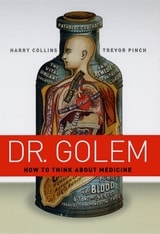
Dr. Golem
How to Think about MedicineHarry Collins and Trevor Pinch
University of Chicago Press, 2005
Dr. Golem explores some of the mysteries and complexities of medicine while untangling the inherent conundrums of scientific research and highlighting its vagaries. Driven by the question of what to do in the face of the fallibility of medicine, Dr. Golem encourages a more inquisitive attitude toward the explanations and accounts offered by medical science. In eight chapters devoted to case studies of modern medicine, Collins and Pinch consider the prevalence of tonsillectomies, the placebo effect and randomized control trials, bogus doctors, CPR, the efficacy of Vitamin C in fighting cancer, chronic fatigue syndrome, AIDS cures, and vaccination. They also examine the tension between the conflicting faces of medicine: medicine as science versus medicine as a source of succor; the interests of an individual versus the interests of a group; and the benefits in the short term versus success rates in the long term. Throughout, Collins and Pinch remind readers that medical science is an economic as well as a social consideration, encapsulated for the authors in the timeless struggle to balance the good health of the many—with vaccinations, for instance—with the good health of a few—those who have adverse reactions to the vaccine.
In an age when the deaths of research subjects, the early termination of clinical trials, and the research guidelines for stem cells are front-page news, Dr. Golem is a timely analysis of the limitations of medicine that never loses sight of its strengths.
Popular Print and Popular Medicine
Almanacs and Health Advice in Early AmericaThomas A. Horrocks
University of Massachusetts Press, 2008
In this innovative study of the relationship between popular print and popular attitudes toward the body, health, and disease in antebellum America, Thomas A. Horrocks focuses our attention on a publication long neglected by scholars—the almanac.
Approaching his subject as both a historian of the book and a historian of medicine, Horrocks contends that the almanac, the most popular secular publication in America from the late eighteenth century to the first quarter of the nineteenth, both shaped and was shaped by early Americans' beliefs and practices pertaining to health and medicine. Analyzing the astrological, therapeutic, and regimen advice offered in American almanacs over two centuries, and comparing it with similar advice offered in other genres of popular print of the period, Horrocks effectively demonstrates that the almanac was a leading source of health information in America prior to the Civil War. He contends that the almanac was an integral component of a complicated, fragmented, semi-vernacular health literature of the period, and that the genre played a leading role in disseminating astrological health advice as well as shaping contemporary and future perceptions of astrology.
In terms of therapeutic and regimen advice, Horrocks asserts that the almanac performed a complementary role, confirming and reinforcing traditional beliefs and practices. By analyzing the almanac as a cultural artifact that represents a time, a place, and a certain set of assumptions and beliefs, he demonstrates that the genre can provide a lens through which scholars may examine early American attitudes and practices concerning their health in particular and American popular culture in general.
Recipes and Everyday Knowledge
Medicine, Science, and the Household in Early Modern EnglandElaine Leong
University of Chicago Press, 2018
In Recipes and Everyday Knowledge, Elaine Leong situates recipe knowledge and practices among larger questions of gender and cultural history, the history of the printed word, and the history of science, medicine, and technology. The production of recipes and recipe books, she argues, were at the heart of quotidian investigations of the natural world or “household science”. She shows how English homes acted as vibrant spaces for knowledge making and transmission, and explores how recipe trials allowed householders to gain deeper understandings of sickness and health, of the human body, and of natural and human-built processes. By recovering this story, Leong extends the parameters of natural inquiry and productively widens the cast of historical characters participating in and contributing to early modern science.
The Second Part of the Popular Errors
Laurent Joubert
University of Alabama Press, 1995
English translation of the second volume of Laurent Joubert’s 1578 French work Erreurs Populaires
Joubert proposed to dispel folk remedies and folklore still relied on by doctors and care-givers in France. It also challenged medical theories and advice from classical Greek and Latin writers that French doctors followed uncritically.