Results by title
12 books match the query 'Medicine in Literature'
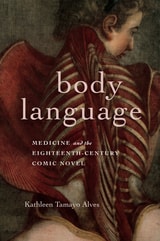
Body Language
Medicine and the Eighteenth-Century Comic NovelKathleen Tamayo Alves
Bucknell University Press, 2026
Body Language examines the complex intersections of British eighteenth-century comic fiction and medical discourse. By engaging medical writings of renowned and widely-read physicians of the Enlightenment such as John Freind, Thomas Sydenham, Albrecht von Haller, John Whytt, and William Cullen, with novels of humor by Henry Fielding, Tobias Smollett, Laurence Sterne, and Charlotte Lennox, Alves explains how medicine shaped comic language by dramatizing female-specific phenomena like menstruation, hysteria, nervous disorders, and pregnancy. In these novels, the medical belief that women are incapable of bodily self-regulation becomes an imperative for policing women’s bodies and highlights the enduring shortcomings of patriarchal systems. Ultimately, these comic representations offer a counternarrative of women’s bodies, agency, and selfhood, exposing masculine anxieties about the effectiveness of marriage to regulate women’s sexuality.
Published by Bucknell University Press. Distributed worldwide by Rutgers University Press.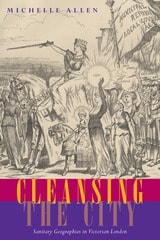
Cleansing the City
Sanitary Geographies in Victorian LondonMichelle Allen
Ohio University Press, 2008
From the novels of Charles Dickens and George Gissing to anonymous magazine articles and pamphlets, resistance to reform found expression in the nostalgic appreciation of a threatened urban landscape and anxiety about domestic autonomy in an era of networked sanitary services. Cleansing the City emphasizes the disruptions and disorientation occasioned by purification—a process we are generally inclined to see as positive. By recovering these sometimes oppositional, sometimes ambivalent responses, Michelle Allen elevates a significant undercurrent of Victorian thought into the mainstream and thus provides insight into the contested nature of sanitary modernization.
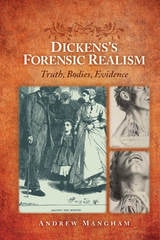
Dickens's Forensic Realism
Truth, Bodies, EvidenceAndrew Mangham
The Ohio State University Press, 2017
As Mangham shows, forensic medicine grew out of a perceived need to understand things with accuracy, leaning in part on the range of objectivities that inspired the inorganic sciences. At the same time, it had the burden of assisting the law in convicting the guilty and in exonerating the innocent. Practitioners of forensic medicine were uniquely mindful of unwanted variables such as human error and the vagaries of interpretation. In readings of Oliver Twist, Our Mutual Friend, Bleak House, The Pickwick Papers, Great Expectations, and Dickens’s early journalism, Mangham demonstrates that these questions about signification, perception, and reality are central to the stylistic complexities and playful tone often associated with Dickens. Moreover, the medico-legal context of Dickens’s fiction illuminates the richness and profundity, style and impact of Dicken’s narratives.
Imagining Health
Medicine, Social Protest, and Modern American LiteratureIra Halpern
University of Massachusetts Press, 2026
In the United States, a deep suspicion of professional medical expertise is becoming increasingly prominent. Meanwhile, many arguments for health justice take a highly critical view of medical authority, even rejecting it entirely. In the early to mid-twentieth century, alternatively, as medicine rapidly professionalized, Americans came to hold the medical establishment in a particularly high regard, while many saw how it could play a crucial role in progressive politics. In this period, technologies developed, specializations grew, and medical education became standardized. With this process came inequities, as marginalized populations struggled to access the highest levels of care. Literary writers confronting social ills through their work included critiques of this new system in their writing, Ira Halpern argues. Without abandoning professional medicine, they called for alternative systems of care that could better serve diverse populations.
Halpern examines the work of several writers—including Robert Herrick, Wallace Thurman, Frank Slaughter, Charles Chesnutt, Walter White, Ralph Ellison, Charlotte Perkins Gilman, Upton Sinclair, Stephen Crane, and Edith Wharton—to demonstrate how American writing from this period embedded a critical look at healthcare within other elements of progressive politics, from racial protest and women’s rights to disability justice and counter-capitalist viewpoints. Placing this writing into historical context, in terms of medical and scientific developments as well as traditions of social protest, Halpern reveals the efforts of these writers to envision better alternative trajectories for a quickly evolving medical establishment that left too many Americans without reliable care.
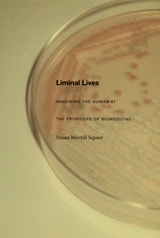
Liminal Lives
Imagining the Human at the Frontiers of BiomedicineSusan Merrill Squier
Duke University Press, 2004
Drawing on archival materials of twentieth-century biology; little-known works of fiction and science fiction; and twentieth- and twenty-first century U.S. and U.K. government reports by the National Institutes of Health, the Parliamentary Advisory Group on the Ethics of Xenotransplantation, and the President’s Council on Bioethics, she examines a number of biomedical changes as each was portrayed by scientists, social scientists, and authors of fiction and poetry. Among the scientific developments she considers are the cultured cell, the hybrid embryo, the engineered intrauterine fetus, the child treated with human growth hormone, the process of organ transplantation, and the elderly person rejuvenated by hormone replacement therapy or other artificial means. Squier shows that in the midst of new phenomena such as these, literature helps us imagine new ways of living. It allows us to reflect on the possibilities and perils of our liminal lives.
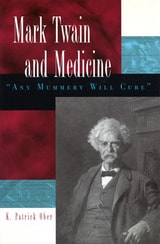
Mark Twain and Medicine
"Any Mummery Will Cure"K. Patrick Ober
University of Missouri Press, 2003
Mark Twain has always been America’s spokesman, and his comments on a wide range of topics continue to be accurate, valid, and frequently amusing. His opinions on the medical field are no exception. While Twain’s works, including his popular novels about Tom Sawyer and Huckleberry Finn, are rich in medical imagery and medical themes derived from his personal experiences, his interactions with the medical profession and his comments about health, illness, and physicians have largely been overlooked.
In Mark Twain and Medicine, K. Patrick Ober remedies this omission. The nineteenth century was a critical time in the development of American medicine, with much competition among the different systems of health care, both traditional and alternative. Not surprisingly, Mark Twain was right in the middle of it all. He experimented with many of the alternative care systems that were available in his day—in part because of his frustration with traditional medicine and in part because he hoped to find the “perfect” system that would bring health to his family.
Twain’s commentary provides a unique perspective on American medicine and the revolution in medical systems that he experienced firsthand. Ober explores Twain’s personal perspective in this area, as he expressed it in fiction, speeches, and letters. As a medical educator, Ober explains in sufficient detail and with clarity all medical and scientific terms, making this volume accessible to the general reader.
Ober demonstrates that many of Twain’s observations are still relevant to today’s health care issues, including the use of alternative or complementary medicine in dealing with illness, the utility of placebo therapies, and the role of hope in the healing process.
Twain’s evaluation of the medical practices of his era provides a fresh, humanistic, and personalized view of the dramatic changes that occurred in medicine through the nineteenth century and into the first decade of the twentieth. Twain scholars, general readers, and medical professionals will all find this unique look at his work appealing.
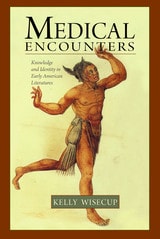
Medical Encounters
Knowledge and Identity in Early American LiteraturesKelly Wisecup
University of Massachusetts Press, 2013
Against the prevailing view that colonial texts provide insight only into their writers' perspectives, Wisecup demonstrates that Europeans, Natives, and Africans held certain medical ideas in common, including a conception of disease as both a spiritual and a physical entity, and a belief in the power of special rituals or prayers to restore health. As a consequence, medical knowledge and practices operated as a shared form of communication on which everyone drew in order to adapt to a world of devastating new maladies and unfamiliar cures.
By signaling one's relation to supernatural forces, to the natural world, and to other people, medicine became an effective means of communicating a variety of messages about power and identity as well as bodies and minds. Native Americans in Virginia and New England, for example, responded to the nearly simultaneous arrival of mysterious epidemics and peoples by incorporating colonists into explanations of disease, while British American colonists emphasized to their audiences back home the value of medical knowledge drawn from cross-cultural encounters in the New World.
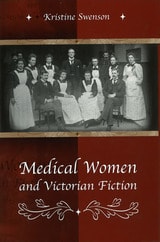
Medical Women and Victorian Fiction
Kristine Swenson
University of Missouri Press, 2005
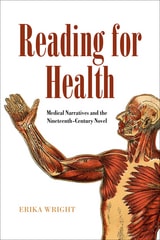
Reading for Health
Medical Narratives and the Nineteenth-Century NovelErika Wright
Ohio University Press, 2016
In Reading for Health: Medical Narratives and the Nineteenth-Century Novel, Erika Wright argues that the emphasis in Victorian Studies on disease as the primary source of narrative conflict that must be resolved has obscured the complex reading practices that emerge around the concept of health. By shifting attention to the ways that prevention of illness and the preservation of well-being operate in fiction, both thematically and structurally, Wright offers a new approach to reading character and voice, order and temporality, setting and metaphor. As Wright reveals, while canonical works by Austen, Brontë, Dickens, Martineau, and Gaskell register the pervasiveness of a conventional “therapeutic” form of action and mode of reading, they demonstrate as well an equally powerful investment in the achievement and maintenance of “health”—what Wright refers to as a “hygienic” narrative—both in personal and domestic conduct and in social interaction of the individual within the community.
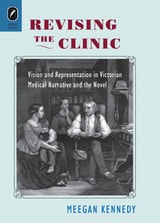
Revising the Clinic
Vision and Representation in Victorian Medical Narrative and the NovelMeegan Kennedy
The Ohio State University Press, 2010
Critics have examined how novelists borrow from other genres—newspapers, legal cases, autobiographies. Medical writing likewise enriches the novel’s uniquely flexible and wide-ranging presentation of Victorian culture. In turn, the novel shapes medical narrative even as clinical science idealizes methodological rigor. Revising the Clinic shows how the wealth of scientific material in mainstream Victorian periodicals creates a productive literary “commons” where novelists and physicians can encounter each others’ strategies for seeing and stating. Novelists adapt physicians’ techniques to nonmedical scenes, and physicians echo the sentimental or sensational novel to gain sympathy or rhetorical force when medical knowledge falters.
Kennedy traces the development of the Victorian novel and the case history from eighteenth-century curious observation and curious sights through nineteenth-century clinical observation, mechanical observation, and speculation, to Freud’s labyrinthine mapping and speculative insight. These make new sense, read within the literary tradition of the case history. The lens of Kennedy’s argument clarifies and illuminates the preoccupation with genre and visuality that is common to Victorian medicine and the novel.
The Last Physician
Walker Percy and the Moral Life of MedicineCarl Elliott and John Lantos, eds.
Duke University Press, 1999
The contributors—physicians, philosophers, and literary critics—examine the relevance of Percy’s work to current dilemmas in medical education and health policy. They reflect upon the role doctors and patients play in his novels, his family legacy of depression, how his medical background influenced his writing style, and his philosophy of psychiatry. They contemplate the private ways in which Percy’s work affected their own lives and analyze the author’s tendency to contrast the medical-scientific worldview with a more spiritual one. Assessing Percy’s stature as an author and elucidating the many ways that reading and writing can combine with diagnosing and treating to offer an antidote to despair, they ask what it means to be a doctor, a writer, and a seeker of cures and truths—not just for the body but for the malaise and diseased spirituality of modern times.
This collection will appeal to lovers of literature as well as medical professionals—indeed, anyone concerned with medical ethics and the human side of doctoring.
Contributors. Robert Coles, Brock Eide, Carl Elliott, John D. Lantos, Ross McElwee, Richard Martinez, Martha Montello, David Schiedermayer, Jay Tolson, Bertram Wyatt-Brown, Laurie Zoloth-Dorfman
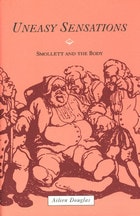
Uneasy Sensations
Smollett and the BodyAileen Douglas
University of Chicago Press, 1995
Aileen Douglas draws on feminist and other new theoretical perspectives to reassess Smollett's entire body of fiction as well as his classic Travels through France and Italy. Like many writers of his time, Douglas argues, Smollett was interested in the body and in how accurately it reflects internal disposition. But Smollett's special contribution to the eighteenth-century novel is his emphasis on sentience, or the sensations of the physical body. Looking at such works as The Adventures of Roderick Random, The Expedition of Humphry Clinker, The Adventures of Peregrine Pickle, and The History and Adventures of an Atom, Douglas explores the ways Smollett uses representations of sentience—especially torment and pain—in his critique of the social and political order.
Trained in medicine, Smollett was especially alert to the ways in which the discourses of medicine, philosophy, and law construct (as we would put it now) the body as an object of knowledge, and yet his work always returns to the importance of the physical world of the body and its feelings. Smollett reminds us, as Douglas aptly puts it, that "if you prick a socially constructed body, it still bleeds."