Results by title
4 books match the query 'Medieval Canon Law'
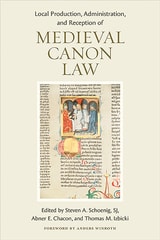
Local Production, Administration, and Reception of Medieval Canon Law
Steven A. Schoenig
Catholic University of America Press, 2026
These nine essays, written by leading experts in the field, focus on the production and application of canon law at the local level. This broad theme permits many subjects to be explored: canonical collections produced in a particular locale by key figures in that area; local manuscript copies of widespread texts; administrative usages and canonical rules for churches within a certain area; specific synodal decrees important to regional ecclesiastical activity and governance; and the reception and adaptation of canonical norms and rules in a particular diocese or other venue. These studies collectively deepen our appreciation of the importance of canon law for people in their home churches and regions. They help us understand canon law in its decentralized, non-papally administered forms, across the full temporal range of the Middle Ages. The special value of these works lies in illuminating the pragmatic role of particular circumstances in adapting the church’s tradition in order to be relevant and to meet local needs.
[more]
The History of Courts and Procedure in Medieval Canon Law
Wilfried Hartmann
Catholic University of America Press, 2016
By the end of the thirteenth century, court procedure in continental Europe in secular and ecclesiastical courts shared many characteristics. As the academic jurists of the Ius commune began to excavate the norms of procedure from Justinian's great codification of law and then to expound them in the classroom and in their writings, they shaped the structure of ecclesiastical courts and secular courts as well. These essays also illuminate striking differences in the sources that we find in different parts of Europe. In northern Europe the archives are rich but do not always provide the details we need to understand a particular case. In Italy and Southern France the documentation is more detailed than in other parts of Europe but here too the historical records do not answer every question we might pose to them. In Spain, detailed documentation is strangely lacking, if not altogether absent. Iberian conciliar canons and tracts on procedure tell us much about practice in Spanish courts. As these essays demonstrate, scholars who want to peer into the medieval courtroom, must also read letters, papal decretals, chronicles, conciliar canons, and consilia to provide a nuanced and complete picture of what happened in medieval trials. This volume will give sophisticated guidance to all readers with an interest in European law and courts.
[more]
The History of Medieval Canon Law in the Classical Period, 1140-1234
From Gratian to the Decretals of Pope Gregory IX (History of Medieval Canon Law)Wilfried Hartmann
Catholic University of America Press, 2008
This latest volume in the ongoing History of Medieval Canon Law series covers the period from Gratian's initial teaching of canon law during the 1120s to just before the promulgation of the Decretals of Pope Gregory IX in 1234.
[more]
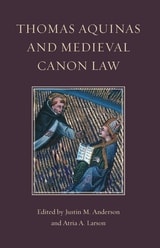
Thomas Aquinas and Medieval Canon Law
Justin M. Anderson
Catholic University of America Press, 2025
Thomas Aquinas and Medieval Canon Law bridges, for the first time, two worlds of scholarship that have never been explored in book-length form and investigates an under-researched area in Thomistic studies, namely the question of how Thomas Aquinas engaged the ecclesiastical law and jurisprudence of his day.
Neither historians of medieval canon law nor experts on Thomas's thought have previously paid much attention to the canon law tradition as a source for Thomas's work and an influence on his thought. But, as this volume shows, his consideration of mendicant life, law, justice, oaths, penance, clerical orders, the Eucharist, baptism, property, commerce, marriage and more reveal engagement with key canon law texts and concepts and with the jurisprudence of major canonists. The book uncovers how Aquinas encountered canonical regulations and jurisprudence as a Dominican, an educator in both theology and pastoral care, and a participant in the secular-mendicant controversy. In his life, education, community, and his way of thought, Thomas Aquinas could not avoid and necessarily encountered and dealt with the canonical tradition. He did so in a distinctive way, working as he did with his theological and philosophical source material to craft his own great synthesis. What this volume shows, if nothing else, is that the canon law tradition should be taken into consideration when assessing Thomas's synthetic thought.
Following the editors' introduction, thirteen scholarly contributions and an epilogue explore Aquinas's interaction with medieval canon law through four major themes: Dominican Matters; Foundations Matters of Faith, Truth, and Law; Moral Matters; and Sacramental Matters. Approximately half the contributors are specialists from the field of medieval canon law, and half are grounded in Thomistic tradition. The result is a unique and scholarly contribution to two major research areas that may open avenues for similar studies of other key figures in the scholastic tradition.
[more]