Results by title
9 books match the query 'Medieval Europe'
Charity and Religion in Medieval Europe
James William Brodman
Catholic University of America Press, 2009
City and Spectacle in Medieval Europe
Barbara Hanawalt
University of Minnesota Press, 1994
Medieval Europe is known for its sense of ceremony and drama. Knightings, tournaments, coronations, religious processions, and even private celebrations such as baptisms, weddings, and funerals were occasions for ritual, feasting, and public display. This volume is the first to take a comprehensive look at the many types of city spectacles that entertained the masses and confirmed various messages of power in late medieval Europe. Bringing together leading scholars in history, art history, and literature, this interdisciplinary collection sets new standards for the study of medieval popular culture.
Drawing examples from Spain, England, France, Italy, and the Netherlands, most of them in the fifteenth century, the authors explore the uses of ceremony as statements of political power, as pleas for divine intercession, and as expressions of popular culture. Their essays show us spectacles meant to confirm events such as victories, the signing of a city charter, or the coronation of a king. In other circumstances, the spectacle acts as a battleground where a struggle for the control of the metaphors of power is played out between factions within cities or between cities and kings. Still other ceremonies called upon divine spiritual powers in the hope that their intervention might save the urban inhabitants. We see here a public cognizant of the power of symbols to express its goals and achievements, a society reaching the height of sophistication in its manipulation of popular and elite culture for grand shows.
Deprived of Sense and Intellect
Insanity, Possession, and Diagnosis in Medieval EuropeLeigh Ann Craig
University of Michigan Press, 2026
While medieval communities assigned these tensions to a malfunction of consciousness in a single person, medieval miracle texts also reveal how the function and malfunction of consciousness was named and classified. In studying these texts, Leigh Ann Craig explores the terminology and rhetoric used to diagnose a loss of mind as either from natural causes or as an effect of demonic predation, tracing the use of Latin vocabulary in medical compendia, law, and theology. Deprived of Sense and Intellect finds that since diagnoses were difficult and frequently subject to doubt, they varied based on regional cultures of disability in northern and southern Europe, the influences on the development of community consensus in Latin Europe in the Middle Ages, and assumptions based on gender, material evidence, and self-diagnosis.
Law, Sex, and Christian Society in Medieval Europe
James A. Brundage
University of Chicago Press, 1990
"Brundage's book is consistently learned, enormously useful, and frequently entertaining. It is the best we have on the relationships between theological norms, legal principles, and sexual practice."—Peter Iver Kaufman, Church History
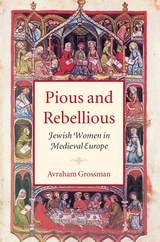
Pious and Rebellious
Jewish Women in Medieval EuropeAvraham Grossman
Brandeis University Press, 2004
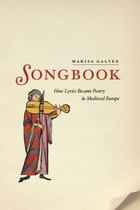
Songbook
How Lyrics Became Poetry in Medieval EuropeMarisa Galvez
University of Chicago Press, 2012
Today we usually think of a book of poems as composed by a poet, rather than assembled or adapted by a network of poets and readers. But the earliest European vernacular poetries challenge these assumptions. Medieval songbooks remind us how lyric poetry was once communally produced and received—a collaboration of artists, performers, live audiences, and readers stretching across languages and societies.
The only comparative study of its kind, Songbook treats what poetry was before the emergence of the modern category “poetry”: that is, how vernacular songbooks of the thirteenth to fifteenth centuries shaped our modern understanding of poetry by establishing expectations of what is a poem, what is a poet, and what is lyric poetry itself. Marisa Galvez analyzes the seminal songbooks representing the vernacular traditions of Occitan, Middle High German, and Castilian, and tracks the process by which the songbook emerged from the original performance contexts of oral publication, into a medium for preservation, and, finally, into an established literary object. Galvez reveals that songbooks—in ways that resonate with our modern practice of curated archives and playlists—contain lyric, music, images, and other nonlyric texts selected and ordered to reflect the local values and preferences of their readers. At a time when medievalists are reassessing the historical foundations of their field and especially the national literary canons established in the nineteenth century, a new examination of the songbook’s role in several vernacular traditions is more relevant than ever.
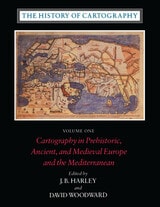
The History of Cartography, Volume One
Cartography in Prehistoric, Ancient, and Medieval Europe and the MediterraneanEdited by J. B. Harley and David Woodward
University of Chicago Press, 1987
Volume One addresses the prehistorical and historical mapping traditions of premodern Europe and the Mediterranean world. A substantial introductory essay surveys the historiography and theoretical development of the history of cartography and situates the work of the multi-volume series within this scholarly tradition. Cartographic themes include an emphasis on the spatial-cognitive abilities of Europe's prehistoric peoples and their transmission of cartographic concepts through media such as rock art; the emphasis on mensuration, land surveys, and architectural plans in the cartography of Ancient Egypt and the Near East; the emergence of both theoretical and practical cartographic knowledge in the Greco-Roman world; and the parallel existence of diverse mapping traditions (mappaemundi, portolan charts, local and regional cartography) in the Medieval period.
Throughout the volume, a commitment to include cosmographical and celestial maps underscores the inclusive definition of "map" and sets the tone for the breadth of scholarship found in later volumes of the series.
The Spectral Jew
Conversion and Embodiment in Medieval EuropeSteven F. Kruger
University of Minnesota Press, 2006
Looking closely at how medieval Jewish and Christian identities are distinguished from each other, yet intimately intertwined, Kruger demonstrates how Jews were often corporealized in ways that posited them as inferior to Christians—archaic and incapable of change—even as the two mutually shaped each other. But such attempts to differentiate Jews and Christians were inevitably haunted by the knowledge that Christianity had emerged out of Judaism and was, in its own self-understanding, a community of converts.
Examining the points of contact between Christian and Jewish communities, Kruger discloses the profound paradox of the Jew as different in all ways, yet capable of converting to fully Christian status. He draws from central medieval authors and texts such as Peter Damian, Guibert of Nogent, the Barcelona Disputation, and the Hebrew chronicles of the First Crusade, as well as lesser known writings such as the disputations of Ceuta, Majorca, and Tortosa and the immensely popular Dialogues of Peter Alfonsi.
By putting the conversion narrative at the center of this analysis, Kruger exposes it as a disruption of categories rather than a smooth passage and reveals the prominent role Judaism played in the medieval Christian imagination.
Steven F. Kruger is professor of English and medieval studies at Queens College and the Graduate Center, CUNY. He is author of several books and editor with Glenn Burger of Queering the Middle Ages (Minnesota, 2001).
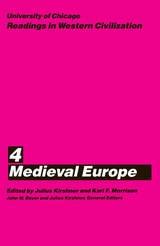
University of Chicago Readings in Western Civilization, Volume 4
Medieval EuropeEdited by Julius Kirshner and Karl F. Morrison
University of Chicago Press, 1986
Individual volumes provide essential background reading for courses covering specific eras and periods. The complete nine-volume series is ideal for general courses in history and Western civilization sequences.