Results by title
4 books match the query 'Medieval Literature'
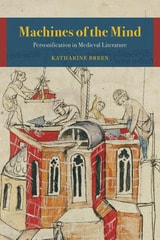
Machines of the Mind
Personification in Medieval LiteratureKatharine Breen
University of Chicago Press, 2021
In Machines of the Mind, Katharine Breen proposes that medieval personifications should be understood neither as failed novelistic characters nor as instruments of heavy-handed didacticism. She argues that personifications are instead powerful tools for thought that help us to remember and manipulate complex ideas, testing them against existing moral and political paradigms. Specifically, different types of medieval personification should be seen as corresponding to positions in the rich and nuanced medieval debate over universals. Breen identifies three different types of personification—Platonic, Aristotelian, and Prudentian—that gave medieval writers a surprisingly varied spectrum with which to paint their characters.
Through a series of new readings of major authors and works, from Plato to Piers Plowman, Breen illuminates how medieval personifications embody the full range of positions between philosophical realism and nominalism, varying according to the convictions of individual authors and the purposes of individual works. Recalling Gregory the Great’s reference to machinae mentis (machines of the mind), Breen demonstrates that medieval writers applied personification with utility and subtlety, employing methods of personification as tools that serve different functions. Machines of the Mind offers insight for medievalists working at the crossroads of religion, philosophy, and literature, as well as for scholars interested in literary character-building and gendered relationships among characters, readers, and texts beyond the Middle Ages.
[more]
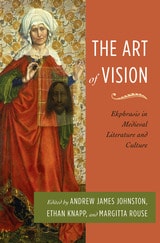
The Art of Vision
Ekphrasis in Medieval Literature and CultureEdited by Ethan Knapp, Andrew James Johnston, and Margitta Rouse
The Ohio State University Press, 2015
One of the most common ways of setting the arts in parallel, at least from the literary side, is through the popular rhetorical device of ekphrasis. The original meaning of this term is simply an extended and detailed, lively description, but it has been used most commonly in reference to painting or sculpture. In this lively collection of essays, Andrew James Johnston, Ethan Knapp, and Margitta Rouse offer a major contribution to the study of text–image relationships in medieval Europe. Resisting any rigid definition of ekphrasis, The Art of Vision is committed to reclaiming medieval ekphrasis, which has not only been criticized for its supposed aesthetic narcissism but has also frequently been depicted as belonging to an epoch when the distinctions between word and image were far less rigidly drawn. Examples studied range from the eleventh through the seventeenth centuries and include texts written in Medieval Latin, Medieval French, Middle English, Middle Scots, Middle High German, and Early Modern English.
The essays in this volume highlight precisely the entanglements that ekphrasis suggests and/or rejects: not merely of word and image, but also of sign and thing, stasis and mobility, medieval and (early) modern, absence and presence, the rhetorical and the visual, thinking and feeling, knowledge and desire, and many more. The Art of Vision furthers our understanding of the complexities of medieval ekphrasis while also complicating later understandings of this device. As such, it offers a more diverse account of medieval ekphrasis than previous studies of medieval text–image relationships, which have normally focused on a single country, language, or even manuscript.
The essays in this volume highlight precisely the entanglements that ekphrasis suggests and/or rejects: not merely of word and image, but also of sign and thing, stasis and mobility, medieval and (early) modern, absence and presence, the rhetorical and the visual, thinking and feeling, knowledge and desire, and many more. The Art of Vision furthers our understanding of the complexities of medieval ekphrasis while also complicating later understandings of this device. As such, it offers a more diverse account of medieval ekphrasis than previous studies of medieval text–image relationships, which have normally focused on a single country, language, or even manuscript.
[more]
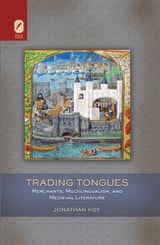
Trading Tongues
Merchants, Multilingualism, and Medieval LiteratureJonathan Hsy
The Ohio State University Press, 2013
Trading Tongues offers fresh approaches to the multilingualism of major early English authors like Geoffrey Chaucer, John Gower, Margery Kempe, and William Caxton, and lesser-known figures like French lyricist Charles d’Orléans. Juxtaposing literary works with contemporaneous Latin and French civic records, mixed-language merchant miscellanies, and bilingual phrasebooks, Jonathan Hsy illustrates how languages commingled in late medieval and early modern cities. Chaucer, a customs official for the Port of London, infused English poetry with French and Latin merchant jargon, and London merchants incorporated Latin and vernacular verse forms into trilingual account books.
Hsy examines how writers working in English, Latin, and French (and combinations thereof) theorized the rich contours of polyglot identity. In a range of genres—from multilingual lyrics, poems about urban life, and autobiographical narratives—writers found venues to consider their own linguistic capacities and to develop new modes of conceiving language contact and exchange. Interweaving close readings of medieval texts with insights from sociolinguistics and postcolonial theory, Trading Tongues not only illuminates how multilingual identities were expressed in the past; it generates new ways of thinking about cultural contact and language crossings in our own time.
[more]
Women’s Friendship in Medieval Literature
Edited by Karma Lochrie and Usha Vishnuvajjala
The Ohio State University Press, 2022
In Women’s Friendship in Medieval Literature, Karma Lochrie and Usha Vishnuvajjala bring together established scholars and new voices to illuminate a previously understudied but consequential element of life in the Middle Ages. Contributors focus on representations of women’s friendships in medieval European literature and their afterlives both to historicize them and draw out the finer nuances of the multitude of forms, affects, values, and ethics that emerge within those friendships. This volume examines works by Chaucer, Gower, Malory, Marie de France, female saints, and late-Middle Scots poets alongside lesser-known late medieval lyrics and Middle English romances to chart women’s friendships and their many and sometimes conflicting affinities with the cultural categories of gender, religion, politics, and sexuality. In addition to exploring the parameters of female friendship across a range of texts and historical contexts, contributors evaluate the political, religious, and civic structures negotiated in public and private and engage with the long history of theory and philosophy on friendship. The result is a theoretical and historical rubric for the future study of women’s friendships in medieval texts and beyond.
Contributors:
Penelope Anderson, Andrea Boffa, Jennifer N. Brown, Christine Chism, Melissa Ridley Elmes, Laurie Finke, Carissa M. Harris, Lydia Yaitsky Kertz, Clare A. Lees, Karma Lochrie, Gillian R. Overing, Alexandra Verini, Usha Vishnuvajjala, Stella Wang
Contributors:
Penelope Anderson, Andrea Boffa, Jennifer N. Brown, Christine Chism, Melissa Ridley Elmes, Laurie Finke, Carissa M. Harris, Lydia Yaitsky Kertz, Clare A. Lees, Karma Lochrie, Gillian R. Overing, Alexandra Verini, Usha Vishnuvajjala, Stella Wang
[more]