Results by title
4 books match the query 'Medieval period, 1066-1485'
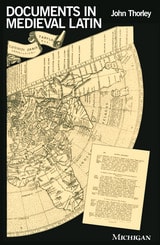
Documents in Medieval Latin
John Thorley
University of Michigan Press, 1998
This handbook of medieval Latin texts is designed for historians of the Middle Ages with some knowledge of Latin who wish to be able to read a wide range of original source material. It broadens the traditional scope of medieval Latin readers by including historical documents such as deeds and charters along with traditional literary samples. Within the context of a running narrative, Thorley starts with texts from the Anglo-Saxon period and then moves through subsequent centuries genre by genre. Each text is accompanied by a grammatical and historical commentary, both of which allow for independent study. In addition, all selections are translated at the back of the book.
Documents in Medieval Latin will be useful to students of medieval history, literature, and philosophy and those interested in reading more about the Middle Ages. Thorley's cheerful approach, the lively and representative selections of tests, and the documentary and epigraphic focus will prove valuable for those wishing to explore these vital original sources.
John Thorley teaches medieval Latin at Lancaster University.
[more]
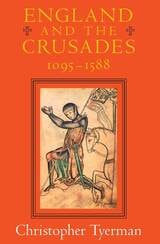
England and the Crusades, 1095-1588
Christopher Tyerman
University of Chicago Press, 1988
A potent mixt of salvation and adventure, the Crusades were one of the most prominent features of medieval Europe, reflecting and directing religious and secular movements in Western society for half a millennium. Christopher Tyerman offers the first book-length study of the role of England in the Crusades. Focusing on the courtroom and council chamber rather than the battlefield, he demonstrates the impact of the Crusades on the political and economic functions of English society.
Drawing on a wide range of archival, chronicle, and literary evidence, Tyerman brings to life the royal personalities, foreign policy, political intrigue, taxation and fundraising, and the crusading ethos that gripped England for hundreds of years.
"An ambitious task to undertake. . . . Tyerman has done the job not only thoroughly but brilliantly. . . . A highly impressive study, deserving rich praise and wide readership."—Norman Housley, Times Literary Supplement
"Christopher Tyerman has written a wonderful book. . . . [He] manages to confront thorny issues in scholarship and to contribute new perspectives on them."—William Chester Jordan, American Historical Review
"Tyerman provides valuable insights into preaching, recruitment, and the funding and organisation of crusading expeditions. . . . Fascinating new perspectives on English history."—Edward Powell, Sunday Times
"Impressive. . . . Tyerman's research has yielded valuable evidence, and his admirably lucid argument sheds new light on a complex and bloody period in English history."—Virginia Quarterly Review
[more]
Laughing at the Devil
Seeing the World with Julian of NorwichAmy Laura Hall
Duke University Press, 2018
Laughing at the Devil is an invitation to see the world with a medieval visionary now known as Julian of Norwich, believed to be the first woman to have written a book in English. (We do not know her given name, because she became known by the name of a church that became her home.) Julian “saw our Lord scorn [the Devil's] wickedness” and noted that “he wants us to do the same.” In this impassioned, analytic, and irreverent book, Amy Laura Hall emphasizes Julian's call to scorn the Devil. Julian of Norwich envisioned courage during a time of fear. Laughing at the Devil describes how a courageous woman transformed a setting of dread into hope, solidarity, and resistance.
[more]

The Victoria History of Hampshire
Medieval BasingstokeJohn Hare
University of London Press, 2017
Basingstoke is frequently seen as a very modern town, the product of the last decades of the 20th century. In reality it has a long, rich and prosperous history. From its beginnings c.1000 it became a significant market centre for the area around, and a place on the route to London from the west. By 1500 it was among the top 60 towns in England by wealth and taxpayers, and the centre of a major industrial area, whose manufactured cloths formed part of international patterns of trade. Moreover, it is well documented particularly for the 15th and 16th century, when it was at its peak, and should provide a useful addition to the limited number of studies of small medieval towns. Much of the old town has been swept away by the shopping centre, but something of the medieval footprint survives in its street beyond this, in a few surviving buildings and above all in its magnificent church. This book examines these features as well as the families, whether outsiders or locals, who made the most of the new thriving economic conditions, and whose dynamism helped create the town’s expansion.
[more]