Results by title

12 books match the query 'Meditation'

cover of America's National Cemeteries: A Meditation on History, Memory, and Place

America's National Cemeteries

A Meditation on History, Memory, and Place

Timothy B. Spears, Foreword by Roderick Gainer

University of Alabama Press, 2025

A poignant photographic tour of honor, sacrifice, and memory within America's national cemeteries

In America’s National Cemeteries, Timothy B. Spears takes the reader on a grand tour of these singular places of commemoration, the final resting place for more than four million American military personnel who died either in wartime, during their time of service, or after their honorable discharge. His absorbing account—part historical narrative and part travelogue—is enhanced by 180 of his remarkable photographs, which capture the spirit, beauty, and solemn remembrance to be found in each of the 156 national cemeteries across America.

Spears details the history of the cemeteries since their establishment during the American Civil War and explores their ongoing evolution and importance to American society and the commitment America has made to honoring its military dead. With headstones neatly arrayed in rows and each soldier typically buried in an identical fashion, the cemeteries symbolize an enduring connection between human mortality and national identity. They also reflect the nation’s persistent challenges with inequalities and injustice, violence and racism, lingering questions about “good” versus “bad” wars, and the vexed legacies of America’s military forays.

In this unique meditation on American history, memory, and place, Spears embraces the impact of the past on the present, offering an original perspective on the meaning of military service, mortality, and remembrance and how these national cemeteries have evolved into truly iconic and emblematic American spaces. The book also features a foreword by Roderick Gainer, Chief Curator of Arlington National Cemetery since 2013.
[more]
cover of Beautiful Work: A Meditation on Pain

Beautiful Work

A Meditation on Pain

Sharon Cameron

Duke University Press, 2000

The stories one tells about pain are profound ones. Nothing is more legible than these stories. But something is left out of them. If there were no stories, there might be a moment of innocence. A moment before the burden of the stories and their perceived causes and consequences. For Anna, the narrator of Beautiful Work, there were moments when it was not accurate to say in relation to pain "because of this‚" or "leading to that." They were lucid moments. And so she began to hunger for storylessness.
In order to understand the nature of pain, Anna undertakes a meditation practice. We tend to think of pain as self-absorbing and exclusively our own ("my pain," "I am in pain"). In distinction, Sharon Cameron’s Anna comes to explore pain as common property, and as the basis for a radically reconceived selfhood. Resisting the limitations of memoir, Beautiful Work speaks from experience and simultaneously releases it from the closed shell of personal ownership. Outside of the not quite inevitable stories we tell about it, experience is less protected, less compromised, and more vivid than could be supposed.
Beautiful Work brings to bear the same interest in consciousness and intersubjectivity that characterizes Cameron’s other work.
[more]
cover of Dying Modern: A Meditation on Elegy

Dying Modern

A Meditation on Elegy

Diana Fuss

Duke University Press, 2013

In Dying Modern, one of our foremost literary critics inspires new ways to read, write, and talk about poetry. Diana Fuss does so by identifying three distinct but largely unrecognized voices within the well-studied genre of the elegy: the dying voice, the reviving voice, and the surviving voice. Through her deft readings of modern poetry, Fuss unveils the dramatic within the elegiac: the dying diva who relishes a great deathbed scene, the speaking corpse who fancies a good haunting, and the departing lover who delights in a dramatic exit.

Focusing primarily on American and British poetry written during the past two centuries, Fuss maintains that poetry can still offer genuine ethical compensation, even for the deep wounds and shocking banalities of modern death. As dying, loss, and grief become ever more thoroughly obscured from public view, the dead start chattering away in verse. Through bold, original interpretations of little-known works, as well as canonical poems by writers such as Emily Dickinson, Randall Jarrell, Elizabeth Bishop, Richard Wright, and Sylvia Plath, Fuss explores modern poetry's fascination with pre- and postmortem speech, pondering the literary desire to make death speak in the face of its cultural silencing.
[more]
cover of Imagination, Meditation, and Cognition in the Middle Ages

Imagination, Meditation, and Cognition in the Middle Ages

Michelle Karnes

University of Chicago Press, 2011
In Imagination, Meditation, and Cognition in the Middle Ages, Michelle Karnes revises the history of medieval imagination with a detailed analysis of its role in the period’s meditations and theories of cognition. Karnes here understands imagination in its technical, philosophical sense, taking her cue from Bonaventure, the thirteenth-century scholastic theologian and philosopher who provided the first sustained account of how the philosophical imagination could be transformed into a devotional one. Karnes examines Bonaventure’s meditational works, the Meditationes vitae Christi, the Stimulis amoris, Piers Plowman, and Nicholas Love’s Myrrour, among others, and argues that the cognitive importance that imagination enjoyed in scholastic philosophy informed its importance in medieval meditations on the life of Christ. Emphasizing the cognitive significance of both imagination and the meditations that relied on it, she revises a long-standing association of imagination with the Middle Ages. In her account, imagination was not simply an object of suspicion but also a crucial intellectual, spiritual, and literary resource that exercised considerable authority.
[more]
cover of Inward: Vipassana Meditation and the Embodiment of the Self

Inward

Vipassana Meditation and the Embodiment of the Self

Michal Pagis

University of Chicago Press, 2019

Western society has never been more interested in interiority. Indeed, it seems more and more people are deliberately looking inward—toward the mind, the body, or both. Michal Pagis’s Inward focuses on one increasingly popular channel for the introverted gaze: vipassana meditation, which has spread from Burma to more than forty countries and counting. Lacing her account with vivid anecdotes and personal stories, Pagis turns our attention not only to the practice of vipassana but to the communities that have sprung up around it. Inward is also a social history of the westward diffusion of Eastern religious practices spurred on by the lingering effects of the British colonial presence in India. At the same time Pagis asks knotty questions about what happens when we continually turn inward, as she investigates the complex relations between physical selves, emotional selves, and our larger social worlds. Her book sheds new light on evergreen topics such as globalization, social psychology, and the place of the human body in the enduring process of self-awareness.
[more]
cover of Meditation as Spiritual Therapy: Bernard of Clairvaux's <i>De consideratione</i>

Meditation as Spiritual Therapy

Bernard of Clairvaux's <i>De consideratione</i>

Matthew McWhorter

Catholic University of America Press, 2024
Christian persons today might seek spiritual development and ponder the benefit of mindfulness exercises but also maintain concerns if they perceive such exercises to originate from other religious traditions. Such persons may not be aware of a long tradition of meditation practice in Christianity that promotes personal growth. This spiritual tradition receives a careful formulation by Christian mo- nastic authors in the twelfth century. One such teaching on meditation is found in the treatise De consideratione written by St. Bernard of Clairvaux (d. 1153) to Pope Eugene III (d. 1153). In textual passages where St. Bernard exhibits a clear concern for the mental health of the Pope (due to numerous ongoing ecclesial, political, and military problems), St. Bernard reminds Eugene III of his original monastic vocation and the meditation exercises associated with that vocation. The advice that St. Bernard gives to Eugene III can be received today in a way that provides a structure for Christian meditation practice which is relevant for personal develop- ment, spiritual direction, and civil psychotherapy that integrates a client’s spirituality into the course of treatment. St. Bernard thus might be interpreted as a teacher of a kind of Christian mindfulness that can benefit both a person’s mental health as well as a person’s relationship with God. Meditation as Spiritual Therapy examines the historical context of Bernard’s work, his purpose for writing it, as well as the numerous Christian sources he drew upon to formulate his teaching. Bernard’s teaching on the course of meditation itself is explored in depth and in dialogue with his other treatises, letters, and sermons. Lastly, a contemporary summary of Bernard’s teaching is provided with reflections concerning the relationship of this teaching to contemporary spiritual direction and spiritually integrated civil psychotherapy.
[more]
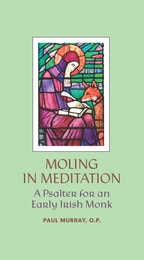
cover of Moling in Meditation: A Psalter for an Early Irish Monk

Moling in Meditation

A Psalter for an Early Irish Monk

Paul Murray

St. Augustine's Press, 2021

These quiet, surprising, amazing poems deliver to the reader fresh contact with wisdom for life––lessons we should have known had we paused a little more and looked, things we may have known and lost track of, insights we perhaps sense and now can finally grasp with these words of Moling––of Paul Murray––sharing with us his thoughts, his prayers, his stories of struggle and grace. These poems are “the hidden lost language of the soul” revealed.
Jeremy Driscoll, O.S.B. Abbot of Mount Angel Abbey
 
Paul Murray’s poetry is always a miracle of compression and economy without ever seeming sparse or austere. These luminous meditative pieces have the richness that comes from an intent focus on the everyday and the material as carrying immeasurable grace.
Rowan Williams, Former Archbishop of Canterbury

The present work contains poems and meditations voiced by Paul Murray for Moling, an Irish monk and poet of the 7th century. In the Irish tradition, Moling is the figure who most resembles St Francis of Assisi. He is a man, a saint, whose presence resists linear history, who yet walks toward us in wonder and myth. In Moling in Meditation, the poems, though quiet in their form and expression, represent nevertheless a fresh and, at times, bold exploration of states of soul and psyche which, in almost every age, accompany the spiritual journey. 
 
[more]
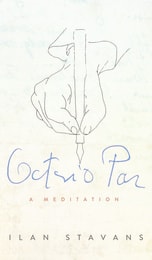
cover of Octavio Paz: A Meditation

Octavio Paz

A Meditation

Ilan Stavans

University of Arizona Press, 2001
Octavio Paz: Nobel Prize winner, author of The Labyrinth of Solitude and Sor Juana, or, the Traps of Faith, precursor and pathfinder, a guiding light of the Mexican intelligentsia in the twentieth century. In this small, memorable meditation on Octavio Paz as a thinker and man of action, Ilan Stavans—described by the Washington Post as "one of our foremost cultural critics" and by the New York Times as "the czar of Latino culture in the United States"—ponders Paz's intellectual courage against the ideological tapestry of his epoch and shows us what lessons can be learned from him. He does so by exploring such timeless issues as the crossroads where literature and politics meet, the place of criticism in society, and Mexico’s difficult quest to come to terms with its own history. Stavans reflects on Paz's personal struggle with Marxism and surrealism, his reflections on pachucos, his analysis of love and eroticism, his study of the life and legacy of Sor Juana Inés de la Cruz, and his influence as a magazine editor. But this extraordinary rumination is not only a thought-provoking appraisal of Paz; it is also a feast for the myriad admirers of Stavans, himself a spirited, mordant essayist who is not afraid of controversy. This explains why Richard Rodriguez has portrayed Stavans as "the rarest of North American writers—he sees the Americas whole," and then added, "Not since Octavio Paz has Mexico given us an intellectual so able to violate borders with learning and grace." Octavio Paz: A Meditation is a fitting addition to Stavans’s own oeuvre that will stimulate discerning readers.
[more]
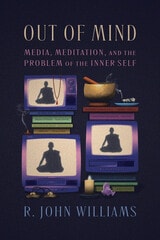
cover of Out of Mind: Media, Meditation, and the Problem of the Inner Self

Out of Mind

Media, Meditation, and the Problem of the Inner Self

R. John Williams

University of Chicago Press, 2026

A history of modern mindfulness meditation and a critique of it as a practice that deeply misunderstands human consciousness.

Mindfulness meditation is often presented as a simple practice of turning inward and quieting the world to discover an authentic “inner voice,” but the very idea that consciousness contains such a voice depends on a slew of contradictory beliefs about Buddhism, neuroscience, and more. In Out of Mind, R. John Williams challenges the core (and misguided) assumptions about human nature that shaped the development of modern meditation, revealing how they were informed by nineteenth-century theosophy, German idealism, Buddhist modernism, Heideggerian mindfulness, Cold War brainwashing, and even phenomena like sensory deprivation tanks. Against the notion that truth lies hidden in our brains, Williams argues that we are never sealed off from the world. Our consciousness extends beyond our own minds—into the intricate web of language, literature, art, and other people to which we are intimately connected.

[more]
cover of Piercing the Clouds: Lectio Divina and the Preparation for Ministry

Piercing the Clouds

Lectio Divina and the Preparation for Ministry

Kevin Zilverberg

Saint Paul Seminary Press, 2021
This book’s six essays pertain to the “piercing of the clouds,” or the experience of heavenly mysteries, which characterizes lectio divina practiced well. Moreover, these peer-reviewed essays give special attention to the practice of lectio divina during preparation for ministry, especially the ministry of Catholic priests. That being said, any current or prospective Bible-reader may profit from this book; most of its content applies to Catholic seminarians and literate Christians alike. Here follow brief descriptions of each chapter. Laurence Kriegshauser, OSB, begins the book with a chapter on the Western monastic tradition of lectio divina and seminary formation, including an historical survey of lectio divina, a description of its characteristics, and reflections on its practice in seminaries. Michael Magee reflects upon the implications of exegetical method for lectio divina, with a comparison and critique of three commentaries’ treatments of John 6. Konrad Schaefer, OSB, advocates for fostering growth and formation through lectio divina, beginning his chapter with a description of its theological underpinnings and then taking up some practical considerations for students. Marcin Kowalski focuses on meditatio of lectio divina following upon exegesis-informed lectio, with an examination of Romans 7:7–25 as a test case. Daniel Keating examines oratio and contemplatio (and actio) of lectio divina, giving attention to theologians from twelfth-century Carthusian Prior Guigo II to Pope Benedict XVI. Anthony Giambrone, OP, contributes the final essay, on searching the Scriptures and the mystery of preaching. For him, exquisitio (intellectual engagement) leads to supplicatio (prayerful supplication), which culminates in praedicatio (preaching).
[more]
cover of Taoist Meditation and Longevity Techniques

Taoist Meditation and Longevity Techniques

Edited by Livia Kohn, in cooperation with Yoshinobu Sakade

University of Michigan Press, 1989
Taoist Meditation and Longevity Techniques covers the major areas of Taoist meditation and longevity techniques in roughly chronological order. The book addresses itself to the China area specialist or the scholar of religion and the history of science who wishes to know more about (and perhaps even must teach) aspects of Chinese culture that involve Taoism and traditional medicine. [viii, ix]
Other topics include Japanese interpretations of longevity techniques, drugs and immortality, visualization and ecstatic experience, and qigong and gymnastics.
[more]
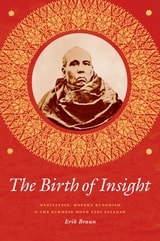
cover of The Birth of Insight: Meditation, Modern Buddhism, and the Burmese Monk Ledi Sayadaw

The Birth of Insight

Meditation, Modern Buddhism, and the Burmese Monk Ledi Sayadaw

Erik Braun

University of Chicago Press, 2013

Insight meditation, which claims to offer practitioners a chance to escape all suffering by perceiving the true nature of reality, is one of the most popular forms of meditation today. The Theravada Buddhist cultures of South and Southeast Asia often see it as the Buddha’s most important gift to humanity. In the first book to examine how this practice came to play such a dominant—and relatively recent—role in Buddhism, Erik Braun takes readers to Burma, revealing that Burmese Buddhists in the colonial period were pioneers in making insight meditation indispensable to modern Buddhism.

Braun focuses on the Burmese monk Ledi Sayadaw, a pivotal architect of modern insight meditation, and explores Ledi’s popularization of the study of crucial Buddhist philosophical texts in the early twentieth century. By promoting the study of such abstruse texts, Braun shows, Ledi was able to standardize and simplify meditation methods and make them widely accessible—in part to protect Buddhism in Burma after the British takeover in 1885. Braun also addresses the question of what really constitutes the “modern” in colonial and postcolonial forms of Buddhism, arguing that the emergence of this type of meditation was caused by precolonial factors in Burmese culture as well as the disruptive forces of the colonial era. Offering a readable narrative of the life and legacy of one of modern Buddhism’s most important figures, The Birth of Insight provides an original account of the development of mass meditation.
[more]