Results by title
8 books match the query 'Melanesia'
Body Thoughts
Andrew J. Strathern
University of Michigan Press, 1996
Encompassing Others
The Magic of Modernity in MelanesiaEdward LiPuma
University of Michigan Press, 2001
Focusing on the Maring people of Highland New Guinea and on the Westerners who interacted with them, Edward LiPuma presents issues from the perspectives of both sides. We hear the voice of the Anglican priest from San Francisco as well as the most powerful Maring shamans. Further, the book seeks to develop a theory of generations that helps explain how change accelerates and societies take on new directions across generations.
Theoretical, descriptive, but almost entirely free of jargon, this book is intended for all those who are interested in how the West's encompassment of other peoples influences how these others conceive of their past, imagine their future, and experience the present. It will have wide appeal for anthropologists and others concerned with colonialism, globalization, and the formation of the nation-state.
Edward LiPuma is Professor and Chair, Department of Anthropology, University of Miami.
From Primitive to Postcolonial in Melanesia and Anthropology
Bruce M. Knauft
University of Michigan Press, 1999

Michigan Family Farms and Farm Buildings
Landscapes of the Heart and MindHemalata Dandekar
University of Michigan Press, 2010
Eight family-farm case studies display farm buildings' relationship to the land they sit on, their function on the farm, the materials they're made with, the farm enterprises themselves, and the families who own them. Photographs, plans, elevations, and sections of typical, exemplary traditional farm buildings show the aesthetic and architectural qualities of those types of buildings across the state.
The ways in which the buildings serve the productive activities of the farm, shelter and nourish the people and livestock, yield a living, and enable the aspirations of farm people are shown in the words and photographs of the farmers themselves. The buildings form a window into the lives of Michigan's family farms and into the hearts and minds of the people who have lived and worked in them their entire lives.
Nation Making
Emergent Identities in Postcolonial MelanesiaRobert J. Foster, Editor
University of Michigan Press, 1997
In this theoretically sophisticated volume, contributors examine the process of nation making in Fiji, Papua New Guinea, the Solomon Islands, and Vanuatu- states that attained formal political independence between 1970 and 1980. The remarkable cultural diversity within these states demands close ethnographic study of different groups and their contesting definitions of nationhood and leads to highly original approaches.
The essays explore the political conditions and cultural assumptions that inform how Melanesians variously imagine a national community. The authors interpret a wide range of materials, from political speeches and official ceremonies of state to newspaper advertisements and life crisis rites. They demonstrate both how the legacies of divisive colonial rule, the weakness of the postcolonial state, and the exigencies of capitalist markets undermine the processes of nation making in contemporary Melanesia and how new forms of popular and consumer culture potentially shape an emergent national consciousness.
Comparative and historical in its orientation, this book will appeal to readers not only in anthropology but in political science, social history, and cultural studies. It will be of special value to those interested in comparative politics and history, Pacific studies, ethnicity and nationalism, and colonial and postcolonial studies.
Robert J. Foster is Assistant Professor of Anthropology, University of Rochester.
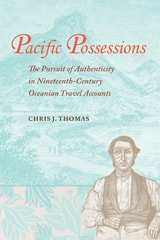
Pacific Possessions
The Pursuit of Authenticity in Nineteenth-Century Oceanian Travel AccountsChris J. Thomas
University of Alabama Press, 2021
Reimagining Oceania through the travel narratives that shaped the meaning of authenticity.
In Pacific Possessions: The Pursuit of Authenticity in Nineteenth-Century Oceanian Travel Accounts, Chris J. Thomas expands the literary canon on Polynesia and Melanesia beyond the giants, such as Herman Melville and Jack London, to include travel narratives by British and American visitors. These accounts were widely read and reviewed when they first appeared but have largely been ignored by scholars. For the first time, Thomas defines these writings as a significant literary genre.
Recovering these works allows us to reconceive of nineteenth-century Oceania as a vibrant hub of cultural interchange. Pacific Possessions recaptures the polyphony of voices that enlivened this space through the writing of these travelers, while also paying attention to their Oceanian interlocutors. Each chapter centers on a Pacific cultural marker, what Thomas refers to as each writer’s “possession”: the Tongan tattoo, the Hawaiian hula, the Fijian cannibal fork, and Robert Louis Stevenson’s cache of South Seas photographs.
Thomas analyzes how westerners formed narratives around these objects and what those objects meant within nineteenth-century Oceanian cultures. He argues that the accounts served to shape a version of Oceanian authenticity that persists today. The profiled traveler-writers had complex experiences, at times promoting exoticized exaggerations of so-called authentic Polynesian and Melanesian cultures and at other times genuinely engaging in cultural exchange. However, their views were ultimately compromised by a western lens. In Thomas’s words, “the authenticity is at once celebrated and written over.”

Person and Myth
Maurice Leenhardt in the Melanesian WorldJames Clifford
Duke University Press, 1992
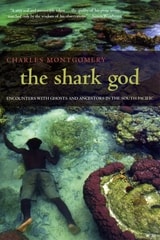
The Shark God
Encounters with Ghosts and Ancestors in the South PacificCharles Montgomery
University of Chicago Press, 2007
In the South Pacific, he discovers a world of sorcery and shark worship, where Christian and pagan rituals coexist and an ordinary day is marked by confrontations with America-worshiping cult leaders and militants alike. A defiantly original blend of history and memoir, anthropology and travel writing, The Shark God is ultimately a tale of personal and political transformation.
“The Shark God, a travel story as dark and twisted as one might ever wish to hear . . . reaches a superb climax with some apocalyptically page-turning scenes.”—Guardian
“A fascinating account of the drama of Melanesian life.”—Times Literary Supplement
“With exquisite writing, Montgomery lovingly captures the beauty and the horrors, the mysteries and the shams of the people and places he visits.”—Publishers Weekly
“A very real and memorable talent. . . . The endurance [Montgomery] displayed on his travels was admirable, the adventures he survived were tremendous, and the quality of his prose seems matched only by the wisdom of his observations.”—Simon Winchester, Globe and Mail (Toronto)