Results by title

7 books match the query 'Melodrama'
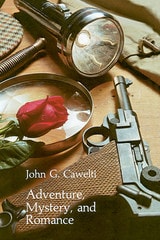
cover of Adventure, Mystery, and Romance: Formula Stories as Art and Popular Culture

Adventure, Mystery, and Romance

Formula Stories as Art and Popular Culture

John G. Cawelti

University of Chicago Press, 1976
In this first general theory for the analysis of popular literary formulas, John G. Cawelti reveals the artistry that underlies the best in formulaic literature. Cawelti discusses such seemingly diverse works as Mario Puzo's The Godfather, Dorothy Sayers's The Nine Tailors, and Owen Wister's The Virginian in the light of his hypotheses about the cultural function of formula literature. He describes the most important artistic characteristics of popular formula stories and the differences between this literature and that commonly labeled "high" or "serious" literature. He also defines the archetypal patterns of adventure, mystery, romance, melodrama, and fantasy, and offers a tentative account of their basis in human psychology.
[more]
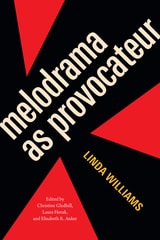
cover of Melodrama as Provocateur

Melodrama as Provocateur

Linda Williams. Edited by Christine Gledhill, Laura Horak, and Elisabeth R. Anker

Duke University Press, 2026
As one of the most influential contemporary film scholars, Linda Williams brought her critical feminist lens to some of society’s most maligned and underappreciated film genres. Melodrama as Provocateur showcases what was to be Williams's last project in which, insisting on melodrama as a cross-generic, cross-media mode, she investigates the divergence between French and American attitudes to film melodrama. A diverse group of scholars respond to her provocations, rethinking melodrama’s transnational, transmedia histories and potential futures. Their contributions examine how melodrama became, as Williams argues, the default mode of contemporary media, and demonstrate how it plays an increasingly powerful role in public discourse and political rhetoric today.
[more]
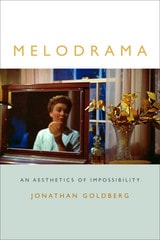
cover of Melodrama: An Aesthetics of Impossibility

Melodrama

An Aesthetics of Impossibility

Jonathan Goldberg

Duke University Press, 2016
Offering a new queer theorization of melodrama, Jonathan Goldberg explores the ways melodramatic film and literature provide an aesthetics of impossibility. Focused on the notion of what Douglas Sirk termed the "impossible situation" in melodrama, such as impasses in sexual relations that are not simply reflections of social taboo and prohibitions, Goldberg pursues films by Rainer Werner Fassbinder and Todd Haynes that respond to Sirk's prompt. His analysis hones in on melodrama's original definition--a form combining music and drama--as he explores the use of melodrama in Beethoven's opera Fidelio, films by Alfred Hitchcock, and fiction by Willa Cather and Patricia Highsmith, including her Ripley novels. Goldberg illuminates how music and sound provide queer ways to promote identifications that exceed the bounds of the identity categories meant to regulate social life. The interaction of musical, dramatic, and visual elements gives melodrama its indeterminacy, making it resistant to normative forms of value and a powerful tool for creating new potentials. 
 
[more]
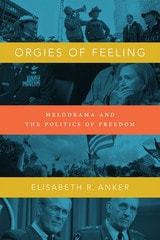
cover of Orgies of Feeling: Melodrama and the Politics of Freedom

Orgies of Feeling

Melodrama and the Politics of Freedom

Elisabeth R. Anker

Duke University Press, 2014

Melodrama is not just a film or literary genre but a powerful political discourse that galvanizes national sentiment to legitimate state violence. Finding virtue in national suffering and heroism in sovereign action, melodramatic political discourses cast war and surveillance as moral imperatives for eradicating villainy and upholding freedom. In Orgies of Feeling, Elisabeth R. Anker boldly reframes political theories of sovereignty, freedom, and power by analyzing the work of melodrama and affect in contemporary politics. Arguing that melodrama animates desires for unconstrained power, Anker examines melodramatic discourses in the War on Terror, neoliberal politics, anticommunist rhetoric, Hollywood film, and post-Marxist critical theory. Building on Friedrich Nietzsche's notion of "orgies of feeling," in which overwhelming emotions displace commonplace experiences of vulnerability and powerlessness onto a dramatic story of injured freedom, Anker contends that the recent upsurge in melodrama in the United States is an indication of public discontent. Yet the discontent that melodrama reflects is ultimately an expression of the public's inability to overcome systemic exploitation and inequality rather than an alarmist response to inflated threats to the nation.
 
[more]
cover of Stage Blood: Vampires of the 19th Century Stage

Stage Blood

Vampires of the 19th Century Stage

Roxana Stuart

University of Wisconsin Press, 1994
The vampire originally took on its characteristics in the public imagination from a series of plays written and performed by some of the most important figures in nineteenth-century theater. This work is the first major study devoted to the vampire on stage; the author discusses the figure that preceded Dracula—Lord Ruthven—the subject of more than forty English, French, and American plays. The principal works are melodramas, but the vampire theme was also treated in tragedy, opera, ballet, burlesque, farce, burletta, and satire.
[more]
cover of The Elocutionists: Women, Music, and the Spoken Word

The Elocutionists

Women, Music, and the Spoken Word

Marian Wilson Kimber

University of Illinois Press, 2017

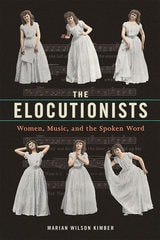
Emerging in the 1850s, elocutionists recited poetry or drama with music to create a new type of performance. The genre--dominated by women--achieved remarkable popularity. Yet the elocutionists and their art fell into total obscurity during the twentieth century.

Marian Wilson Kimber restores elocution with music to its rightful place in performance history. Gazing through the lenses of gender and genre, Wilson Kimber argues that these female artists transgressed the previous boundaries between private and public domains. Their performances advocated for female agency while also contributing to a new social construction of gender. Elocutionists, proud purveyors of wholesome entertainment, pointedly contrasted their "acceptable" feminine attributes against those of morally suspect actresses. As Wilson Kimber shows, their influence far outlived their heyday. Women, the primary composers of melodramatic compositions, did nothing less than create a tradition that helped shape the history of American music.
[more]
cover of The Melodramatic Moment: Music and Theatrical Culture, 1790–1820

The Melodramatic Moment

Music and Theatrical Culture, 1790–1820

Edited by Katherine G Hambridge and Jonathan Hicks

University of Chicago Press, 2018

We seem to see melodrama everywhere we look—from the soliloquies of devastation in a Dickens novel to the abject monstrosity of Frankenstein’s creation, and from Louise Brooks’s exaggerated acting in Pandora’s Box to the vicissitudes endlessly reshaping the life of a brooding Don Draper.

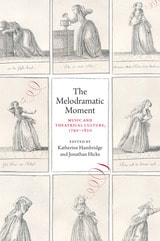
This anthology proposes to address the sometimes bewilderingly broad understandings of melodrama by insisting on the historical specificity of its genesis on the stage in late-eighteenth-century Europe.  Melodrama emerged during this time in the metropolitan centers of London, Paris, Vienna, and Berlin through stage adaptations of classical subjects and gothic novels, and they became famous for their use of passionate expression and spectacular scenery. Yet, as contributors to this volume emphasize, early melodramas also placed sound at center stage, through their distinctive—and often disconcerting—alternations between speech and music. This book draws out the melo of melodrama, showing the crucial dimensions of sound and music for a genre that permeates our dramatic, literary, and cinematic sensibilities today.

A richly interdisciplinary anthology, The Melodramatic Moment will open up new dialogues between musicology and literary and theater studies.
[more]