Results by title
8 books match the query 'Meltzer, Françoise'

Dark Lens
Imaging Germany, 1945Françoise Meltzer
University of Chicago Press, 2019
The ruins of war have long held the power to stupefy and appall. Can such ruins ever be persuasively depicted and comprehended? Can images of ruins force us to identify with the suffering of the enemy and raise uncomfortable questions about forgiveness and revenge?
Françoise Meltzer explores these questions in Dark Lens, which uses the images of war ruins in Nazi Germany to investigate problems of aestheticization and the representation of catastrophe. Through texts that give accounts of bombed-out towns in Germany in the last years of the war, painters’ attempts to depict the destruction, and her own mother’s photographs taken in 1945, Meltzer asks if any medium offers a direct experience of war ruins for the viewer. Refreshingly accessible and deeply personal, Dark Lens is a compelling look at the role images play in constructing memory.

For Fear of the Fire
Joan of Arc and the Limits of SubjectivityFrançoise Meltzer
University of Chicago Press, 2001
Engaging a number of theorists, and alternating between Joan's historical and cultural context, Meltzer also explores the ways in which postmodern thinkers question subjectivity. She argues that the way masculine subjects imagine Joan betrays their fear of death and necessitates the role of women as cultural others: enigmatic, mysterious, dark, and impossible. As such, Joan serves as a useful model of the limits and risks of subjectivity. For Meltzer, she is both the first modern and the last medieval figure. From the ecclesial jury that burned her, to the theorists of today who deny their attraction to the supernatural, the philosophical assumptions that inform Joan's story, as Meltzer ultimately shows, have changed very little.

Hot Property
The Stakes and Claims of Literary OriginalityFrançoise Meltzer
University of Chicago Press, 1994
Freud, inventor of "dream work," turns a blind eye upon the dreams that were the starting point of his predecessor Descartes's famous methode, the one man's obsession with originality mirroring the other's fear of plagiarism. The Holocaust poet Paul Celan, whose sense of identity and place resided in his work, is devastated by a charge of plagiarism. Colette's husband Willy outdoes himself, and his "lazy" wife as well, with his enactment of literary seriousness. Walter Benjamin's early interpreters, notably Hannah Arendt and Theodor Adorno, insidiously undermine the originality of his project . In each of these cases, Meltzer shows how a threat to a writer's status as creator betrays the larger fraud of the originality myth itself.
Fascinating for its insights into the ways originality is both at risk and at work in Western literary culture, Hot Property will engage all those who have an interest in questions of authorship, textual soveriegnty, and the legitimacy of the critical establishment.

Saints
Faith without BordersEdited by Françoise Meltzer and Jas Elsner
University of Chicago Press, 2011
While the modern world has largely dismissed the figure of the saint as a throwback, we remain fascinated by excess, marginality, transgression, and porous subjectivity—categories that define the saint. In this collection, Françoise Meltzer and Jas Elsner bring together top scholars from across the humanities to reconsider our denial of saintliness and examine how modernity returns to the lure of saintly grace, energy, and charisma.
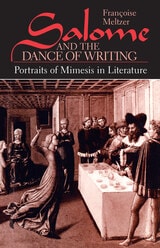
Salome and the Dance of Writing
Portraits of Mimesis in LiteratureFrançoise Meltzer
University of Chicago Press, 1987
Meltzer's readings of textual portraits—in the Gospel writers and Huysmans, Virgil and Stendhal, the Old Testament and Apuleius, Hawthorne and Poe, Kafka and Rousseau, Walter Scott and Mme de Lafayette—reveal an interplay of control and subversion: writing attempts to veil the visual and to erase the sensual in favor of "meaning," while portraiture, with its claims to bringing the natural object to "life," resists and eludes such control. Meltzer shows how this tension is indicative of a politics of repression and subversion intrinsic to the very act of representation. Throughout, she raises and illuminates fascinating issues: about the relation of flattery to caricature, the nature of the uncanny, the relation of representation to memory and history, the narcissistic character of representation, and the interdependency of representation and power.
Writing, thinking, speaking, dreaming, acting—the extent to which these are all controlled by representation must, Meltzer concludes, become "consciously unconscious." In the textual portrait, she locates the moment when this essential process is both revealed and repressed.
Seeing Double
Baudelaire's ModernityFrançoise Meltzer
University of Chicago Press, 2011
The poet Charles Baudelaire (1821–1867) has been labeled the very icon of modernity, the scribe of the modern city, and an observer of an emerging capitalist culture. Seeing Double reconsiders this iconic literary figure and his fraught relationship with the nineteenth-century world by examining the way in which he viewed the increasing dominance of modern life. In doing so, it revises some of our most common assumptions about the unresolved tensions that emerged in Baudelaire’s writing during a time of political and social upheaval.
Françoise Meltzer argues that Baudelaire did not simply describe the contradictions of modernity; instead, his work embodied and recorded them, leaving them unresolved and often less than comprehensible. Baudelaire’s penchant for looking simultaneously backward to an idealized past and forward to an anxious future, while suspending the tension between them, is part of what Meltzer calls his “double vision”—a way of seeing that produces encounters that are doomed to fail, poems that can’t advance, and communications that always seem to falter. In looking again at the poet and his work, Seeing Double helps to us to understand the prodigious transformations at stake in the writing of modern life.

Signature Derrida
Jacques Derrida
University of Chicago Press, 2013

The Trial(s) of Psychoanalysis
Françoise Meltzer
University of Chicago Press, 1988