Results by title

4 books match the query 'Memory in art'
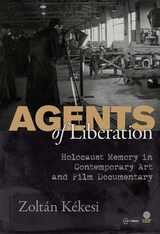
cover of Agents of Liberations: Holocaust Memory in Contemporary Art and Documentary Film

Agents of Liberations

Holocaust Memory in Contemporary Art and Documentary Film

Zoltán Kékesi

Central European University Press, 2015
The book explores representations of the Holocaust in contemporary art practices. Through carefully selected art projects, the author illuminates the specific historical, cultural, and political circumstances that influence the way we speak—or do not speak—about the Holocaust. The book's international focus brings into view film projects made by key artists reflecting critically upon forms of Holocaust memory in a variety of geographical contexts. Kékesi connects the ethical implications of the memory of the Holocaust with a critical analysis of contemporary societies, focusing upon artists who are deeply engaged in doing both of the above within three regions: Eastern Europe (especially Poland), Germany, and Israel. The case studies apply current methods of contemporary art theory, unfolding their implications in terms of memory politics and social critique.
[more]
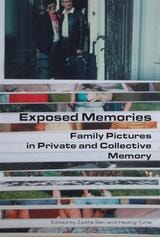
cover of Exposed Memories: Family Pictures in Private and Collective Memory

Exposed Memories

Family Pictures in Private and Collective Memory

Hedvig Turai

Central European University Press, 2010
Within the larger context of cultural memory, family pictures have become one of the most intriguing multi- and interdisciplinary fields of investigation in the past decade. This field brings together artists working in different media (e.g. documentary photography and film, photo-based painting and installations, digital art, collage, montage, comics, etc.) as well as academics, critics, theorists and writers working in a wide range of disciplines including literature, history, art history, sociology, anthropology, psychoanalysis, film and media studies, visual culture studies, gender studies, postcolonial studies, and word and image studies. This volume intends to offer a broad, panoramic view of the topic combining West and East European as well as American perspectives.
[more]
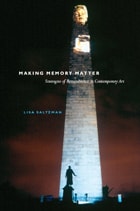
cover of Making Memory Matter: Strategies of Remembrance in Contemporary Art

Making Memory Matter

Strategies of Remembrance in Contemporary Art

Lisa Saltzman

University of Chicago Press, 2006

In an ancient account of painting’s origins, a woman traces the shadow of her departing lover on the wall in an act that anticipates future grief and commemoration. Lisa Saltzman shows here that nearly two thousand years after this story was first told, contemporary artists are returning to similar strategies of remembrance, ranging from vaudevillian silhouettes and sepulchral casts to incinerated architectures and ghostly processions. 

Exploring these artists’ work, Saltzman demonstrates that their methods have now eclipsed painting and traditional sculpture as preeminent forms of visual representation. She pays particular attention to the groundbreaking art of Krzysztof Wodiczko, who is known for his projections of historical subjects; Kara Walker, who creates powerful silhouetted images of racial violence in American history; and Rachel Whiteread, whose work centers on making casts of empty interior spaces. Each of the artists Saltzman discusses is struggling with the roles that history and memory have come to play in an age when any historical statement is subject to question and doubt. In identifying this new and powerful movement, she provides a framework for understanding the art of our time.
[more]
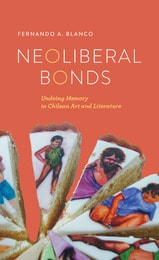
cover of Neoliberal Bonds: Undoing Memory in Chilean Art and Literature

Neoliberal Bonds

Undoing Memory in Chilean Art and Literature

Fernando A. Blanco

The Ohio State University Press, 2015

Fernando A. Blanco’s Neoliberal Bonds: Undoing Memory in Chilean Art and Literature analyzes the sociocultural processes that have reshaped subjectivities in post-Pinochet Chile. By creatively exploring the intersections among memory, gender, post-trauma, sociology, psychoanalysis, and neoliberalism, Neoliberal Bonds draws on Lacan’s notion of perversion to critique the subjective fantasies that people create to compensate for the loss of the social bond in the wake of a dictatorship founded on individualism, competition, and privatization.
 
Neoliberal Bonds vehemently criticizes how Chile’s transition governments, through a series of political and legal maneuvers, created the state’s official memory narratives. Blanco argues that the state, the media, academia, and the neoliberal market colluded to colonize and mediatize the “memory scene.” In contrast to these official narratives, Neoliberal Bonds analyzes alternative memory accounts within the visual arts and literature that push back against the state, its institutions, and its economic allies. These alternative memory narratives highlight the ontological fracture of the new neoliberal subjects; they also bring into sharp relief the urgent need for democratization that still poses a challenge to Chile a quarter century after its “transition to democracy” began.
[more]