Results by title
2 books match the query 'Men's movement'
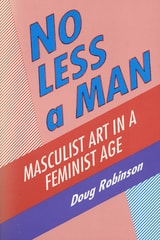
No Less a Man
Masculist Art in a Feminist AgeDoug Robinson
University of Wisconsin Press, 1994
Robert B. Parker's detective Spenser. John Rambo, created by David Morrell and played on the silver screen by Sylvester Stallone. Bruce Springsteen. All three, Douglas Robinson claims, are central figures in a new form of popular men’s art: art that explores what it means to be a man in a feminist age. Robinson develops a three-stage transformation myth out of Joseph Campbell’s studies of hero mythology: the road of trials, on which repressive “normality” is tested and found lacking (Spenser); a symbolic death in which defensive rational ego-structures are surrendered (the Rambo of First Blood); and regeneration and return, the gradual rebirth of masculinity in a redemptive transformation (Springsteen).
[more]
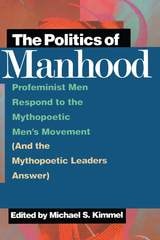
The Politics of Manhood
Profeminist Men Respond to the Mythopoetic Men's Movement (And the Mythopoetic Leaders Answer)edited by Michael S. Kimmel
Temple University Press, 1995
The concept and reality of revolution continue to pose some of the most challenging and important questions in the world today. What causes revolution? Why do some people participate in revolutionary events while others do not? What is the role of religion and ideology in causing and sustaining revolution? Why do some revolutions succeed and some fail? These questions have preoccupied philosophers and social scientists for centuries. In Revolution, Michael S. Kimmel examines why the study of revolution has attained such importance and he provides a systematic historical analysis of key ideas and theories.
The book surveys the classical perspectives on revolution offered by nineteenth- and early twentieth-century theorists, such as Marx, Weber, Durkheim, Tocqueville, and Freud. Kimmel argues that their perspectives on revolution were affected by the reality of living through the revolutions of 1848 and 1917, a reality that raised crucial issues of class, state, bureaucracy, and motivation.
The author then turns to the interpretations of revolution offered by social scientists in the post-World War II period, especially modernization theory and social psychological theories. Here, he contends that the relative quiescence of the 1950s cast revolutions in a different light, which was poorly suited to explain the revolutionary upheavals that have marked the 1960s, 1970s, and 1980s. With reference to the work of Barrington Moore, Theda Skocpol, Immanuel Wallerstein, and Charles Tilly, among others, Kimmel develops the criteria for a structural theory of revolution. This lucid, accessible account includes contemporary analyses of the Nicaraguan, Iranian, and Angolan revolutions.
[more]