Results by title
8 books match the query 'Mennonite'

A Cappella
Mennonite Voices in PoetryAnn Hostetler
University of Iowa Press, 2003
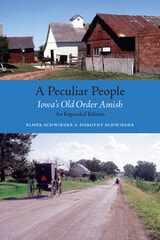
A Peculiar People
Iowa's Old Order AmishElmer Schwieder
University of Iowa Press, 1975
A Peculiar People explores the origin and growth of the Old Order Amish in Iowa, their religious practices, economic organization, family life, the formation of new communities, and the vital issue of education. Included also are appendixes giving the 1967 “Act Relating to Compulsory School Attendance and Educational Standards”; a sample “Church Organization Financial Agreement,” demonstrating the group’s unusual but advantageous mutual financial system; and the 1632 Dortrecht Confession of Faith, whose eighteen articles cover all the basic religious tenets of the Old Order Amish.
Thomas Morain’s new essay describes external and internal issues for the Iowa Amish from the 1970s to today. The growth of utopian Amish communities across the nation, changes in occupation (although The Amish Directory still lists buggy shop operators, wheelwrights, and one lone horse dentist), the current state of education and health care, and the conscious balance between modern and traditional ways are reflected in an essay that describes how the Old Order dedication to Gelassenheit—the yielding of self to the interests of the larger community—has served its members well into the twenty-first century.

Cast a Blue Shadow
An Amish Country MysteryP. L. Gaus
Ohio University Press, 2003
In Cast a Blue Shadow, his fourth Amish mystery, P. L. Gaus spins a suspenseful tale of power, pride, and tested faith. As always, Gaus explores the threshold of culture and faith among the Amish sects and their English neighbors, combining it here with the political divisions unique to the academic world.
After an early winter blizzard in Holmes County, Ohio, a wealthy socialite is found murdered in her mansion. That same morning, a troubled student, Martha Lehman, turns up at her psychiatrist’s office, bloody and unable to speak.
Professor Michael Branden and Sheriff Bruce Robertson begin an investigation that threatens to tear Millersburg College apart. Mute for many years as a child, Martha is once again unable (or unwilling) to speak. As Branden wrestles with the murder of the college’s leading benefactor, the real story of Martha Lehman begins to emerge—born Amish, converted to Mennonite, and drawn to the “English” world for the worst of reasons.
This new edition of Cast a Blue Shadow features an exclusive interview with the author, reading group materials, and a detailed map and driving guide to Holmes County, Ohio, with everything one needs to visit the iconic scenes depicted in the story.
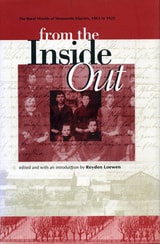
From the Inside Out
The Rural Worlds of Mennonite DiaristsRoyden Loewen
University of Manitoba Press, 1999
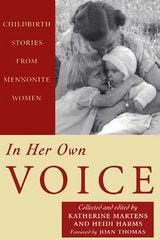
In Her Own Voice
Childbirth Stories from Mennonite WomenKatherine Martens
University of Manitoba Press, 1997
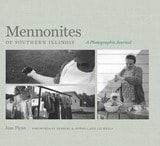
Mennonites of Southern Illinois
A Photographic JournalJane Flynn, with forewords by Herbert K. Russell and Liz Wells
Southern Illinois University Press, 2024
WINNER, Certificate of Excellence in “Publications – Other” from the Illinois State Historical Society’s 2025 Best of Illinois History Awards!
“In the World But Not of It”
Offering a glimpse into a world largely misunderstood by mainstream society, this book documents the period of eight years that Jane Flynn practiced with Mennonites in two different Southern Illinois communities: Stonefort, and Mount Pleasant in Anna. Despite her status as an outsider, Flynn was welcomed and allowed to photograph the Mennonites in their homes, making applesauce, farming, and beekeeping.
Escaping persecution from the Catholic Church in Europe, the Mennonites arrived in America in 1683, settling in what is now Pennsylvania. Today, they live in almost all 50 states, Canada, and South America. To reflect the Mennonites’ manual-labor lifestyle, Flynn processed her black-and-white photographs by hand and hand-printed them in a dark room. The imagery explores the Mennonites’ labors, leisure, and faith by documenting their homes, places of work and worship, and the Illinois Ozark landscape they inhabit.
Similar to the Amish and the Quakers, Mennonites consider the Bible the supreme authority and insist on a separation between church and state. To enact that separation, they distinguish themselves from society in speech, dress, business, recreation, education, pacifism, and by refusing to participate in politics. They believe in nonconformity to the world, discipleship, and being born again through adult baptism. With Mennonites of Southern Illinois, Jane Flynn provides representation for these closed communities and illustrates the Mennonites’ struggle to find and maintain balance between rustic and modern life while remaining faithful to their religious beliefs.
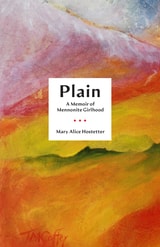
Plain
A Memoir of Mennonite GirlhoodMary Alice Hostetter
University of Wisconsin Press, 2022
This quietly powerful memoir of longing and acceptance casts a humanizing eye on a little-understood American religious tradition and a woman’s striving to grow within and beyond it.

Visits with the Amish
Impressions of the Plain LifeLinda Egenes
University of Iowa Press, 2000
Who are the “plain people,” the men and women who till their fields with horse and plow, travel by horse and buggy, live without electricity and telephones, and practice “help thy neighbor” in daily life? Linda Egenes visited with her Old Order Amish neighbors in southeast Iowa for thirteen years before writing this informative and companionable introduction to their lifeways.
Drawn to their slower pace of life and their resistance to the lures of a consumer society, Egenes found a warm welcome among the Amish, and in return she has given us an equally warm perspective on Amish family life as she experienced it. The Amish value harmony in family life above all, and Egenes found an abundance of harmony as she savored homemade ice cream in a kitchen where the refrigerator ran on kerosene, learned to milk a two-bucket cow, helped cook dinner for nine in a summer kitchen, spent the day in a one-room schoolhouse, and sang “The Hymn of Praise” in its original German at Sunday service.
Whether quilting at a weekly sewing circle above the Stringtown Grocery, playing Dutch Blitz and Dare Base with schoolchildren, learning the intricacies of harness making, or mulching strawberries in a huge garden, Egenes was treated with the kindness, respect, and dignity that exemplify the strong community ties of the Amish. Her engaging account of her visits with the Amish, beautifully illustrated with woodcuts by Caldecott Medal winner Mary Azarian, reveals the serene and peaceful ways of a plain people whose lives are anything but plain.