Results by title
6 books match the query 'Menominee Indians'
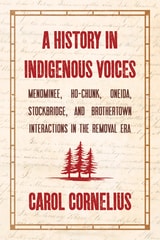
A History in Indigenous Voices
Menominee, Ho-Chunk, Oneida, Stockbridge, and Brothertown Interactions in the Removal EraCarol Cornelius
Wisconsin Historical Society Press, 2023
Treaties made in the 1800s between the United States and the Indigenous nations of what is now Wisconsin have had profound influence on the region’s cultural and political landscape. Yet few people realize that in the early part of that century, the Menominee and Ho-Chunk Nations of Wisconsin signed land treaties with several Indigenous nations from New York State. At the onset of the removal era, these eastern nations, including the Oneida Nation and the Six Nations Confederacy, were under constant pressure from the federal government and land speculators to move to lands around Green Bay and Lake Winnebago.
In this groundbreaking book, Carol A. Cornelius has compiled a careful account of these nation-to-nation treaties, in large part in the words of those Indigenous leaders who served as the voices and representatives of their nations. Drawing on a rich collection of primary sources, Cornelius walks readers through how, why, and for whom these treaties were made and how the federal government’s failure and unwillingness to acknowledge their legitimacy led to the further loss of Indigenous lands. The living documents transcribed here testify to the complexity and sovereignty of Indigenous governance then and now, making this volume a vital resource for historians and an accessible introduction to Indigenous treatymaking in Wisconsin.
Winner of the 2024 Wisconsin Historical Society’s Book of Merit Award
Finalist for the 2023 Foreword INDIES Book of the Year Award for Adult Nonfiction History
Culture and Resource Conflict
Why Meanings MatterDouglas L. Medin
Russell Sage Foundation, 2006
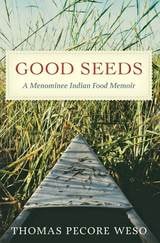
Good Seeds
A Menominee Indian Food MemoirThomas Pecore Weso
Wisconsin Historical Society Press, 2027
To the Menominee people, the "good seeds” of life are the manomin, or wild rice, that also gives the tribe its name. In this unique food memoir, Tribal member Thomas Pecore Weso takes readers on a cook’s journey through Wisconsin’s North Woods tribal lands, connecting Menominee food—beaver, trout, blackberry, wild rice, maple sugar, partridge—to the colorful individuals who taught him Indigenous values and traditions. Featuring more than forty recipes, Good Seeds keeps those traditions alive for future generations.
With a rare perspective as a Native American anthropologist and artist, Weso mixes a poignant personal story with the seeds of Menominee cooking traditions. He tells of the foods and the people who helped shape the person he became. His grandfather Moon was a medicine man, whose morning prayers formed the foundation for all the day’s meals. His grandmother Jennie “made fire” each morning in a wood-burning stove and oversaw huge breakfasts of wild game, fish, and fruit pies. His uncles taught him to hunt bear, deer, squirrels, raccoons, and skunks for the daily larder. Along with authentic family recipes, Weso recalls favorite foods served at the Menominee fair and at local diners.
In Good Seeds, adventurous cooks will gain insight and inspiration from Weso’s recipes, and readers of all stripes will appreciate the often-humorous stories about reservation life during the mid-twentieth century.

Little Hawk and the Lone Wolf
A MemoirRaymond Kaquatosh
Wisconsin Historical Society Press, 2014
After his father’s death, eight-year-old Ray was sent to an Indian boarding school in Keshena. There he experienced isolation and despair, but also comfort and kindness. Upon his return home, Ray remained a lonely boy in a full house until he met and befriended a lone timber wolf. The unusual bond they formed would last through both their lifetimes. As Ray grew into a young man, he left the reservation more frequently. Yet whenever he returned—from school and work, from service in the Marines, and finally from postwar Wausau with his future wife—the wolf waited.
In this rare first-person narrative of a Menominee Indian’s coming of age, Raymond Kaquatosh shares a story that is wise and irreverent, often funny, and in the end, deeply moving.
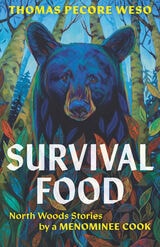
Survival Food
North Woods Stories by a Menominee CookThomas Pecore Weso
Wisconsin Historical Society Press, 2023
In these coming-of-age tales set on the Menominee Indian Reservation of the 1980s and 1990s, Thomas Pecore Weso explores the interrelated nature of meals and memories. As he puts it, “I cannot separate foods from the moments in my life when I first tasted them.” Weso’s stories recall the foods that influenced his youth in northern Wisconsin: subsistence meals from hunted, fished, and gathered sources; the culinary traditions of the German, Polish, and Swedish settler descendants in the area; and the commodity foods distributed by the government—like canned pork, dried beans, and powdered eggs—that made up the bulk of his family’s pantry. His mom called this “survival food.”
These stories from the author’s teen and tween years—some serious, some laugh-out-loud funny—will take readers from Catholic schoolyards to Native foot trails to North Woods bowling alleys, while providing Weso’s perspective on the political currents of the era. The book also contains dozens of recipes, from turtle soup and gray squirrel stew to twice-baked cheesy potatoes. This follow-up to Weso’s Good Seeds: A Menominee Indian Food Memoir is a hybrid of modern foodways, Indigenous history, and creative nonfiction from a singular storyteller.
2024 Wisconsin Library Association Outstanding Achievement Award
2024 PEN Oakland Josephine Miles Award for Excellence
Silver winner of the 2023 Midwest Book Award for Cookbooks/Crafts/Hobbies
Thomas Pecore Weso’s Survival Food was selected by the Wisconsin Center for the Book as the Wisconsin entry in the “Great Reads from Great Places” program of the Library of Congress.
“This book is not only about survival food, but about the singular beauty, creativity, and fortitude that comes out of that survival.”
—Chef Sean Sherman, author, The Sioux Chef’s Indigenous Kitchen
“Survival Food is interesting because it’s one part cookbook, three parts memoir, one part history, and one part multidisciplinary exploration of its setting, northern Wisconsin."
—James Norton, The Cookbook Test
“Nothing brings people together like good food and good stories. There’s an abundance of both in Thomas Pecore Weso’s latest memoir. As Weso attests, food can bring back happy, loving memories of times that were far from happy. Even a tray of funeral sandwiches brings a kind of comfort. This is a wonderful, honest portrait of northeastern Wisconsin, enlightening even to those of us who call this area home.”
—Jared Santek, Founder & Artistic Director, Write On Door County
“Survival Food provides ample nourishment for the mind and body. . . . The stories, told with humor and affection, are complemented by recipes ranging from mouth-watering instructions for cooking wild asparagus to ever-so-interesting advice for preparing bear stew.”
—Lucille Lang Day, author of Birds of San Pancho and Other Poems of Place and coeditor of Red Indian Road West: Native American Poetry from California
“His grandmother cooked according to Native traditions; his mother, ‘a nontraditional college student during my teens,’ resorted to instant meals. His grandfather was town constable and days spent with him brought Weso to the meatloaf, sausage and sauerkraut of German and Polish neighbors. Uncle Buddy’s flash car brings buckwheat pancakes to Weso’s mind, and he lived for a time near Cheese Box Curve—so called after a truck hauling dairy products overturned. Weso includes a few recipes, but mostly, Survival Food is an entertaining look back at life in Wisconsin’s rural north.”
—David Luhrssen, Shepherd Express
“Survival Food: North Woods Stories by a Menominee Cook by Thomas Pecore Weso is a posthumous sequel to his celebrated collection of family stories, Good Seeds: A Menominee Food Memoir. . . . Rich with captivating tales that include driving a convertible on logging roads, agreeing on terms before throwing eggs at passing cars, and his grandmother’s brief stay in a jailhouse she’d later purchase, Weso’s entries offer readers catharsis—demonstrating how to laugh, boast, debate, eat, mourn, and heal.”
—Ryan Winn, College of Menominee Nation, Tribal College Journal
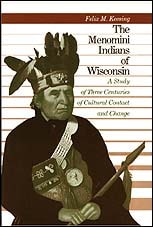
The Menomini Indians of Wisconsin
A Study of Three Centuries of Cultural Contact and ChangeFelix M. Keesing
University of Wisconsin Press, 1987
The Menomini, a peaceful people, lived by farming, hunting, fishing, and gathering wild rice. Perhaps because of their peaceful nature their name was not generally found in the white military annals, and they were largely unknown until 1892, when Walter James Hoffman published a detailed ethnographic account of them.
Felix Keesing's classic 1939 work on the Menomini is one of the most detailed, authoritative, and useful accounts of their history and culture. It superseded Hoffman's earlier work because of Keesing's modern methods of research. This work was among the first monographs on an American Indian people to employ a model of acculturation, and it is also an excellent early example of what is now called ethnohistory. It served as a model of anthropological research for decades after its publication.
Keesing's work, reprinted in this new Wisconsin edition, will continue to serve as a comprehensive introduction for the general reader, a book respected by both anthropologists and historians, and by the Menomini themselves. It is still the most important study of Menomini life up until 1939.