Results by title
7 books match the query 'Menstruation'
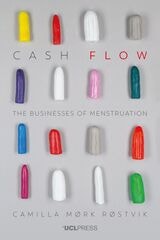
Cash Flow
The Businesses of MenstruationCamilla Mørk Røstvik
University College London, 2022
Commerce and menstruation from the twentieth century to today.
The menstrual product industry has played a large role in shaping the past hundred years of menstrual culture, including technological innovation, creative advertising, and education in classrooms. How much do we know about this sector and how has it changed in later decades? What constitutes “the industry,” who works in it, and how is it adapting to the current menstrual equity movement?
Cash Flow provides a new academic study of the menstrual corporate landscape that links its twentieth-century origins to the current day. Drawing on a range of previously unexplored archival materials and interviews with industry insiders, each chapter examines one key company and brand: Saba in Norway, Essity in Sweden, Tambrands in the Soviet Union, Procter & Gamble in Britain and Europe, Kimberly-Clark in North America, and start-ups Clue and Thinx. The book provides timely insights into a secretive and largely unexamined corporate world and the ongoing political and industry-wide debate about the cost of menstrual products. Cash Flow will be of interest to a wide range of groups within and outside academia, including scholars in the emerging field of critical menstruation studies and menstrual activists.
[more]

Forsaken
The Menstruant in Medieval Jewish MysticismSharon Faye Koren
Brandeis University Press, 2011
This book addresses a central question in the study of Jewish mysticism in the medieval and early modern periods: why are there no known female mystics in medieval Judaism, unlike contemporaneous movements in Christianity and Islam? Sharon Faye Koren demonstrates that the male rejection of female mystical aspirations is based in deeply rooted attitudes toward corporeality and ritual purity. In particular, medieval Jewish male mystics increasingly emphasized that the changing states of the female body between ritual purity and impurity disqualified women from the quest for mystical connection with God. Offering a provocative look at premodern rabbinical views of the female body and their ramifications for women’s spiritual development, Koren compares Jewish views with medieval Christian and Muslim views of both female menstruation and the possibility of female mystical experience.
[more]
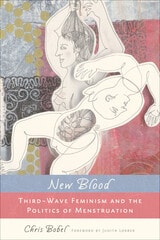
New Blood
Third-Wave Feminism and the Politics of MenstruationChris Bobel
Rutgers University Press, 2010
New Blood offers a fresh interdisciplinary look at feminism-in-flux. For over three decades, menstrual activists have questioned the safety and necessity of feminine care products while contesting menstruation as a deeply entrenched taboo. Chris Bobel shows how a little-known yet enduring force in the feminist health, environmental, and consumer rights movements lays bare tensions between second- and third-wave feminisms and reveals a complicated story of continuity and change within the women's movement.
Through her critical ethnographic lens, Bobel focuses on debates central to feminist thought (including the utility of the category "gender") and challenges to building an inclusive feminist movement. Filled with personal narratives, playful visuals, and original humor, New Blood reveals middle-aged progressives communing in Red Tents, urban punks and artists "culture jamming" commercial menstrual products in their zines and sketch comedy, queer anarchists practicing DIY health care, African American health educators espousing "holistic womb health," and hopeful mothers refusing to pass on the shame to their pubescent daughters. With verve and conviction, Bobel illuminates today's feminism-on-the-ground--indisputably vibrant, contentious, and ever-dynamic.
Through her critical ethnographic lens, Bobel focuses on debates central to feminist thought (including the utility of the category "gender") and challenges to building an inclusive feminist movement. Filled with personal narratives, playful visuals, and original humor, New Blood reveals middle-aged progressives communing in Red Tents, urban punks and artists "culture jamming" commercial menstrual products in their zines and sketch comedy, queer anarchists practicing DIY health care, African American health educators espousing "holistic womb health," and hopeful mothers refusing to pass on the shame to their pubescent daughters. With verve and conviction, Bobel illuminates today's feminism-on-the-ground--indisputably vibrant, contentious, and ever-dynamic.
[more]
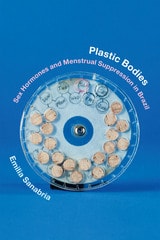
Plastic Bodies
Sex Hormones and Menstrual Suppression in BrazilEmilia Sanabria
Duke University Press, 2016
In Plastic Bodies Emilia Sanabria examines how sex hormones are enrolled to create, mold, and discipline social relations and subjectivities. She shows how hormones have become central to contemporary understandings of the body, class, gender, sex, personhood, modernity, and Brazilian national identity. Through interviews with women and doctors; observations in clinics, research centers and pharmacies; and analyses of contraceptive marketing, Sanabria traces the genealogy of menstrual suppression, from its use in population control strategies in the global South to its remarketing as a practice of pharmaceutical self-enhancement couched in neoliberal notions of choice. She links the widespread practice of menstrual suppression and other related elective medical interventions to Bahian views of the body as a malleable object that requires constant work. Given this bodily plasticity, and its potentially limitless character, the book considers ways to assess the values attributed to bodily interventions. Plastic Bodies will be of interest to all those working in medical anthropology, gender studies, and sexual and reproductive health.
[more]
Regulating Menstruation
Beliefs, Practices, InterpretationsEdited by Etienne van de Walle and Elisha P. Renne
University of Chicago Press, 2001
Menstruation, seen alternately as something negative—a "curse" or a failed conception—or as a positive part of the reproductive process to be celebrated as evidence of fertility, has long been a universal concern. How women interpret and react to menstruation and its absence reflects their individual needs both historically as well as in the contemporary cultural, social, economic, and political context in which they live. This unique volume considers what is known of women's options and practices used to regulate menstruation—practices used to control the periodicity, quantity, color, and even consistency of menses—in different places and times, while revealing the ambiguity that those practices present.
Originating from an Internet conference held in February 1998, this volume contains fourteen papers that have been revised and updated to cover everything from the impact of the birth control pill to contemporary views on reproduction to the pharmacological properties of various herbal substances, reflecting the historical, contemporary, and anthropological perspectives of this timely and complex issue.
Originating from an Internet conference held in February 1998, this volume contains fourteen papers that have been revised and updated to cover everything from the impact of the birth control pill to contemporary views on reproduction to the pharmacological properties of various herbal substances, reflecting the historical, contemporary, and anthropological perspectives of this timely and complex issue.
[more]
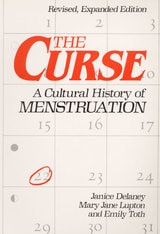
The Curse
A CULTURAL HISTORY OF MENSTRUATIONJanice Delaney, Mary Jane Lupton, and Emily Toth
University of Illinois Press, 1988
"In its hard headed, richly documented concreteness, it is worth a thousand polemics."
-- New York Times, from a review of the first edition
"The Curse deserves a place in every women's studies library collection."
-- Sharon Golub, editor of Lifting the curse of Menstruation
"A stimulating and useful book, both for the scholarly and the general reader."
-- Paula A. Treichler, co-author of A Feminist Dictionary
[more]
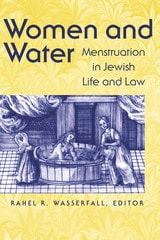
Women and Water
Menstruation in Jewish Life and LawEdited by Rahel Wasserfall
Brandeis University Press, 1999
The term Niddah means separation. During her menstrual flow and for several days thereafter, a Jewish woman is considered Niddah -- separate from her husband and unable to practice the sacred rituals of Judaism. Purification in a miqveh (a ritual bath) following her period restores full status as a wife and member of the Jewish community. In the contemporary world, debates about Niddah focus less on the literal exclusion of menstruating women from the synagogue, instead emphasizing relations between husband and wife and the general role of Jewish women in Judaism. Although this has been the law since ancient times, the meaning and practice of Niddah has been widely contested. Women and Water explores how these purity rituals have affected Jewish women across time and place, and shows how their own interpretation of Niddah often conflicted with rabbinic views. These essays also speak to contemporary feminist issues such as shaping women's identity, power relations between women and men, and the role of women in the sacred.
[more]