Results by title
18 books match the query 'Mental health services'

Between Families and Institutions
Mental Health and Biopolitical Paternalism in Contemporary ChinaZhiying Ma
Duke University Press, 2025

Crip Screens
Countering Psychiatric Media TechnologiesOlivia Banner
Duke University Press, 2025

Double Jeopardy
Adolescent Offenders with Mental DisordersThomas Grisso
University of Chicago Press, 2004
Double Jeopardy considers the newest data on the nature of youths' mental disorders—their relationships to delinquency, the values and limits of methods to treat them, and the common patterns of adolescent offending. That information is used to chart a rational course for fulfilling the juvenile justice system's duty—as a custodian of children in need of health care, as a legal system promoting fairness in youth adjudication, and as a protector of public safety—to respond to delinquent youths' mental disorders. Moreover, Double Jeopardy provides a scientific yet practical foundation for lawmakers, judges, attorneys, and mental health care professionals, as well as researchers who must fill the knowledge gaps that limit the juvenile justice system's abilities to meet youths' mental health needs.

Ethics in Mental Health and Deafness
Virginia Gutman
Gallaudet University Press, 2002
This volume explores ethical issues specific to working with deaf clients, particularly matters of confidentiality, managing multiple relationships, and the clinician’s competency to provide services, particularly in communicating with and understanding deaf people. Led by editor Virginia Gutman, a unique assembly of respected mental health professionals share their experiences and knowledge in working with deaf clients.
Irene Leigh commences Ethics in Mental Health and Deafness with her varied experiences as a deaf mental health practitioner, and Gutman follows with insights on ethics in the “small world” of the Deaf community. William McCrone discusses the law and ethics, and Patrick Brice considers ethical issues regarding deaf children, adolescents, and their families. In contrast, Janet Pray addresses concerns about deaf and hard of hearing older clients.
Minority deaf populations pose additional ethical aspects, which are detailed by Carolyn Corbett. Kathleen Peoples explores the challenges of training professionals in mental health services specifically for deaf clients. Closely related to these topics is the influence of interpreters with deaf clients in mental health settings, which Lynnette Taylor thoroughly treats. Ethics and Mental Health in Deafness also features a chapter on genetic counseling and testing for deafness by Kathleen Arnos. The final section, written by Robert Pollard, examines ethical conduct in research with deaf people, a fitting conclusion to a volume that will become required reading for all professionals and students in this discipline.

Global Mental Health
Latin America and Spanish-Speaking PopulationsJavier I Escobar
Rutgers University Press, 2020

Head-to-Head and Heart-to-Heart
Contemporary Discourse on Deaf Mental HealthCathy J. Chovaz
Gallaudet University Press, 2026

Managing Madness
Weyburn Mental Hospital and the Transformation of Psychiatric Care in CanadaErika Dyck
University of Manitoba Press, 2017

Of Others Inside
Insanity, Addiction And Belonging in AmericaDarin Weinberg, foreword by Bryan S. Turner
Temple University Press, 2005
Seeking to offer a new sociological understanding of the relationship between social exclusion and mental disability, Of Others Inside considers the general social conditions of homelessness, poverty, and social marginality in the U.S. Weinberg also explores questions about American perceptions of these conditions, and examines in great detail the social reality of mental disability and drug addiction without reducing people's suffering to simple notions of biological fate or social disorder.

Psychiatric Encounters
Madness and Modernity in Yucatan, MexicoReyes-Foster, Beatriz M.
Rutgers University Press, 2019

Reproductive Boundaries
Psychosocial Care and Pregnancy in SwitzerlandEdmée Ballif
Rutgers University Press, 2026
Reproductive Boundaries examines the shifting boundaries of prenatal care in Switzerland, focusing on the Pregnancy Support Center's innovative psychosocial model. By redefining the territory of care, the Center extends its reach beyond the medical domain, exemplifying the reproductivization of life, the increasing organization of various life aspects through a reproductive lens. The book explores how this approach challenges traditional borders between medical and psychosocial care, offering an alternative to Switzerland's heavily medicalized reproductive care. Through ethnographic insights into reproductive talk, it reveals how psychosocial advisors shift the boundaries of reproductive care, balancing support with broader state goals of reproductive governance. Set against Switzerland's history of stratified reproductive policies, the study critically examines how psychosocial care reshapes the landscape of pregnancy, raising questions about surveillance and evolving gender roles. This thought-provoking work invites readers to reconsider the limits and possibilities of care in a fragmented society.
This book is also freely available online as an open access digital edition. (https://www.rutgersuniversitypress.org/media/wysiwyg/documents/Reproductive_Boundaries_PDF.pdf)

Sons, Daughters, and Sidewalk Psychotics
Mental Illness and Homelessness in Los AngelesNeil Gong
University of Chicago Press, 2024
Drawing on the nuanced experiences of patients and care providers, Sons, Daughters, and Sidewalk Psychotics introduces readers to two drastically different forms of community psychiatric services: public safety net clinics focused on keeping people housed and out of jail and elite private care trying to push clients toward respectable futures.
In downtown Los Angeles, many people in psychiatric crisis only receive help after experiencing homelessness or arrest. Public providers engage in guerrilla social work to secure housing and safety, but these programs are rarely able to deliver true rehabilitation for psychological distress and addiction. Patients are free to refuse treatment or use illegal drugs—so long as they do so away from public view. Across town in West LA or Malibu, wealthy people diagnosed with serious mental illness attend luxurious treatment centers. Programs may offer yoga and organic meals alongside personalized therapeutic treatments, but patients can feel trapped, as their families pay exorbitantly to surveil and “fix” them. Meanwhile, middle-class families—stymied by private insurers, unable to afford elite providers, and yet not poor enough to qualify for social services—struggle to find care at all.
Examining this divergent treatment of people facing similar mental struggles, Gong raises provocative questions about urban policy, individual freedom, and what it would take to create a fundamentally different psychiatric system—one that will meet the needs of patients, their loved ones, and society at large.

The Dilemma of Federal Mental Health Policy
Radical Reform or Incremental Change?Grob, Gerald N
Rutgers University Press, 2006
For nearly two centuries Americans have grappled with the question of how to serve individuals with severe disorders. During the second half of the twentieth century, mental health policy advocates reacted against institutional care, claiming that community care and treatment would improve the lives of people with mental disorders. Once the exclusive province of state governments, the federal government moved into this policy arena after World War II. Policies ranged from those focused on mental disorders, to those that focused more broadly on health and social welfare.
In this book, Gerald N. Grob and Howard H. Goldman trace how an ever-changing coalition of mental health experts, patients' rights activists, and politicians envisioned this community-based system of psychiatric services. The authors show how policies shifted emphasis from radical reform to incremental change. Many have benefited from this shift, but many are left without the care they require.

The Invention of Madness
State, Society, and the Insane in Modern ChinaEmily Baum
University of Chicago Press, 2018
Focusing on typically marginalized historical actors, including municipal functionaries and the urban poor, The Invention of Madness shifts our attention from the elite desire for modern medical care to the ways in which psychiatric discourses were implemented and redeployed in the midst of everyday life. New meanings and practices of madness, Baum argues, were not just imposed on the Beijing public but continuously invented by a range of people in ways that reflected their own needs and interests. Exhaustively researched and theoretically informed, The Invention of Madness is an innovative contribution to medical history, urban studies, and the social history of twentieth-century China.

The Kennedy Family
Edward Shorter
Temple University Press, 2000
Long a generous benefactor of MR-related organizations, Joseph P. Kennedy made MR the special charitable interest of the family foundation he set up in the 1950s. Although he gave all of his children official roles, he involved his daughter Eunice in performing its actual work -- identifying appropriate recipients of awards and organizing the foundation's activities. With unique access to family and foundation papers, Shorter brings to light the Kennedy family's strong commitment to public service, showing that Rose and Joe taught their children by precept and example that their wealth and status obligated them to perform good works. Their parents expected each of them to apply their considerable energies to making a difference.
Eunice Kennedy Shriver took up that charge and focused her organizational and rhetorical talent on putting MR on the federal policy agenda. As a sister of the President of the United States, she had access to the most powerful people in the country and drew their attention to the desperate situation of families affected by mental retardation. Her efforts made an enormous difference, resulting in unprecedented public attention to MR and new approaches to coordinating medical and social services. Along with her husband, R. Sargent Shriver, she made the Special Olympics an international, annual event in order to encourage people with mental retardation to develop their skills and discover the joy of achievement. She emerges from these pages as a remarkable and dedicated advocate for people with developmental disabilities.
Shorter's account of mental retardation presents an unfamiliar view of the Kennedy family and adds a significant chapter to the history of disability in this country.

The Occupied Clinic
Militarism and Care in KashmirSaiba Varma
Duke University Press, 2020
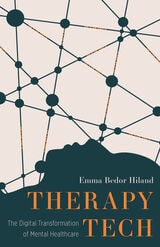
Therapy Tech
The Digital Transformation of Mental HealthcareEmma Bedor Hiland
University of Minnesota Press, 2021
A pointed look at the state of tech-based mental healthcare and what we must do to change it
Proponents of technology trumpet it as the solution to the massive increase in the mental distress that confronts our nation. They herald the arrival of algorithms, intelligent chatbots, smartphone applications, telemental healthcare services, and more—but are these technological fixes really as good as they seem? In Therapy Tech, Emma Bedor Hiland presents the first comprehensive study of how technology has transformed mental healthcare, showing that this revolution can’t deliver what it promises.
Far from providing a solution, technological mental healthcare perpetuates preexisting disparities while relying on the same failed focus on personal responsibility that has let us down before. Through vivid, in-depth case studies, Therapy Tech reveals these problems, covering issues including psychosurveillance on websites like Facebook and 7 Cups of Tea, shortcomings of popular AI “doctors on demand” like Woebot, Wysa, and Joy, and even how therapists are being conscripted into the gig economy.
Featuring a vital coda that brings Therapy Tech up to date for the COVID era, this book is the first to give readers a large-scale analysis of mental health technologies and the cultural changes they have enabled. Both a sobering dissection of the current state of mental health and a necessary warning of where things are headed, Therapy Tech makes an important assertion about how to help those in need of mental health services today.

Transgender Care
Recom Guidelines, Practical InfoGianna Israel
Temple University Press, 2001
By empowering clients to be well-informed medical consumers and by delivering care providers from the straitjacket of inadequate diagnostic standards and stereotypes, this book sets out to transform the nature of transgender care.
In an accessible style, the authors discuss the key mental health issues, with much attention to the vexed relationship between professionals and clients. They propose a new professional role; that of "Gender Specialist."
Chapters 3, 4, and 5 provide definitive information (in the context of consulting health professionals) on hormone administration, aesthetic surgery, and genital reassignment surgery. Chapter 6 takes up the little-examined issue of HIV and AIDS among transgender people. There is also a chapter devoted to issues of transgender people of color, as well as a chapter on transgender adolescents.
The book contains a wealth of practical information and accounts of people's experiences about coming out to one's employer or to one's friends or spouse. Several essays spell out the legal rights of transgender people with regard to insurance, work, marriage, and the use of rest rooms.
The second part of the book consists of thirteen essays on a range of controversial topics. They include three personal stories of transgender life, one essay on the new academic field of Transgender Studies, two essays on legal rights, three essays on medical issues, and two essays on the origins and possible resolution of the conflicts between therapist and client. The authors have also provided useful listings of organizations, centers, and Web sites.
The book has been reviewed by a national committee of professionals and consumers, some of whose members have contributed the essays in the second part of the book.

With the Wind and the Waves
A Guide to Mental Health Practices in Alaska Native CommunitiesRay M. Droby
University of Alaska Press, 2020