Results by title
11 books match the query 'Mental illness in literature'
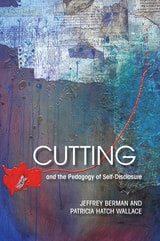
Cutting and the Pedagogy of Self-Disclosure
Jeffrey Berman
University of Massachusetts Press, 2007
Cutting, a form of self-mutilation, is a growing problem in the United States, especially among adolescent females. It is regarded as self-destructive behavior, yet paradoxically, people who cut themselves generally do not wish to die but to find relief from unbearable psychological pain.
Cutting and the Pedagogy of Self-Disclosure is the first book to explore how college students write about their experiences as cutters. The idea behind the book arose when Patricia Hatch Wallace, a high school English teacher, wrote a reader-response diary for a graduate course taught by Professor Jeffrey Berman in which she revealed for the first time that she had cut herself twenty years earlier. At Berman's suggestion, Wallace wrote her Master's thesis on cutting. Not long after she finished her thesis, two students in Berman's expository writing course revealed their own experiences as cutters. Their disclosures encouraged several students in another writing class to share their own cutting stories with classmates. Realizing that so many students were writing about the same phenomenon, Berman and Wallace decided to write a book about a subject that is rarely discussed inside or outside the classroom.
In Part 1, Wallace discusses clinical and theoretical aspects of cutting and then applies these insights to several memoirs and novels, including Susanna Kaysen's Girl, Interrupted, Caroline Kettlewell's Skin Game, and Patricia McCormick's Cut. The motivation behind Wallace's research was the desire to learn more about herself, and she reads these stories through her own experience as a cutter. In Part 2, Berman focuses on the pedagogical dynamics of cutting: how undergraduate students write about cutting, how their writings affect classmates and teachers, and how students who cut themselves can educate everyone in the classroom about a problem that has personal, psychological, cultural, and educational significance.
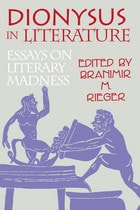
Dionysus in Literature
Essays on Literary MadnessEdited by Branimir M. Rieger
University of Wisconsin Press, 1994
In this anthology, outstanding authorities present their assessments of literary madness in a variety of topics and approaches. The entire collection of essays presents intriguing aspects of the Dionysian element in literature.

Dramatizing Dementia
Madness In The Plays Of Tennessee WilliamsJacqueline O'Connor
University of Wisconsin Press, 1997

Jungle Fever
Exploring Madness and Medicine in Twentieth-Century Tropical NarrativesCharlotte Rogers
Vanderbilt University Press, 2012
The canonical works of authors such as Joseph Conrad, Andre Malraux, Jose Eustasio Rivera, and others present jungles and wildernesses as fundamentally corrupting and dangerous. Rogers explores how the methods these authors use to communicate the physical and psychological maladies that afflict their characters evolved symbiotically with modern medicine. While the wilderness challenges Conrad's and Malraux's European travelers to question their civility and mental stability, Latin American authors such as Alejo Carpentier deftly turn pseudoscientific theories into their greatest asset, as their characters transform madness into an essential creative spark.
Ultimately, Jungle Fever suggests that the greatest horror of the jungle is the unknown regions of the character's own mind.
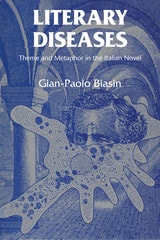
Literary Diseases
Theme and Metaphor in the Italian NovelBy Gian-Paolo Biasin
University of Texas Press, 1975
Disease—real or imagined, physical or mental—is a common theme in Western literature and is often a symbol of modern alienation. In Literary Diseases, a comprehensive analysis of the metaphorical and symbolic force of disease in modern Italian literature, Gian-Paolo Biasin expands the geography of the discussion of this important theme. Using as a backdrop the perspective of European experiences of the previous hundred years, Biasin analyzes the theme of disease as a reflection of certain sociological and historical phenomena in modern European novels, as a metaphor for the world visions of selected Italian novelists, and especially as a vehicle for understanding the nature and function of fiction itself.
The core of Biasin’s study is found in his discussion of the works of four major Italian writers. In his criticism of the novels of Giovanni Verga, who stood at the center of many complex developments in the nineteenth century, he examines the antecedents of modern Italian prose. He then scrutinizes the works of Italo Svevo and Luigi Pirandello, who together inaugurated the modern novel in Italy. Of particular interest is his exploration of their critical use of psychoanalysis and madness climaxed by apocalyptic visions. He then discusses the prose of Carlo Emilio Gadda, which epitomizes the problems of the avant-garde in its experimentalism and expressionism.
Biasin utilizes a broad spectrum of critical approaches—from sociology, psychoanalysis, and different trends in modern French, American, and Italian literary criticism—in shaping his own methodology, which is a thematic and structural symbolism. He concludes that disease in literature should be considered as a metaphor for writing (écriture) and as a cognitive instrument that calls into question the anthropocentric values of Western culture. The book, with its textual comparisons and unusual supporting examples, constitutes a significant methodological contribution as well as a major survey of modern Italian prose, and will allow the reader to see traditional landmarks in European fiction in a new light.
Madness, Language, Literature
Michel Foucault
University of Chicago Press, 2023
Perceiving an enigmatic relationship between madness, language, and literature, French philosopher Michel Foucault developed ideas during the 1960s that are less explicit in his later, more well-known writings. Collected here, these previously unpublished texts reveal a Foucault who undertakes an analysis of language and experience detached from their historical constraints. Three issues predominate: the experience of madness across societies; madness and language in Artaud, Roussel, and Baroque theater; and structuralist literary criticism. Not only do these texts pursue concepts unique to this period such as the “extra-linguistic,” but they also reveal a far more complex relationship between structuralism and Foucault than has typically been acknowledged.
Pushkin and the Genres of Madness
The Masterpieces of 1833Gary Rosenshield
University of Wisconsin Press, 2003
In 1833 Alexander Pushkin began to explore the topic of madness, a subject little explored in Russian literature before his time. The works he produced on the theme are three of his greatest masterpieces: the prose novella The Queen of Spades, the narrative poem The Bronze Horseman, and the lyric "God Grant That I Not Lose My Mind." Gary Rosenshield presents a new interpretation of Pushkin’s genius through an examination of his various representations of madness.
Pushkin brilliantly explored both the destructive and creative sides of madness, a strange fusion of violence and insight. In this study, Rosenshield illustrates the surprising valorization of madness in The Queen of Spades and "God Grant That I Not Lose My Mind" and analyzes The Bronze Horseman’s confrontation with the legacy of Peter the Great, a cornerstone figure of Russian history. Drawing on themes of madness in western literature, Rosenshield situates Pushkin in a greater framework with such luminaries as Shakespeare, Sophocles, Cervantes, and Dostoevsky providing an insightful and absorbing study of Russia’s greatest writer.

Revels in Madness
Insanity in Medicine and LiteratureAllen Thiher
University of Michigan Press, 2004
---Louis Sass, author of Madness and Modernism
"The scope of this book is daunting, ranging from madness in the ancient Greco-Roman world, to Christianized concepts of medieval folly, through the writings of early modern authors such as Shakespeare, Cervantes, and Descartes, and on to German Romantic philosophy, fin de siècle French poetry, and Freud . . . Artaud, Duras, and Plath."
---Isis
"This provocative and closely argued work will reward many readers."
---Choice
In Revels in Madness, Allen Thiher surveys a remarkable range of writers as he shows how conceptions of madness in literature have reflected the cultural assumptions of their era. Thiher underscores the transition from classical to modern theories of madness-a transition that began at the end of the Enlightenment and culminates in recent women's writing that challenges the postmodern understanding of madness as a fall from language or as a dysfunction of culture.
Sanity Plea
Schizophrenia in the Novels of Kurt VonnegutLawrence R. Broer
University of Alabama Press, 1994

The Terrible Fitzball
The Melodramatist of the MacabreLarry Stephen Clifton
University of Wisconsin Press, 1993
The Twisted Mind
Madness In Melville'S FictionPaul Mccarthy
University of Iowa Press, 1990
Paul McCarthy
"Though madness has been a consistent topic in considerations of Melville's work, this is the first full-scale treatment of the subject. It is in a sense, then, a pioneering work that will no doubt receive widespread attention."
—William B. Dillingham