Results by title
8 books match the query 'Mentoring in education'
Charting Your Path to Full
A Guide for Women Associate ProfessorsVicki L. Baker
Rutgers University Press, 2020
Creating Our Own Lives
College Students with Intellectual DisabilityMichael Gill
University of Minnesota Press, 2023
Young adults with intellectual disability tell the story of their own experience of higher education
How do students with intellectual disability experience higher education? Creating Our Own Lives addresses this question through the eyes of participants themselves. In relating their experiences and aspirations, these student perspectives mount a powerful challenge to assumptions that intellectual disability is best met with protection or segregation.
Taken together, the essays expose and contradict the inherently ableist claim that individuals with intellectual disability cannot be reliable storytellers. Instead, their deeply informative stories serve as a corrective narrative. The first of the four sections, “Laying the Foundation: Why Everyone Belongs in College,” focuses on belonging and inclusion; the second, “Opening Up Possibilities: Overcoming Doubt and Uncertainty,” conveys the optimism of this generation of advocates through stories of personal hardship, hopeful perseverance, and triumph over adversity; the third, “Inclusion as Action: Diversifying Student Experiences,” supports the understanding of diverse student experiences in inclusive higher education; and the fourth, “Supporting Growth: Peer Mentoring and Advice,” offers guidance to those reimagining and creating educational spaces.
Students with disabilities belong in higher education. Not only does this book serve as an important record of students enrolled in inclusive higher education programs, it is also an unprecedented resource, packed with information and inspiration both for parents seeking opportunities for their children and for individuals with intellectual disability who aspire to attend college.
Contributors: Makayla Adkins, Olivia Baist, Brandon Baldwin, George Barham, Marquavious Barnes, Katie Bartlett, Steven Brief, De'Onte Brown, Meghan Brozaitis, Mary Bryant, Gracie Carrol, Taylor Cathey, Maia Chamberlain, Antonio E. Contreras, Kim Dean, Elizabeth Droessler, Katie Ducett, Keiron Dyck, Rachel Gomez, Deriq Graves, Micah Gray, Maggie Guillaume, Cleo Hamilton, Nathan Heald, Joshua R. Hourigan, Hannah Lenae Humes, Courtney Jorgensen, Eilish Kelderman, Kailin Kelderman, Kenneth Kelty, Kaelan Knowles, Karlee Lambert, Kate Lisotta, Rachel Mast, Elise McDaniel, Emma Miller, Jake Miller, Lydia Newnum, Brenna Mantz Nielsen, Carly O’Connell, Nadia Osbey, Stirling Peebles, Breyan Pettaway, Amanda Pilkenton, True Rafferty, Taylor Ruppe, Lawrence Sapp, Tyler Shore, Brianna Silva, Alex Smith, Elliott Smith, Phillandra Smith, Payton Storms, Allen Thomas, Kylie Walter, Stephen Wanser, Sayid Webb, Breana Whittlesey, Luke Wilcox, Adam Wolfond.
Futuring Black Lives
Independent Black Institutions and the Literary ImaginationMaisha T. Winn
Vanderbilt University Press, 2025
The rationale for establishing and valuing IBIs remains highly relevant, given the sociopolitical landscape of education today. In addition to persistent racial disparities in academic achievement and Black students’ highly disproportionate experiences of punishment and “discipline,” friction and legislation against critical examination of race, racism, and racist ideas in school settings are front and center, and children’s and young adult literature are under attack through censorship and outright book bans. Yet Black institution builders left useful maps of and for the educational future/s of Black children that remain available in journals, newspapers, pamphlets, and other ephemera. Author Maisha T. Winn demonstrates how and why the historiography-grounded futuring of Black education can and should inform current pursuits of equity, justice, and liberation through education.
Good Boys, Bad Hombres
The Racial Politics of Mentoring Latino Boys in SchoolsMichael V Singh
University of Minnesota Press, 2024
The unintended consequences of youth empowerment programs for Latino boys
Educational research has long documented the politics of punishment for boys and young men of color in schools—but what about the politics of empowerment and inclusion? In Good Boys, Bad Hombres, Michael V. Singh focuses on this aspect of youth control in schools, asking on whose terms a positive Latino manhood gets to be envisioned.
Based on two years of ethnographic research in an urban school district in California, Good Boys, Bad Hombres examines Latino Male Success, a school-based mentorship program for Latino boys. Instead of attempting to shape these boys’ lives through the threat of punishment, the program aims to provide an “invitation to a respectable and productive masculinity” framed as being rooted in traditional Latinx signifiers of manhood. Singh argues, however, that the promotion of this aspirational form of Latino masculinity is rooted in neoliberal multiculturalism, heteropatriarchy, and anti-Blackness, and that even such empowerment programs can unintentionally reproduce attitudes that paint Latino boys as problematic and in need of control and containment.
An insightful gender analysis, Good Boys, Bad Hombres sheds light on how mentorship is a reaction to the alleged crisis of Latino boys and is governed by the perceived remedies of the neoliberal state. Documenting the ways Latino men and boys resist the politics of neoliberal empowerment for new visions of justice, Singh works to deconstruct male empowerment, arguing that new narratives and practices—beyond patriarchal redemption—are necessary for a reimagining of Latino manhood in schools and beyond.
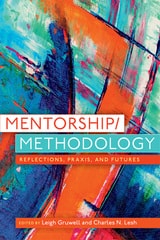
Mentorship/Methodology
Reflections, Praxis, and FuturesLeigh Gruwell
Utah State University Press, 2024
The contributors consider how methodology informs mentorship, how mentorship activates methodology, and how to locate the future of the field in these moments of intersection. Mentorship, through the research and relationships it nourishes, creates the future of writing studies—or, conversely, reproduces the past. At the juncture where this happens, the contributors inquire, Where have current arrangements of mentorship/methodology taken writing studies? Where do these points of intersection exist in performance and practice, in theory, in research? What images of the field do they produce? How can scholars better articulate and write about these moments or spaces in which mentorship and methodology collide in productive disciplinary work?
By making the “slash” more visible, Mentorship/Methodology provides significant opportunities to support and cultivate diverse ways of knowing and being in rhetoric and composition, both locally and globally. The volume will appeal to students and scholars of rhetoric, composition, and technical and professional communication, as well as readers interested in conversations about mentorship and methodology.
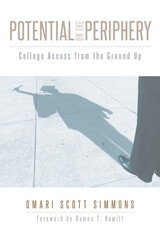
Potential on the Periphery
College Access from the Ground UpOmari Scott Simmons
Rutgers University Press, 2019
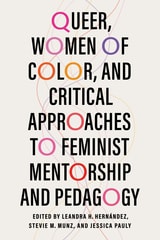
Queer, Women of Color, and Critical Approaches to Feminist Mentorship and Pedagogy
Edited by Leandra H. Hernández, Stevie M. Munz, and Jessica Pauly
University of Illinois Press, 2025
The first section draws upon the contributors’ unique and situated experiences of mentorship in academia. Essays explore their past and current experiences with feminist mentorship in relationships that take many forms: faculty members with fellow faculty members; faculty members with undergraduate and graduate students; and faculty members who feel as if they have become family with their mentors and mentees. In the second section, the contributors deeply interrogate the practices of feminist mentoring by problematizing practices and offering new ways, places, and formats that make space and consider new possibilities. A conclusion reflects on the future of feminist mentorship amidst contemporary debates and concerns in higher education.
Enriching and hopeful, Queer, Women of Color, and Critical Approaches to Feminist Mentorship and Pedagogy is a much-needed challenge to traditional forms of mentorship.
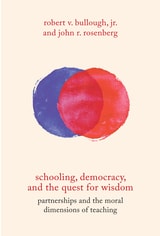
Schooling, Democracy, and the Quest for Wisdom
Partnerships and the Moral Dimensions of TeachingRobert V. Bullough Jr. and John R. Rosenberg
Rutgers University Press, 2018
In response to growing concern in the 1980s about the quality of public education across the United States, a tremendous amount of energy was expended by organizations such as the Holmes Group and the Carnegie Forum to organize professional development schools (PDS) or “partner schools” for teacher education. On the surface, the concept of partnering is simple; however, the practice is very costly, complex, and difficult. In Schooling, Democracy, and the Quest for Wisdom, Robert V. Bullough, Jr. and John R. Rosenberg examine the concept of partnering through various lenses and they address what they think are the major issues that need to be, but rarely are, discussed by thousands of educators in the U.S. who are involved and invested in university-public school partnerships. Ultimately, they assert that the conversation around partnering needs re-centering (most especially on the purposes of public education), refreshing, and re-theorizing.