Results by title
3 books match the query 'Merwood-Salisbury, Joanna'

Chicago 1890
The Skyscraper and the Modern CityJoanna Merwood-Salisbury
University of Chicago Press, 2009
Chicago’s first skyscrapers are famous for projecting the city’s modernity around the world. But what did they mean at home, to the Chicagoans who designed and built them, worked inside their walls, and gazed up at their façades? Answering this multifaceted question, Chicago 1890 reveals that early skyscrapers offered hotly debated solutions to the city’s toughest problems and, in the process, fostered an urban culture that spread across the country.
An ambitious reinterpretation of the works of Louis Sullivan, Daniel Burnham, and John Wellborn Root, this volume uses their towering achievements as a lens through which to view late nineteenth-century urban history. Joanna Merwood-Salisbury sheds new light on many of Chicago’s defining events—including violent building trade strikes, the Haymarket bombing, the World’s Columbian Exposition, and Burnham’s Plan of Chicago—by situating the Masonic Temple, the Monadnock Building, and the Reliance Building at the center of the city’s cultural and political crosscurrents.
While architects and property owners saw these pioneering structures as manifestations of a robust American identity, immigrant laborers and social reformers viewed them as symbols of capitalism’s inequity. Illuminated by rich material from the period’s popular press and professional journals, Merwood-Salisbury’s chronicle of this contentious history reveals that the skyscraper’s vaunted status was never as inevitable as today’s skylines suggest.
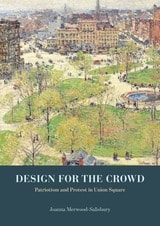
Design for the Crowd
Patriotism and Protest in Union SquareJoanna Merwood-Salisbury
University of Chicago Press, 2019
In this sweeping history of an iconic urban square, Merwood-Salisbury gives us a review of American political activism, philosophies of urban design, and the many ways in which a seemingly stable landmark can change through public engagement and design.
Published with the support of Furthermore: a program of the J. M. Kaplan Fund.
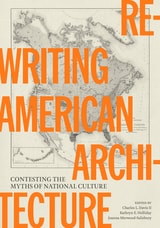
Rewriting American Architecture
Contesting the Myths of National CultureEdited by Charles L. Davis II, Kathryn E. Holliday, and Joanna Merwood-Salisbury
University of Texas Press, 2026
A critical reassessment of nineteenth‑century American architecture that uncovers how race, settler colonialism, and contested national identities shaped the built environment and its historiography.
Rewriting American Architecture offers a revisionist riposte to the canonical story of nineteenth-century American architecture. Drawing on new archival research and revisionist historiography, the essays in this volume reveal how American architecture was shaped not by inevitable progress toward a unified national culture but by the turbulent realities of race, labor, settler colonialism, and territorial expansion. Rather than treating architecture as an apolitical aesthetic expression, the contributors expose it as an active arena in which the meanings of nationhood were constructed, contested, and often violently enforced. From Indigenous spatial practices and Black institutional building to transnational exchanges and the racial politics embedded in professionalization, this collection reframes the built environment as central to the competing cultural, political, and geographic claims that defined the United States during this period.